Mourners attend a funeral for Palestinians killed in Israeli strikes, in Khan Younis in the southern Gaza Strip, on October 24. Reuters


All Palestinians are not Hamas


  • English
  • Arabic

October 26, 2023

There have been too many comments from Israeli political, military and religious leaders suggesting that all Palestinians are legitimate targets because they support Hamas or that they voted for them and are, therefore, complicit in the group’s many crimes. Here are a few examples of the comments:

The President of Israel, Isaac Herzog, said: “It is an entire nation out there that is responsible. It’s not true this rhetoric about civilians not aware, not involved. It's absolutely not true.”

An Israeli Knesset member, Meirav Ben-Ari, said: “The children of Gaza brought it upon themselves.”

And the Israeli Minister of Defence, Yoav Gallant, described the current war: “We are fighting human animals.”

A Palestinian girl wears a bracelet to help identify her if she is killed in Israeli air strikes, at a shelter in Khan Younis, southern Gaza, on October 24. Reuters

Statements of this kind, in which an entire group of people are demonised or seen as responsible for the actions of a few, are sheer bigotry. This is the very same racism that when applied to other groups (such as Jews, blacks, or Native Americans) has led to pogroms, persecution or genocide.

In the first place, it’s important to note, as I do in my book Palestinians, the Invisible Victims: Political Zionism and Palestinian Human Rights, political Zionism has long promoted this view of the indigenous people of Palestine as less civilised, more violent and less worthy than the settler movement that sought to displace them.

Theodor Herzl, the Austro-Hungarian Jewish journalist and political activist, termed his project as “an outpost of civilisation against barbarism”. This was echoed by Chaim Weizmann, the first president of Israel, who appealed for support from the West by describing the Zionist/Arab struggle as one between “the forces of destruction and the desert and the forces of civilisation and building”.

Israel's Prime Minister Benjamin Netanyahu has used similar dehumanising rhetoric. Just last week, in the Knesset, he described the ongoing conflict as being between 21st century progress and “the barbaric fanaticism of the Middle Ages” and a “struggle between the children of light and the children of darkness”.

Over the years, Israeli political and religious leaders have also referred to Palestinians as “cockroaches that should be crushed” or “snakes that should be killed”. It is true also that some Arabs make derogatory and unacceptable comments about Jews.

But that said, what about the claim that “all Palestinians support Hamas”. As we at Arab American Institute frequently poll across Palestine and Israel, we have data that can debunk that characterisation.

In our last poll in Gaza (July 2023), of 1,200 Palestinians, only 11 per cent identified themselves as Hamas supporters – as opposed to 32 per cent who said they were with Fatah. Eleven per cent hardly constitutes “all Palestinians”.

As for the claim that Palestinians voted for Hamas and are therefore culpable for their behaviour, this is the same dangerous generalisation that holds all Americans responsible for the actions of the US government, or that holds all Israelis, or Jews, responsible for the atrocities committed by the government of Israel. But more to the point, most Palestinians didn’t vote for Hamas, and those who did, didn’t vote for them for the reasons being suggested.

In our 2006 poll, the Fatah margin over Hamas in Gaza was 34 per cent to 29 per cent. If that’s the case, then how and why did Hamas win the 2006 legislative elections?

In the first place, the Hamas margin of victory in that year’s election was only 44 per cent to 41 per cent. Hamas took control of the legislature because of the way seats were apportioned and because of divisions in the Fatah ranks. Next, while “pundits” say Hamas won because of the PA’s corruption, polling tells a different story.

The outcome of the 2006 election was shaped by a classic “throw the bums out” message. Both parties, Fatah and Hamas were viewed as equally corrupt. In any case, corruption wasn’t the main issue in that election. Because Palestinians had lost hope in peace and the achievement of an independent state, they identified their most important concerns as the release of the thousands of Palestinians who were in prison and the need for internal security.

Interestingly, when we asked them if the prospects for negotiating peace with Israel were dependent on the outcome of the election, a strong majority (including 70 per cent of Hamas voters) said they would choose Fatah. But peace wasn’t in the offing and they knew it.

So instead, what voters said to the incumbent Fatah was: “You’ve been in office for 10 years and gotten nothing from Israel – no state and no peace – so let’s see what the other guys can do.”

To go from this to justifying killing innocent Palestinian civilians because “all Palestinians are Hamas” and therefore responsible for their actions is both racist and unsupported by facts. It is the same despicable logic used by those who justify killing innocent Israelis because of the hideous actions of their government and military.

  • Hind Khoudary is a Palestinian freelance journalist documenting the devastation in the Gaza Strip. Photo: Hind Khoudary
    Hind Khoudary is a Palestinian freelance journalist documenting the devastation in the Gaza Strip. Photo: Hind Khoudary
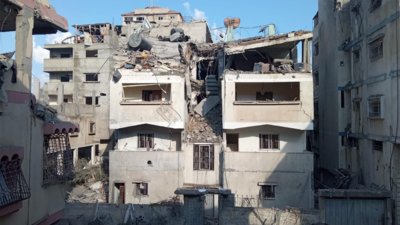
  • Khoudary's husband’s family home was hit by Israeli forces. Photo: Hind Khoudary
    Khoudary's husband’s family home was hit by Israeli forces. Photo: Hind Khoudary
  • People in Al Quds hospital refused to leave despite evacuation warnings. Photo: Hind Khoudary
    People in Al Quds hospital refused to leave despite evacuation warnings. Photo: Hind Khoudary
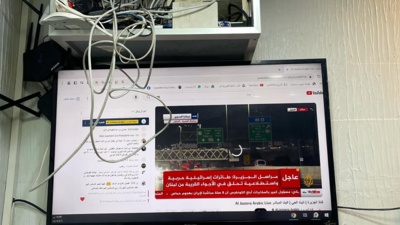
  • Internet disruption has disconnected many residents from the rest of the world. Photo: Hind Khoudary
    Internet disruption has disconnected many residents from the rest of the world. Photo: Hind Khoudary
  • Palestinian Christians mourn family members after an Israeli air strike hit a building in a complex housing one of the oldest churches in the world. Photo: Abed Elhakeem Abo Riash
    Palestinian Christians mourn family members after an Israeli air strike hit a building in a complex housing one of the oldest churches in the world. Photo: Abed Elhakeem Abo Riash
  • Palestinian Christians after an Israeli air strike on a church in Gaza. Photo: Abed Elhakeem Abo Riash
    Palestinian Christians after an Israeli air strike on a church in Gaza. Photo: Abed Elhakeem Abo Riash
  • The Baptist Hospital in Gaza was bombed by Israeli warplanes. Photo: Abed Elhakeem Abo Riash
    The Baptist Hospital in Gaza was bombed by Israeli warplanes. Photo: Abed Elhakeem Abo Riash
  • A young child awaits medical treatment. Photo: Abed Elhakeem Abo Riash
    A young child awaits medical treatment. Photo: Abed Elhakeem Abo Riash

Live updates: Follow the latest news on Israel-Gaza

Third Test

Result: India won by 203 runs

Series: England lead five-match series 2-1

Name: Peter Dicce

Title: Assistant dean of students and director of athletics

Favourite sport: soccer

Favourite team: Bayern Munich

Favourite player: Franz Beckenbauer

Favourite activity in Abu Dhabi: scuba diving in the Northern Emirates 


The Land between Two Rivers: Writing in an Age of Refugees
Tom Sleigh, Graywolf Press

COMPANY PROFILE

Name: Rain Management

Year started: 2017

Based: Bahrain

Employees: 100-120

Amount raised: $2.5m from BitMex Ventures and Blockwater. Another $6m raised from MEVP, Coinbase, Vision Ventures, CMT, Jimco and DIFC Fintech Fund

HOW TO WATCH

Facebook: TheNationalNews 

Twitter: @thenationalnews 

Instagram: @thenationalnews.com 

TikTok: @thenationalnews   

UPI facts

More than 2.2 million Indian tourists arrived in UAE in 2023
More than 3.5 million Indians reside in UAE
Indian tourists can make purchases in UAE using rupee accounts in India through QR-code-based UPI real-time payment systems
Indian residents in UAE can use their non-resident NRO and NRE accounts held in Indian banks linked to a UAE mobile number for UPI transactions

The Travel Diaries of Albert Einstein The Far East, Palestine, and Spain, 1922 – 1923
Editor Ze’ev Rosenkranz
​​​​​​​Princeton

Ain Dubai in numbers

126: The length in metres of the legs supporting the structure

1 football pitch: The length of each permanent spoke is longer than a professional soccer pitch

16 A380 Airbuses: The equivalent weight of the wheel rim.

9,000 tonnes: The amount of steel used to construct the project.

5 tonnes: The weight of each permanent spoke that is holding the wheel rim in place

192: The amount of cable wires used to create the wheel. They measure a distance of 2,4000km in total, the equivalent of the distance between Dubai and Cairo.

Tamkeen's offering
  • Option 1: 70% in year 1, 50% in year 2, 30% in year 3
  • Option 2: 50% across three years
  • Option 3: 30% across five years 
The specs

Engine: four-litre V6 and 3.5-litre V6 twin-turbo

Transmission: six-speed and 10-speed

Power: 271 and 409 horsepower

Torque: 385 and 650Nm

Price: from Dh229,900 to Dh355,000

COMPANY%20PROFILE
%3Cp%3E%3Cstrong%3EName%3A%20%3C%2Fstrong%3EQureos%0D%3Cbr%3E%3Cstrong%3EBased%3A%20%3C%2Fstrong%3EUAE%0D%3Cbr%3E%3Cstrong%3ELaunch%20year%3A%20%3C%2Fstrong%3E2021%0D%3Cbr%3E%3Cstrong%3ENumber%20of%20employees%3A%20%3C%2Fstrong%3E33%0D%3Cbr%3E%3Cstrong%3ESector%3A%20%3C%2Fstrong%3ESoftware%20and%20technology%0D%3Cbr%3E%3Cstrong%3EFunding%3A%20%3C%2Fstrong%3E%243%20million%0D%3Cbr%3E%3C%2Fp%3E%0A
Profile of Whizkey

Date founded: 04 November 2017

Founders: Abdulaziz AlBlooshi and Harsh Hirani

Based: Dubai, UAE

Number of employees: 10

Sector: AI, software

Cashflow: Dh2.5 Million  

Funding stage: Series A

Ten tax points to be aware of in 2026

1. Domestic VAT refund amendments: request your refund within five years

If a business does not apply for the refund on time, they lose their credit.

2. E-invoicing in the UAE

Businesses should continue preparing for the implementation of e-invoicing in the UAE, with 2026 a preparation and transition period ahead of phased mandatory adoption. 

3. More tax audits

Tax authorities are increasingly using data already available across multiple filings to identify audit risks. 

4. More beneficial VAT and excise tax penalty regime

Tax disputes are expected to become more frequent and more structured, with clearer administrative objection and appeal processes. The UAE has adopted a new penalty regime for VAT and excise disputes, which now mirrors the penalty regime for corporate tax.

5. Greater emphasis on statutory audit

There is a greater need for the accuracy of financial statements. The International Financial Reporting Standards standards need to be strictly adhered to and, as a result, the quality of the audits will need to increase.

6. Further transfer pricing enforcement

Transfer pricing enforcement, which refers to the practice of establishing prices for internal transactions between related entities, is expected to broaden in scope. The UAE will shortly open the possibility to negotiate advance pricing agreements, or essentially rulings for transfer pricing purposes. 

7. Limited time periods for audits

Recent amendments also introduce a default five-year limitation period for tax audits and assessments, subject to specific statutory exceptions. While the standard audit and assessment period is five years, this may be extended to up to 15 years in cases involving fraud or tax evasion. 

8. Pillar 2 implementation 

Many multinational groups will begin to feel the practical effect of the Domestic Minimum Top-Up Tax (DMTT), the UAE's implementation of the OECD’s global minimum tax under Pillar 2. While the rules apply for financial years starting on or after January 1, 2025, it is 2026 that marks the transition to an operational phase.

9. Reduced compliance obligations for imported goods and services

Businesses that apply the reverse-charge mechanism for VAT purposes in the UAE may benefit from reduced compliance obligations. 

10. Substance and CbC reporting focus

Tax authorities are expected to continue strengthening the enforcement of economic substance and Country-by-Country (CbC) reporting frameworks. In the UAE, these regimes are increasingly being used as risk-assessment tools, providing tax authorities with a comprehensive view of multinational groups’ global footprints and enabling them to assess whether profits are aligned with real economic activity. 

Contributed by Thomas Vanhee and Hend Rashwan, Aurifer

Updated: October 26, 2023, 10:26 AM