


Close to two weeks after Hamas’s barbaric attack on Israel, there is a need to try to stand back from the constantly changing news and ask a series of questions, many troubling.
No one doubts Israel’s right to defend itself, but until this weekend, when a few caveats emerged, the West’s top leaders declared themselves so unequivocally behind Israel that it appeared they would not denounce the commission of war crimes in pursuit of Prime Minister Benjamin Netanyahu’s plan to “eliminate Hamas”.
To be clear, Jan Egeland, secretary-general of the Norwegian Refugee Council, has said that the order for one million people to evacuate northern Gaza constitutes “forcible transfer of populations and it’s a war crime”. A UN commission has said that the “complete siege” of Gaza amounts to “collective punishment” – also a war crime. But it is only in the past couple of days that any words of restraint have passed the lips of all those western leaders who have been so keen to stress that they “stand by Israel”.
Before the deadly air strike at Al Ahli Arab Hospital on Tuesday, Abbas Milhem, executive director of the Palestinian Farmers’ Union, was among those who had already lost loved ones in the Israeli bombing of Gaza. He is in the West Bank, but his wife’s elderly parents lived in what he called one of the safest areas of the strip, which had never been targeted before. A week last Monday, two missiles demolished their house without warning, killing everyone inside. Mr Milhem tells me that he fears “ethnic cleansing” in Gaza. “There is no safe place. It is horrible. People are waiting for their death. Why is my father-in-law killed and he is 85 years old? Aren’t we equally human beings?”
-

Protesters gather outside the US consulate in Istanbul, Turkey, in support of Palestinians after an air strike on a Gaza city hospital killed hundreds earlier this week. EPA -

Protesters gather near the US embassy in Tokyo, Japan, to show solidarity with Palestinians in Gaza. AP -

Protesters wave Palestinian and Syrian opposition flags in support of Gaza residents, in the rebel-held town of Atme in Syria's Idlib province. AFP -

Protesters take part in a pro-Palestinian rally near the Israeli embassy in Amman, Jordan, amid global outrage over the air strike on Al Ahli Arab Hospital in Gaza. EPA -

Thousands of pro-Palestinian and Palestinian Americans march towards the Israeli consulate in Chicago during a protest. AP -
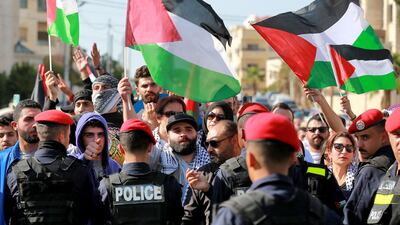
Jordanians protest outside the Israeli embassy in Amman following an Israeli air strike which ripped through a Gaza hospital, killing hundreds. AFP -

A rally in support of the people of Gaza after hundreds of Palestinians were killed in a blast at Al Ahli Arab Hospital for which Israel was blamed, though it denied responsibility, in Ramallah in the occupied West Bank. Reuters -

Hezbollah supporters take part in a demonstration after the horrific blast, in southern Beirut. Reuters -

People gather in Baghdad's Tahrir Square to protest against Israel after it bombed Al Ahli Arab Hospital in Gaza, killing more than 500. Aymen Al-Ameri / The National -

Thousands of people in Iraq, Iran and Jordan rallied to show their outrage in the aftermath of the Israeli air strike. Aymen Al-Ameri/ The National -

Protesters set fire to a Lebanese security building outside the US embassy in Beirut. Reuters -

A wounded protester is carried away outside the US embassy in Beirut. Reuters -

Protesters gather in front of the US embassy in Beirut to demonstrate against an Israeli air strike on Gaza's Al Ahli Hospital. Reuters -

The blast drew condemnation across the Arab world, and protests were also staged at Israel's embassies in Turkey and Jordan. Reuters -

People clash with riot police outside the Israeli consulate during a protest to show solidarity with Palestinians, in Istanbul. AFP -
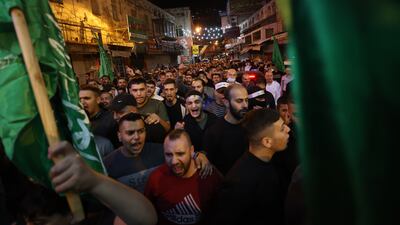
Palestinians protest against an Israeli strike on a hospital in Gaza, in the occupied West Bank city of Nablus. EPA -

Palestinians take part in a protest in Tubas, in the Israeli-occupied West Bank. Reuters -
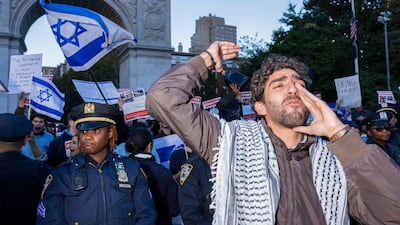
Pro-Israel counter protesters are kept away by police officers as people participate in a candlelight vigil organised by NYU students in support of Palestinians in Washington Square Park in New York. AFP -

A pro-Israel counter protester wrapped in the Flag of Israel is escorted away from a vigil organised by NYU students in support of Palestinians in Washington Square Park in New York. AFP -
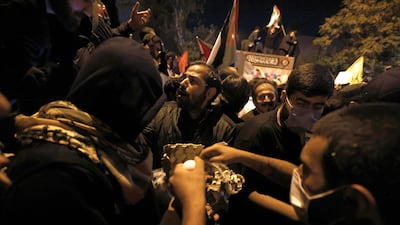
Iranian students and demonstrators throw eggs at the French embassy in Tehran. AFP -
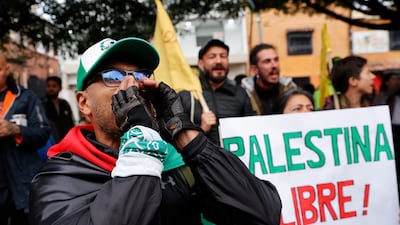
Several people demonstrate in support of Palestine at the Palestinian Embassy in Bogota, Colombia. EPA -

Protesters wave Palestinian and Moroccan flags as they gather in front of Parliament Square in Rabat, Morocco. EPA -
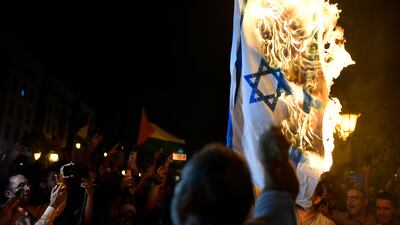
Protesters burn an Israeli flag as they gather in front of Parliament Square. EPA


Israeli Defence Minister Yoav Gallant appears not to agree. “We are fighting human animals, and we are acting accordingly,” he said last week. Israeli Maj Gen Ghassan Alian, head of the Coordination of Government Activities in the Territories, repeated that description, and said of Gaza’s residents: “You wanted hell. You will get hell.”
Such is the excessive leeway that Israel has been given in the West – for I have yet to hear any of the country’s supporters condemn such language – that the awkward question must be asked: is it because many Israelis have white European ancestry, and Palestinians do not? Do western leaders consider “the only democracy in the Middle East” to be “one of us”, while the mainly Muslim Palestinians are something “other”, something “lesser”? The Arab friends to whom I have put this question are convinced this is the case.
The near-unanimity among top American and European politicians is not necessarily shared by their populaces, going by the large rallies expressing solidarity with Palestinians in cities around the world on Saturday. I have no doubt that most of the tens of thousands who massed had noble intentions; I know good people who have spent decades supporting the Palestinian cause.
But in their angry compassion, was there a danger that some at the rallies were forgetting – or even discounting – the anguish of the families of the 1,400 Israelis who died on what is being called their “9/11”? It may well be correct to put that attack into the longer historical context. You might argue that the Hamas gunmen had been driven literally insane by their people’s suffering and oppression. But it is always a choice to murder a child or burn a family alive in their house.
Why did two women at the London protest see fit to wear images of paragliders – a reference to how some Hamas militants entered Israel? More ambiguously, the slogan “from the river to the sea, Palestine will be free” is not entirely neutral. Those chanting it should at least be aware that to some Jewish ears that sounds like a call for the destruction of the state of Israel.
As the world reels at the devastating death toll from the Al Ahli Arab Hospital bombing, some may query why I even raise these points. Unfortunately, they are very relevant since a surge in support for the Palestinians almost always appears to be accompanied by a horrifying increase in anti-Semitic attacks. Jewish people around the world should not have to fear for their safety over the actions of any Israeli government, but particularly not one so extreme and incompetent that in a recent poll 75 percent of Jewish Israelis said they held it mostly to blame for the lack of security preparedness for the attack.

Lastly, many policymakers must ask themselves how they got Hamas’s trajectory so wrong. Many officials, including Americans and Israelis, wrote former US diplomat Robert Silverman last week, “acted on the belief that Hamas was normalising over time as the government of the Gaza Strip and could be managed.” It wasn’t entirely naive to do so. Hamas had accepted the ballot box and won the last Palestinian Legislative Council elections in 2006.
In Malaysia, where I live, Hamas is so far from being proscribed that it has an office in the capital, Kuala Lumpur. It is hard to sit around a table with representatives of the group, and have a reasonable conversation, and think of them as cold-blooded killers. But that’s exactly what the gunmen of October 7 were. Why, after all this time, can the group not accept – as the PLO has – that the only possible future has to include recognising Israel’s right to exist, as well as an independent Palestinian state? The roots of millions of Israelis are in the Mena region. It has been their home for generations.
Some of these questions demand answers now, even as war is upon us. But what of after? If, by some miracle, there is a swift ceasefire, humanitarian aid is allowed into Gaza, and a UN force is put in place to protect civilians: how can Palestinians and Israelis build a new future, somehow managing to overcome what has happened not just these past days but during the past decades?
“We can make peace and live as good neighbours sharing the land,” Abbas Milhem tells me, with admirable dignity and calm amid his grief, “but only with those who believe in a just peace.”

