


We know we live in a world of “alternative facts” where objectivity is becoming ever more elusive, but America and China have just upped the ante. In the past week, the US State Department issued a report accusing Chinese authorities of spending billions per year on disseminating propaganda, while Beijing’s Ministry of Foreign Affairs denounced the US as an “empire of lies, through and through”.
There is plenty of disinformation around all right. But what I most object to is disinformation by omission and oversimplification, often spread by politicians and publications that ought to know better.
Take the case of Nagorno-Karabakh. Until fairly recently, it would be fair to say that most people outside of the region would have had trouble locating it on a map. It has been in the headlines recently, however, after an Azerbaijani military operation took control of the area and most of the ethnic Armenian population – perhaps 100,000 people – fled to the next-door state of Armenia.
Whatever view one takes of the action – and the Azerbaijan government denies accusations of ethnic cleansing – you might have thought it was rather important to mention that although the status of Nagorno-Karabakh has been in dispute since the break-up of the Soviet Union, the region is internationally recognised to be part of Azerbaijan. This paper did so. But many English-language reports have omitted this fact entirely. Readers may have been left with the impression that Azerbaijan has invaded an independent state, rather than asserted its authority over an area that is unquestionably within its boundaries.
Is it too far-fetched to think this important detail is often left out because some western media outlets prefer to take the side of Christian “European” Armenians rather than Muslim Turkic Azerbaijan?
-
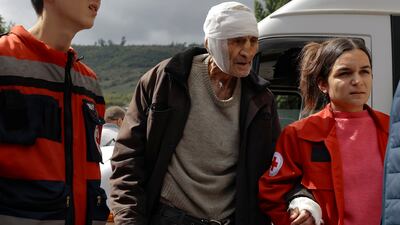
A wounded Armenian man from Stepanakert, Nagorno-Karabakh, is helped by volunteers as he arrives in Goris, Armenia. AP -
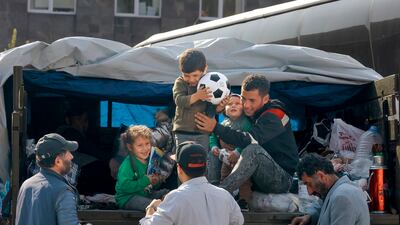
A family from Nagorno-Karabakh are helped as they leave a truck with their belongings after arriving at Goris. AP -
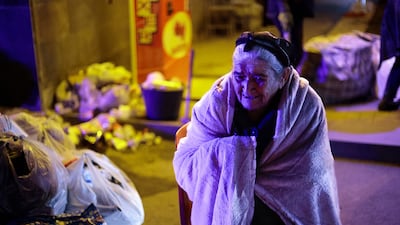
An Armenian woman from Nagorno-Karabakh warms herself near a tent camp after arriving in Goris. AP -
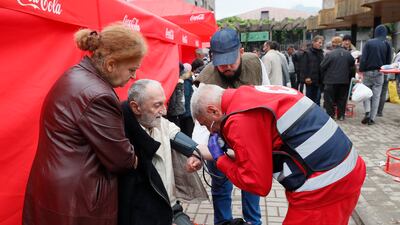
A medic helps an Armenian man from Nagorno-Karabakh near the registration and distribution centre in Goris. EPA -
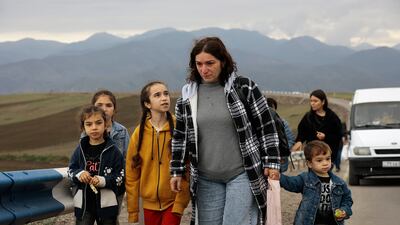
Ethnic Armenians fleeing Nagorno-Karabakh walk on a road to Kornidzor, in Armenia's Syunik region. AP -
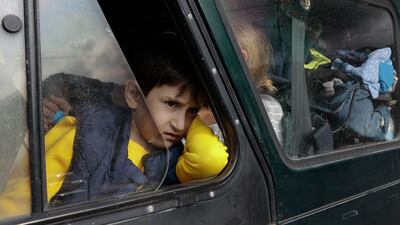
An ethnic Armenian boy from Nagorno-Karabakh, looks out from a car window upon his arrival in Goris, Armenia's Syunik region. AP -
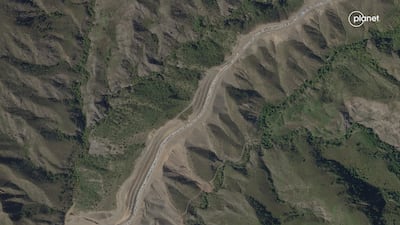
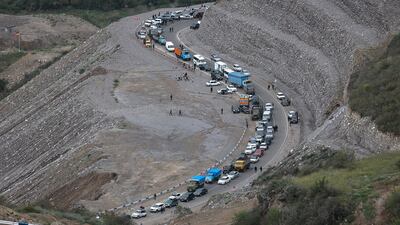
A satellite view of a long traffic jam of vehicles along the highway approaching to the Armenian border with Azerbaijan, at the Lachin corridor in the Nagorno-Karabakh region. AP -
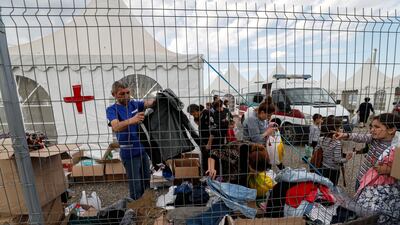
Armenian volunteers distribute clothes to ethnic Armenians fleeing Nagorno-Karabakh, after they crossed the Azerbaijan-Armenia border near the village of Kornidzor, Armenia. EPA -
Ethnic Armenians flee Nagorno-Karabakh to Kornidzor, in Armenia's Syunik region. AP -
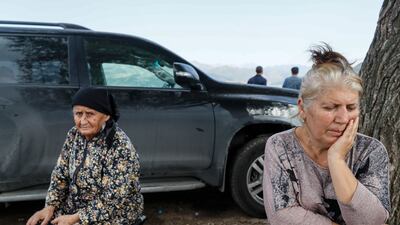
Ethnic Armenians fleeing Nagorno-Karabakh region rest on a roadside after crossing the border with Azerbaijan, near the village of Kornidzor. EPA -
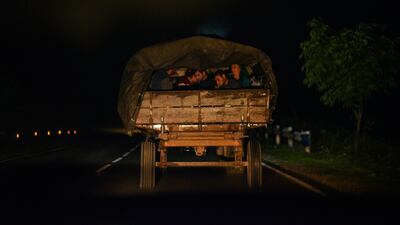
Ethnic Armenians from Nagorno-Karabakh sit in the back of a vehicle after crossing the border on their way to an Armenian Ministry of Foreign Affairs registration centre in Kornidzor, Armenia. EPA -
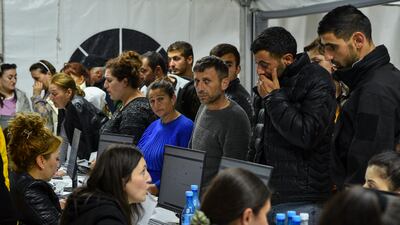
Ethnic Armenians at the registration centre. EPA -
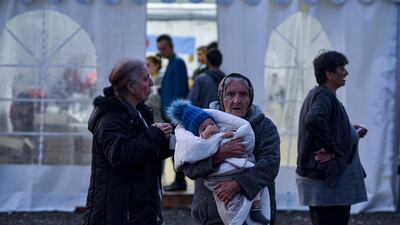
An elderly woman holds an infant. EPA -
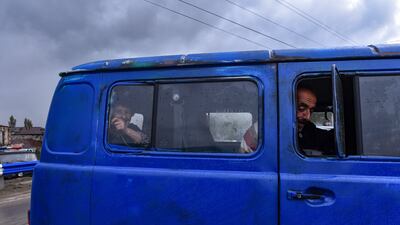
Ethnic Armenians from Nagorno-Karabakh look on from inside a van. EPA -

Ethnic Armenians arrive at the registration centre. EPA -
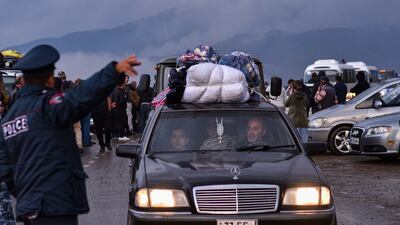
Ethnic Armenians arrive at the registration centre. EPA -

Ethnic Armenians from Nagorno-Karabakh wait near Kornidzor, the town in Syunik region, Armenia. AP -
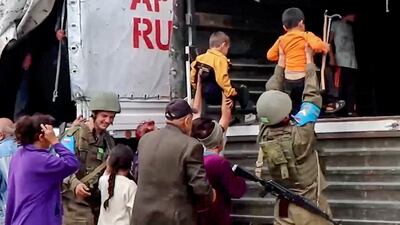
Russian peacekeepers evacuate Nagorno-Karabakh civilians at an undisclosed location. AFP -
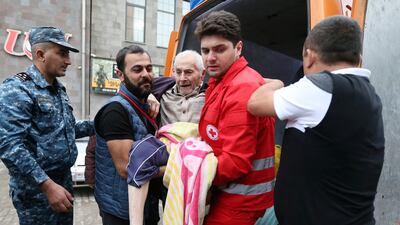
A refugee from Nagorno-Karabakh region is carried out of a vehicle upon arrival at a temporary accommodation centre in the town of Goris, Armenia. Reuters -
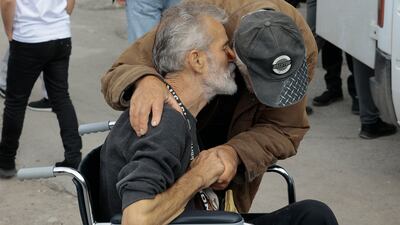
An ethnic Armenian embraces a man upon arrival in Armenia's Goris. AP -
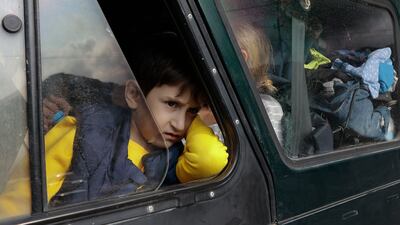
An ethnic Armenian boy from Nagorno-Karabakh, looks on from a car upon arrival in Goris. AP


Similarly, I’ve lost count of the times I have read the words: “Taiwan, which has never been ruled by Communist China.” I would say “so what?”, except that formulation is clearly meant to delegitimise Beijing’s claim to what it considers to be a renegade province. One time, in a noted publication that I will not embarrass by naming, the game was given away. In a revealing slip, the phrase became: “Taiwan, which has never been ruled by China.” That is obviously false.
If one wanted to provide real context, rather than propagandise on behalf of the China hawks in the US, it would be necessary to point out that island’s current separation from the mainland represents the unfinished business of a civil war, when the nationalist leader Chiang Kai-shek retreated to Taiwan (which he certainly thought was part of China) in 1949 – and civil wars occur inside one country, not two.
When has any country willingly allowed secession to happen, especially when it is supported by an unfriendly superpower? Put like that, Beijing’s insistence on eventual reunification does not necessarily seem unreasonable. But omitting this context is handy if all you want to do is demonise China.
Another example: reports of any criticisms, or any comments at all, by American leaders relating to breaches of the UN Convention on the Law of the Sea or arrest warrants issued by the International Criminal Court are hopelessly distorted if they fail to mention that the US has not ratified the former and is not signed up to the latter.
This isn’t about taking sides. It’s about insisting that we are provided with the facts – all of them – so we can take a fully informed view on matters of the day. But there is currently a curious unwillingness among western politicians and mainstream media to demand truth from power. On a whole range of issues, from the internal battles in Britain’s Labour party to the war in Ukraine, a new conformity of not only happily accepting but then cleaving closely to officially sanctioned narratives appear to have taken hold.

What about, for instance, the bombing of the Nord Stream gas pipelines that run from Russia to Germany? They may be majority-owned by Russia (51 per cent), but Western European nations are the other owners and were also co-financiers of the multibillion-dollar project. Right after the strike, Poland’s former foreign minister Radek Sikorski tweeted a picture of gas coming out of the damaged pipeline with the caption “thank you, USA”. He then swiftly deleted it, possibly after someone reminded him that destroying civilian infrastructure constitutes a war crime.
The US investigative journalist Seymour Hersh said Mr Sikorski had it right – and was then roundly rubbished as a fantasist and conspiracy theorist, for his pains. It strains credulity that officials do not know who did it. Yet still we have not been told. Where is the outcry over this outrageous concealment?
It was oversimplification that led to the scenes in Canada’s parliament last month, when a Ukrainian Nazi veteran was given a standing ovation and hailed as a hero.
Everyone – in then speaker Anthony Rota’s office, at any rate – had decided that the Russians were so awful and Ukrainians were such unalloyed saints, that no one questioned what fighting for Ukrainian independence against the Russians in the Second World War might actually mean. It meant being on the side of the Nazis, of course. But such was the determination to see the conflict in Ukraine as a fight between good and evil, that those responsible lost all contact with reality – and history.
It was a reminder that the truth is often complicated. So is history. And that putting out oversimplified narratives or omitting facts that don’t suit your case are acts of disinformation just as surely as is claiming that Donald Trump won the last US presidential election. All three are unmoored from the truth – and that is what we have the right to demand, however inconvenient it may be.

