


Today, it is even more apparent that our planet and weather patterns are changing before our eyes. Extreme weather events are becoming more frequent and ferocious, food security is becoming an issue of life-changing importance for more communities, and our ecosystems are rapidly changing, eradicating our natural flora and fauna.
In light of these mounting challenges, the spirit of inclusivity and collective responsibility must inspire us all to act. Indeed, it is only by working together in the best interests of all people that we may solve the most pressing issues facing humanity.
This is the globally unifying message affirmed by President Sheikh Mohamed and a high-level UAE delegation at the 18th G20 Heads of State and Government Summit, which gathered world leaders, heads of global organisations and national representatives in New Delhi.
At its heart, President Sheikh Mohamed’s message at the summit is a resounding call to back inclusivity over exclusion, fairness over inequality and action today over catastrophe tomorrow – a message that defines the UAE’s own presidency of Cop28 in November.
-
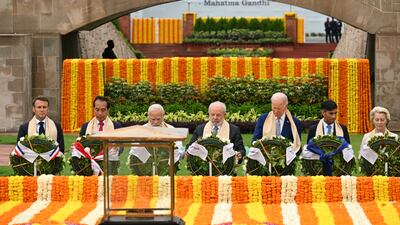
From left, French President Emmanuel Macron, Indonesian President Joko Widodo, Indian Prime Minister Narendra Modi, Brazilian President Luiz Inacio Lula da Silva, US President Joe Biden, British Prime Minister Rishi Sunak and European Commission President Ursula von der Leyen visit Raj Ghat memorial. Reuters -
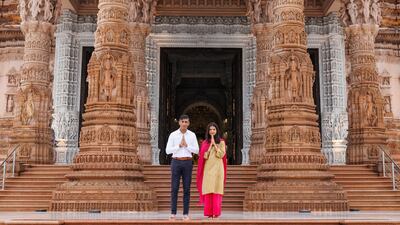
British Prime Minister Rishi Sunak and his wife Akshata Murty visit the Akshardham Hindu Temple in New Delhi. Getty Images -
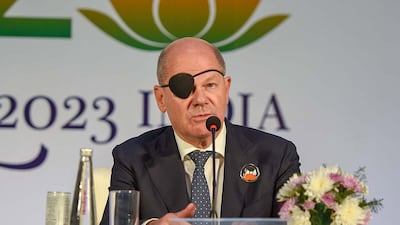
German Chancellor Olaf Scholz addresses a press conference during the G20 Summit in New Delhi. EPA -
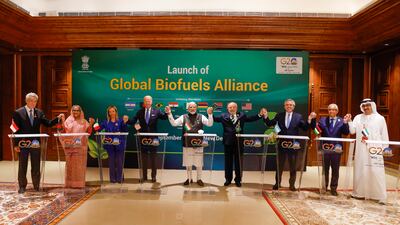
From left, Singaporean Prime Minister Lee Hsien Loong, Bangladeshi Prime Minister Sheikh Hasina, Italian Prime Minister Giorgia Meloni, US President Joe Biden, Indian Prime Minister Narendra Modi, Brazilian President Luiz Inacio Lula da Silva, Argentinian President Alberto Fernandez, Mauritius Prime Minister Pravind Kumar Jugnauth and UAE Minister of Foreign Affairs Sheikh Abdullah bin Zayed attend the launch of the Global Biofuels Alliance at the G20 summit in New Delhi. AP -
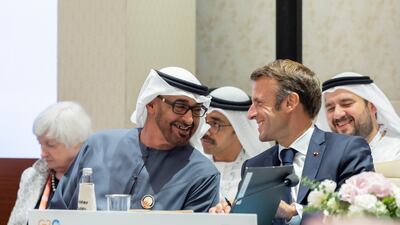
UAE President Sheikh Mohamed and French President Emmanuel Macron attend the India-Middle East-Europe Economic Corridor on the sidelines of the G20 Summit in New Delhi. Photo: UAE Presidential Court -

From left, Indian Prime Minister Narendra Modi, Indian President Droupadi Murmu and UAE Minister of Foreign Affairs Sheikh Abdullah bin Zayed at the G20 summit in New Delhi. AFP -
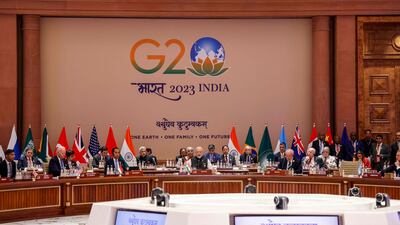
India's Prime Minister Narendra Modi addresses the G20 Leaders' Summit at the Bharat Mandapam in New Delhi. AFP -
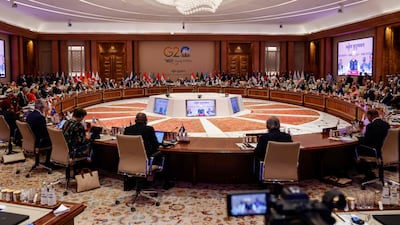
The 18th G20 Summit between 19 countries and the European Union, and now the African Union, is the first to be held in India and South Asia. AFP -
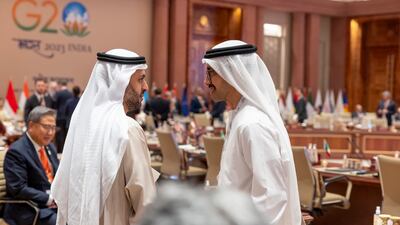
Sheikh Mohamed bin Hamad, Private Affairs Advisor in the Presidential Court, left, and Sheikh Abdullah bin Zayed, UAE Minister of Foreign Affairs, attend the first session of the G20 Summit. UAE Presidential Court -
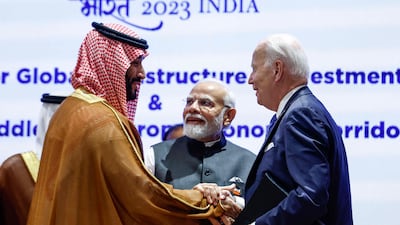
Saudi Arabia's Crown Prince and Prime Minister Mohammed bin Salman, India's Prime Minister Narendra Modi and US President Joe Biden attend a session as part of the G20 Leaders' Summit at the Bharat Mandapam in New Delhi. AFP -
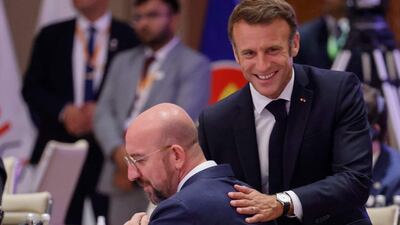
France's President Emmanuel Macron greets European Council President Charles Michel before the start of the second working session. AFP -
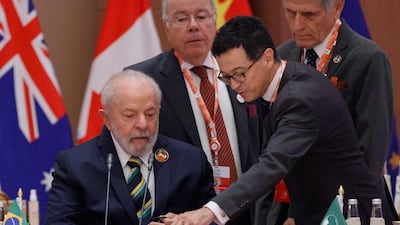
Brazil's President Luiz Inacio Lula da Silva speaks with his advisors before the start of the second working session. AFP -
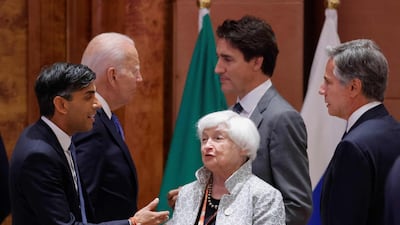
Britain's Prime Minister Rishi Sunak, US Treasury Secretary Janet Yellen, US President Joe Biden, Canada's Prime Minister Justin Trudeau and US Secretary of State Antony Blinken speak before the start of the second working session. AFP -
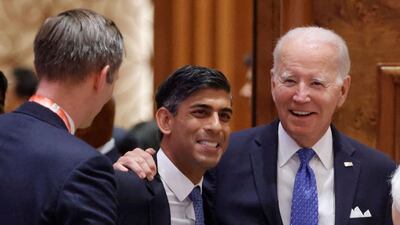
US President Joe Biden greets Britain's Prime Minister Rishi Sunak. AFP -
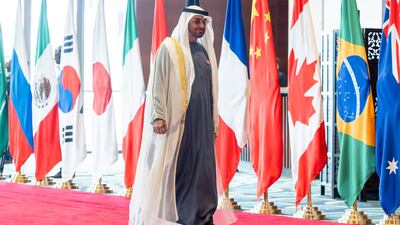
Sheikh Mohamed arrives at the IECC Convention Centre. Photo: UAE Presidential Court -
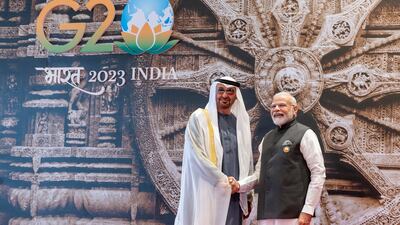
Sheikh Mohamed is greeted by India's Prime Minister Narendra Modi. UAE Presidential Court -
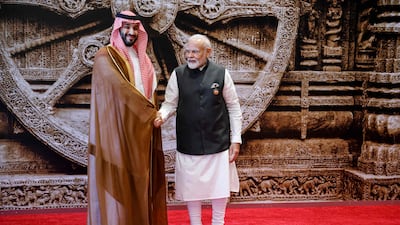
India's Prime Minister Narendra Modi welcomes Saudi Arabia's Crown Prince and Prime Minister Mohammed bin Salman to the G20 summit. AFP -
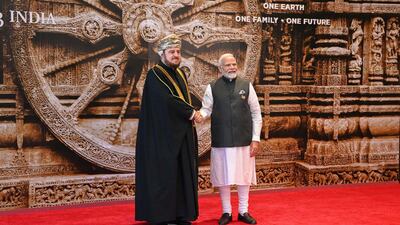
India's Prime Minister Narendra Modi welcomes Oman's Deputy Prime Minister Sayyid Asaad bin Tariq. Oman News Agency -
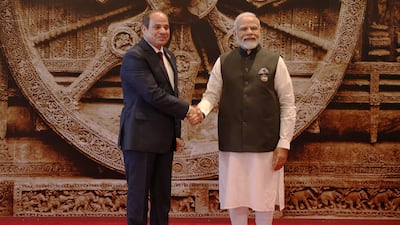
India's Prime Minister Narendra Modi with Egyptian President Abdel Fattah El Sisi at the G20 summit. Getty -
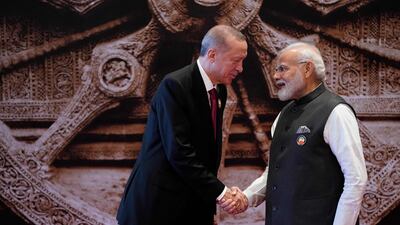
India's Prime Minister Narendra Modi greets Turkey's President Recep Tayyip Erdogan. AFP -
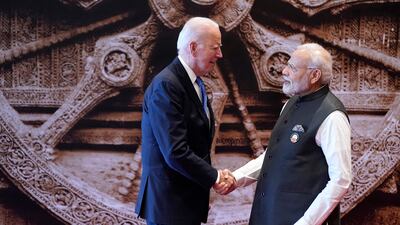
India's Prime Minister Narendra Modi welcomes US President Joe Biden to the G20 summit. AFP -
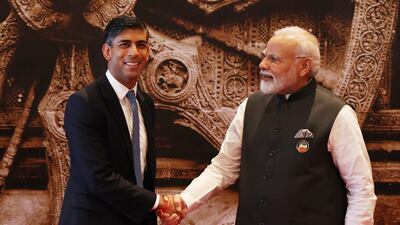
India's Prime Minister Narendra Modi with UK Prime Minister Rishi Sunak. Getty -
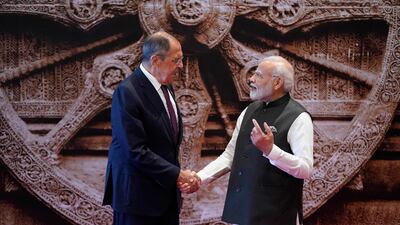
India's Prime Minister Narendra Modi greets Russian Foreign Minister Sergey Lavrov on the opening day of the G20 summit. AFP -

India's Prime Minister Narendra Modi and Canada's Prime Minister Justin Trudeau. AFP -
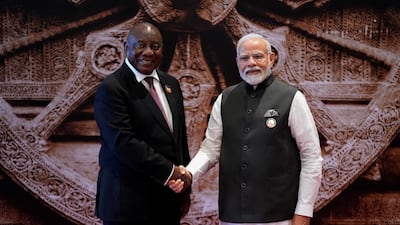
Indian Prime Minister Narendra Modi welcomes South Africa President Cyril Ramaphosa to the G20 summit, three weeks after the leaders were together at the Brics summit in Johannesburg. Reuters -
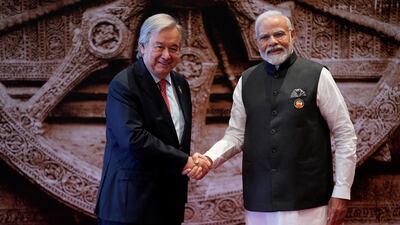
Indian Prime Minister Narendra Modi greets UN Secretary General Antonio Guterres. Reuters -
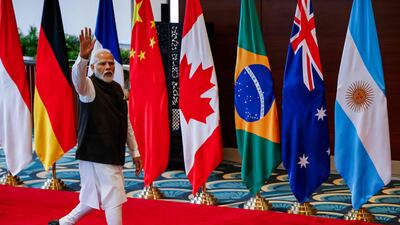
India's Prime Minister Narendra Modi arrives to host the G20 Leaders' Summit in New Delhi. AFP


At the G20 Summit, the President discussed the need to identify a way forward in financing sustainable development to ensure climate action addresses the needs of those most affected around the world.
To make real impact, climate finance must be affordable, available and accessible to all, which Sheikh Mohamed discussed in his side meetings with various leaders, including Indian Prime Minister Narendra Modi, French President Emmanuel Macron, Indonesian President Joko Widodo, Turkish President Recep Tayyip Erdogan, and Argentine President Alberto Fernandez.
The meetings undertaken by Sheikh Mohamed during the G20 Summit reflect the enormous scope of the UAE’s relations spanning the globe – a bridge between East and West, a convener of North and South.
While the UAE is a young nation, our leadership has always believed that we have a duty to work hand-in-hand with others and listen to their diverse perspectives to encourage consensus. It is this sense of shared responsibility that continues to nurture our country’s multilateral partnerships at the highest levels.
Sheikh Mohamed underscored our nation’s commitment to collaboration throughout the G20 Summit, emphasising that the UAE is determined to translate aims into action to uplift communities around the world, particularly youth, women, and civil society.
That is a message we intend to carry forward through to Cop28 and beyond, and the UAE looks forward to working with G20 partners to deliver on pledges to support those whose lives and livelihoods have been significantly altered by climate change. It is encouraging that the G20 has now welcomed the African Union as a member, making the group more representative of the Global South. And our goal, as I reiterated in Kenya and Tanzania last week, is to make Cop28 the most inclusive and impactful yet.

In the run-up to Cop28, the UAE continues to engage with other nations on major sustainability and energy initiatives, as the world witnessed at the G20 Summit. For example, the India-Middle East-Europe Economic Corridor (IMEC) will link multiple regions through trade and development co-operation, with participants agreeing to assess the potential of electricity and clean hydrogen exports to enhance supply chains and connectivity.
Another initiative is the Global Biofuels Alliance launched by India on the sidelines of the G20 Summit with the UAE and other nations as initiating members. The alliance will encourage partners to increase trade in sustainable biofuels while making the economic case for the adoption of greener alternatives.
Through our commitment to both, the UAE has reinforced the steps it is taking to elevate international co-operation towards a shared vision of a cleaner and greener tomorrow.
The G20 Leaders’ Summit Declaration, achieved after more than 200 hours of deliberations, saw participants back the declaration’s 83 paragraphs, which outlined the need to triple renewable energy capacity by 2030 and establish a green development pact to incentivise sustainable growth. Inspired by President Sheikh Mohamed’s engagement on the international stage, we in the UAE believe that the declaration is a promising sign of the progress to come.
Reaching consensus is no small challenge, but the concrete outcomes from the G20 demonstrate what is possible when all parties apply creativity, grit, and optimism to partnership.

