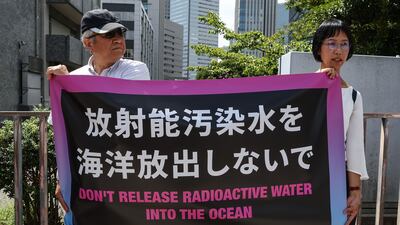
A protester holds a sign that reads "Don't throw radiation-contaminated water into the sea", during a rally against discharging of treated radioactive water the ocean, in front of Prime Minister Fumio Kishida's official residence in Tokyo, Japan, on August 25. Reuters
A protester holds a sign that reads "Don't throw radiation-contaminated water into the sea", during a rally against discharging of treated radioactive water the ocean, in front of Prime Minister Fumio


Japan releasing water from the Fukushima nuclear plant sets a bad example


  • English
  • Arabic

August 29, 2023

How much tritium, carbon-14, strontium-90 and iodine-129 would you like in your sushi? None at all, appears to be the response of the Chinese public, which has been strongly supportive of Beijing’s decision to ban all seafood imports from Japan after more than 1 million tonnes of water from the wrecked Fukushima Daiichi nuclear power plant began discharging into the Pacific Ocean.

The decision has so outraged opinion in China that Tokyo has advised any citizens visiting or living in China to “try to be cautious, such as not speaking Japanese loudly unnecessarily”. The concern is real: last week, a brick was thrown at the Japanese embassy in Beijing, and the country’s diplomats have apparently been deluged by “crank calls” from Chinese telephone numbers.

It is never hard to provoke anti-Japanese feeling in China or South Korea (where people are also upset) given the historical record of the Second World War and the previous decades of Tokyo’s imperial expansion. This has nothing to do with the issue of nuclear power – both countries have plenty of nuclear power plants, and even many hardcore environmentalists have come round to the view that the technology is one of the cleanest and most sustainable when all is working correctly.

Kim Gi-hyeon (R), chief of the ruling People Power Party, and the party's floor leader, Yun Jae-ok, eat slices of raw 'mineo,' or croaker fish, for lunch at a raw fish restaurant in Incheon, west of Seoul, South Korea, on August 29, to promote sales of fish amid Japan's release of radioactive water into the ocean. EPA

Neither has the outrage been mollified by the fact that the UN’s International Atomic Energy Agency has approved the release, which will take place over 30 to 40 years, and that the discharge has been thoroughly cleaned – the levels of tritium, a radioactive isotope of hydrogen, are far below those that the World Health Organisation mandates for drinking water.

“The ocean is the common property of all humanity, and forcibly starting the discharge of Fukushima’s nuclear wastewater into the ocean is an extremely selfish and irresponsible act that ignores international public interests,” said a statement from China’s foreign ministry. The Japanese government disputes that, but really this is a communications fiasco arising from the failure to recognise that for most people the words “nuclear contaminated” and “perfectly safe” do not belong in the same sentence.

Rightly or wrongly, this is an issue to which people have an emotional, not a rational, response

It reminds me of 1990, when Britain was in a frenzy about “mad cow disease”, which could be spread from infected meat to humans. The then environment secretary, John Gummer, attempted to reassure the public there was little or no risk from local produce by posing for a photoshoot while feeding his four-year-old daughter a beef burger. No one was convinced. It only raised questions about the minister’s style of parenting. (Years later, I met Mr Gummer’s by then grown-up daughter at a dinner party. I am pleased to report that she appeared to be unscathed by the experience.)

Rightly or wrongly, this is an issue to which people have an emotional, not a rational, response. Would you swim in the sea next to the site of a nuclear disaster – Fukushima was the world’s worst since Chernobyl after it was struck by a tsunami in 2011 – or in any area where water from the ruined plant was released? I know I wouldn’t. And even if the risk would be minimal, this decision does tap into entirely legitimate fears about humanity’s custodianship of our oceans.

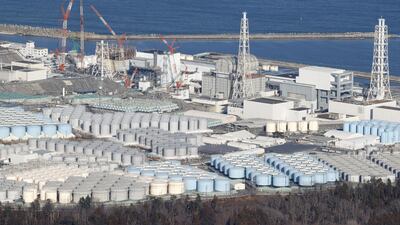
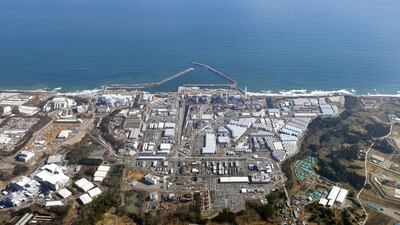
Part of the facility for the releasing treated radioactive water to sea. On August 24, Japan started the discharge of treated radioactive water from the Fukushima nuclear power plant into the Pacific Ocean. It will take 30 years to complete the release. EPA/ Pool

A study published in March estimated that there may be more than 170 trillion plastic particles in the world’s seas, and that there had been a “rapid and unprecedented” increase in plastic pollution since 2005. A global plastic treaty is in the works, but cleaning up just what we have produced so far will be a gargantuan task – only 9 per cent of the historic total has ever been recycled, according to the UN Environment Programme.

To take another example, at the beginning of August, Britain’s team for the World Triathlon Championship finals said they had been forced to stop training in the sea – because there was too much sewage off the coast of Lancashire, where they are based.

These are very troubling news stories for all of us who relish spending time in the water. Some of my happiest memories are of braving chilly British shores, snorkelling in the Red Sea near Jeddah and the Bismarck Sea off Papua New Guinea, and swimming with turtles and baby sharks near the east coast of peninsular Malaysia. But there are serious health costs, too, for both marine and human life. How have we managed to take such a laissez-faire attitude to one of the planet’s most precious resources?

So releasing water from the Fukushima nuclear plant just sets a very bad example – that the ocean continues to be where we offload our refuse. Yes, we have been told that it is safe – although there have been countless times over the decades when professionals were confident that something that turned out to be harmful was not, or the impression was given that it wasn’t too bad. There was an advertising slogan in the 1940s that went: “More doctors smoke Camels than any other cigarette.”

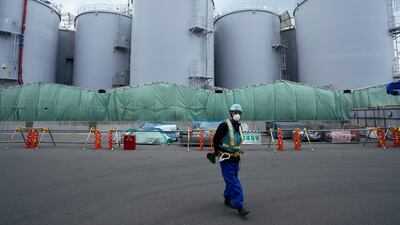
  • Storage tanks for treated water at the Fukushima nuclear power plant in Okuma, Japan. Reuters
    Storage tanks for treated water at the Fukushima nuclear power plant in Okuma, Japan. Reuters
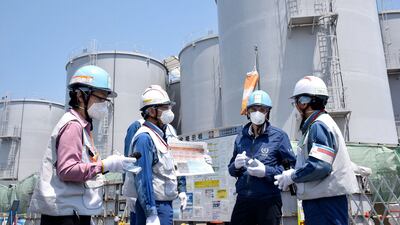
  • Authorities are set to begin pumping more than a million tonnes of treated radioactive water from the nuclear power plant into the sea. AFP
    Authorities are set to begin pumping more than a million tonnes of treated radioactive water from the nuclear power plant into the sea. AFP
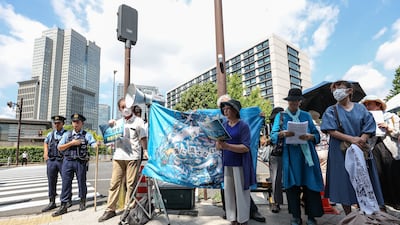
  • The move has drawn criticism, such as from these protesters outside the Japanese prime minister's official residence. Getty Images
    The move has drawn criticism, such as from these protesters outside the Japanese prime minister's official residence. Getty Images
  • Japan's government plans to release water stored at Fukushima into the Pacific. Getty Images
    Japan's government plans to release water stored at Fukushima into the Pacific. Getty Images
  • Neighbouring countries have objected, citing fears of radioactive contamination. Reuters
    Neighbouring countries have objected, citing fears of radioactive contamination. Reuters
  • The accumulating water has been stored in tanks at Fukushima since 2011 and Japan says it needs to start releasing it as those containers are full. AP
    The accumulating water has been stored in tanks at Fukushima since 2011 and Japan says it needs to start releasing it as those containers are full. AP
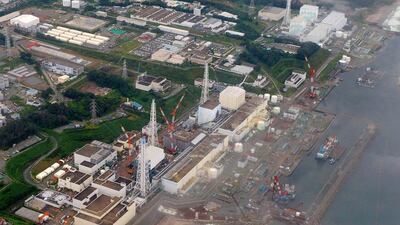
  • The nuclear meltdown at Fukushima in March 2011 was sparked by a tsunami that swept away towns and cities after a 9.0-magnitude earthquake, leaving more than 20,000 people dead or missing. AP
    The nuclear meltdown at Fukushima in March 2011 was sparked by a tsunami that swept away towns and cities after a 9.0-magnitude earthquake, leaving more than 20,000 people dead or missing. AP

But there is not a 100 per cent consensus on the issue. Greenpeace International issued a statement saying: “Scientists have warned that the radiological risks from the discharges have not been fully assessed, and the biological impacts of tritium, carbon-14, strontium-90 and iodine-129, which will be released in the discharges, have been ignored.” Those scientists include members of the US National Association of Marine Laboratories, who would have no reason other than their expertise to side with China over Japan.

So is it really safe? Not everyone is certain that it is, which should have been sufficient cause to put a halt to the release. But above all, it is a matter of common sense, and of appreciating – or rather not appreciating in this case – the widespread and understandable fears associated with any materials that have passed through a plant that suffered the worst nuclear disaster for decades.

The question the Japanese authorities should be asking themselves is not, “how did we not communicate this issue better to our neighbouring countries?”, but “was this at all a good idea in the first place?”


How to wear a kandura

Dos

  • Wear the right fabric for the right season and occasion 
  • Always ask for the dress code if you don’t know
  • Wear a white kandura, white ghutra / shemagh (headwear) and black shoes for work 
  • Wear 100 per cent cotton under the kandura as most fabrics are polyester

Don’ts 

  • Wear hamdania for work, always wear a ghutra and agal 
  • Buy a kandura only based on how it feels; ask questions about the fabric and understand what you are buying
MOUNTAINHEAD REVIEW

Starring: Ramy Youssef, Steve Carell, Jason Schwartzman

Director: Jesse Armstrong

Rating: 3.5/5

Mobile phone packages comparison
The specs

Engine: 2.0-litre 4-cyl turbo

Power: 247hp at 6,500rpm

Torque: 370Nm from 1,500-3,500rpm

Transmission: 10-speed auto

Fuel consumption: 7.8L/100km

Price: from Dh94,900

On sale: now

UAE SQUAD

Mohammed Naveed (captain), Mohamed Usman (vice captain), Ashfaq Ahmed, Chirag Suri, Shaiman Anwar, Mohammed Boota, Ghulam Shabber, Imran Haider, Tahir Mughal, Amir Hayat, Zahoor Khan, Qadeer Ahmed, Fahad Nawaz, Abdul Shakoor, Sultan Ahmed, CP Rizwan

The President's Cake

Director: Hasan Hadi

Starring: Baneen Ahmad Nayyef, Waheed Thabet Khreibat, Sajad Mohamad Qasem 

Rating: 4/5

What can you do?

Document everything immediately; including dates, times, locations and witnesses

Seek professional advice from a legal expert

You can report an incident to HR or an immediate supervisor

You can use the Ministry of Human Resources and Emiratisation’s dedicated hotline

In criminal cases, you can contact the police for additional support

Politics in the West
The Year Earth Changed

Directed by:Tom Beard

Narrated by: Sir David Attenborough

Stars: 4

MATCH INFO

Euro 2020 qualifier

Russia v Scotland, Thursday, 10.45pm (UAE)

TV: Match on BeIN Sports 

Story%20behind%20the%20UAE%20flag
%3Cp%3EThe%20UAE%20flag%20was%20first%20unveiled%20on%20December%202%2C%201971%2C%20the%20day%20the%20UAE%20was%20formed.%C2%A0%3C%2Fp%3E%0A%3Cp%3EIt%20was%20designed%20by%20Abdullah%20Mohammed%20Al%20Maainah%2C%2019%2C%20an%20Emirati%20from%20Abu%20Dhabi.%C2%A0%3C%2Fp%3E%0A%3Cp%3EMr%20Al%20Maainah%20said%20in%20an%20interview%20with%20%3Cem%3EThe%20National%3C%2Fem%3E%20in%202011%20he%20chose%20the%20colours%20for%20local%20reasons.%C2%A0%3C%2Fp%3E%0A%3Cp%3EThe%20black%20represents%20the%20oil%20riches%20that%20transformed%20the%20UAE%2C%20green%20stands%20for%20fertility%20and%20the%20red%20and%20white%20colours%20were%20drawn%20from%20those%20found%20in%20existing%20emirate%20flags.%3C%2Fp%3E%0A
Coming soon

Torno Subito by Massimo Bottura

When the W Dubai – The Palm hotel opens at the end of this year, one of the highlights will be Massimo Bottura’s new restaurant, Torno Subito, which promises “to take guests on a journey back to 1960s Italy”. It is the three Michelinstarred chef’s first venture in Dubai and should be every bit as ambitious as you would expect from the man whose restaurant in Italy, Osteria Francescana, was crowned number one in this year’s list of the World’s 50 Best Restaurants.

Akira Back Dubai

Another exciting opening at the W Dubai – The Palm hotel is South Korean chef Akira Back’s new restaurant, which will continue to showcase some of the finest Asian food in the world. Back, whose Seoul restaurant, Dosa, won a Michelin star last year, describes his menu as,  “an innovative Japanese cuisine prepared with a Korean accent”.

Dinner by Heston Blumenthal

The highly experimental chef, whose dishes are as much about spectacle as taste, opens his first restaurant in Dubai next year. Housed at The Royal Atlantis Resort & Residences, Dinner by Heston Blumenthal will feature contemporary twists on recipes that date back to the 1300s, including goats’ milk cheesecake. Always remember with a Blumenthal dish: nothing is quite as it seems. 

Global Fungi Facts

• Scientists estimate there could be as many as 3 million fungal species globally
• Only about 160,000 have been officially described leaving around 90% undiscovered
• Fungi account for roughly 90% of Earth's unknown biodiversity
• Forest fungi help tackle climate change, absorbing up to 36% of global fossil fuel emissions annually and storing around 5 billion tonnes of carbon in the planet's topsoil

Updated: August 29, 2023, 2:00 PM