

The ongoing actors’ and writers’ strikes that have rocked Hollywood this summer are not just about pay. They are also about AI, and the economic and technological threats to art. The looming threat of film studios replacing actors and writers with AI for the sake of turning a profit raises a question: can art continue to exist in a capitalist and consumer-driven world?
Also raising eyebrows are the AI technologies themselves. Midjourney, for example, is a programme that can create art pieces faster than any artist could ever dream of. This brings up a second, related question: is AI art really art and will it fully replace human art?
As these two questions force us to think about what art really is, should we be bracing ourselves for the end of art?
There’s a general malaise around Hollywood these days. Not having to pay for A-list actors or employ writers is undoubtedly an alluring premise for film studios looking to save money while turning to the cheap labour of AI – deepfake technologies can replicate an actor’s likeness, and programmes such as ChatGPT can write chunks of fully coherent text. This drive to make the production of art as profitable as possible gives the impression that the commodification and monetisation of art are tainting – perhaps even killing – it.
This isn’t necessarily the case, though. Similar concerns have been raised several times throughout history, yet art still stands.
Expressionist artist Willem de Kooning allegedly approached Andy Warhol at a party in the late 60s and shouted: “You’re a killer of art!”
While De Kooning didn’t elaborate on his bombastic statement, several modern art critics and detractors of postmodern art, such as literary critic Fredric Jameson, claimed that the deep entanglement with monetary and consumerist values evident in Warhol’s work nullified its status as art. Warhol earned millions of dollars by painting movie stars such as Marilyn Monroe and branded items such as Campbell's soup, which Jameson labelled as “consumer fetishes” instead of art. Opinions on pop art and Warhol aside, if people such as Jameson are correct, and economic influences are killers of art, then art has been dead since long before they were born.

Hundreds of years before the pop art movement, elites would commission artists to produce pieces they could use as tokens of great wealth and status and sell for innumerable sums. Leonardo da Vinci, Raphael and several other Renaissance painters had much of their work commissioned by European royalty, and deniers of these painters’ immense artistic contributions are far and few between.
In the case of Hollywood today, capitalism remains at the heart of the concerns over what is happening to art, but the specific mechanisms of capitalism at issue are very different. It is not the inherent monetisation of art that is driving the strikes, but rather its monetisation at artists’ expense. In other words, making art profitable is OK, but dehumanising artists to achieve that goal is where the threat to art lies. Writers are often treated as second-class citizens and marginalised at all levels of production. Many allege that the development of AI tools capable of creating art threatens to accelerate that process into overdrive, fearing that human artists may one day cease to exist.
Last year, gaming entrepreneur Jason Allen won first place in the Colorado State Fair’s fine-arts competition with a piece he created using Midjourney, an AI program that can produce images based on user prompts. Mr Allen’s piece caused outrage across the artistic community, with many worried about the ethics of the technology, whether it can really be considered art and the threat it poses to art and artists. Mr Allen himself said: “Art is dead, dude. It’s over. AI won. Humans lost.” But he’s wrong.
The camera was introduced to the world in the early 1800s and the idea of photography as an art form, though widely accepted today, was thoroughly shunned by artists for the better part of a century. Artist Henrietta Clopath said in 1901: “The fear has sometimes been expressed that photography would in time entirely supersede the art of painting. Some people seem to think that when the process of taking photographs in colour has been perfected and made common enough, the painter will have nothing more to do.”
In an 1865 issue of art journal The New Path, a writer claimed that art must have “something beyond the mere mechanism at the bottom of it” and that photography didn’t have that something.
-
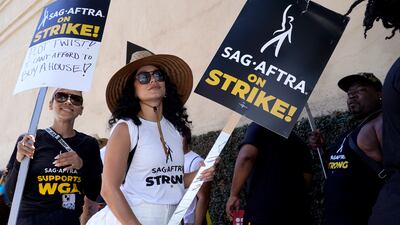
Vanessa Hudgens joins a protest outside Warner Bros Studios, Los Angeles. AP -
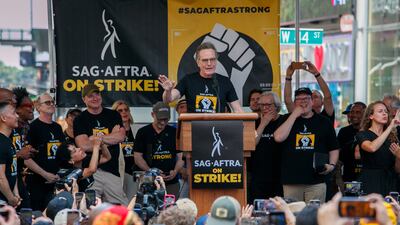
Bryan Cranston speaks during a rally hosted by the actors' union in Times Square, New York. EPA -
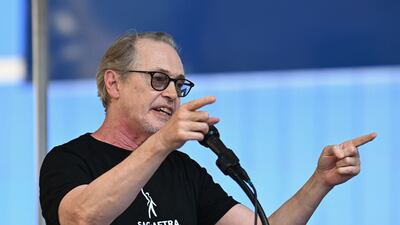
Steve Buscemi also spoke at the rally. AFP -
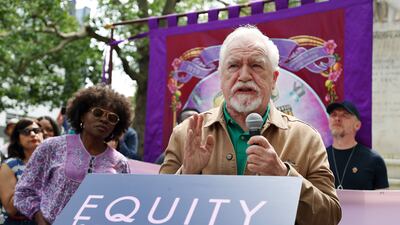
Brian Cox speaks to Equity union members during a British actors' rally at Leicester Square, London. EPA -
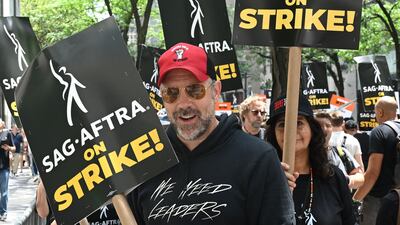
Jason Sudeikis joins members of the Writers Guild of America and the Screen Actors Guild on a picket line outside NBC Universal in New York. AFP -
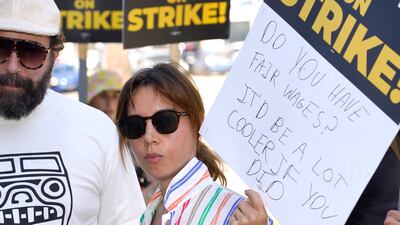
Aubrey Plaza protests outside Netflix studios in Los Angeles. AP -
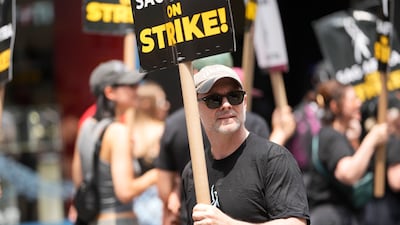
Christian Slater protests outside Paramount in Times Square, New York. AP Photo -
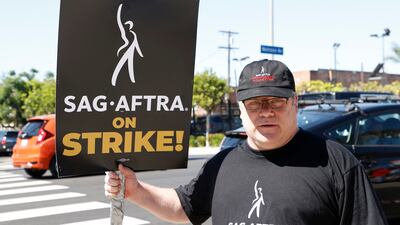
Sean Astin protests outside Paramount Studios in Los Angeles. AFP -
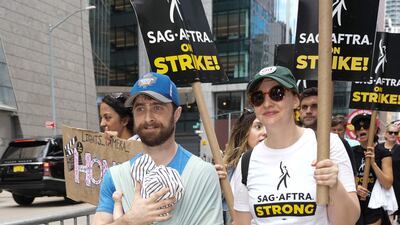
Daniel Radcliffe and girlfriend Erin Darke join the picket line in New York City. Getty Images -
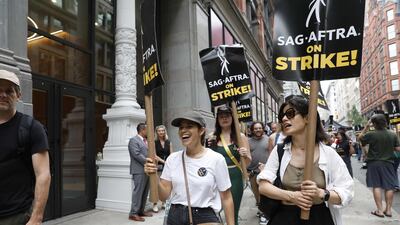
America Ferrera, left, joins the picket line outside Netflix and Warner Bros in New York City. Getty Images -
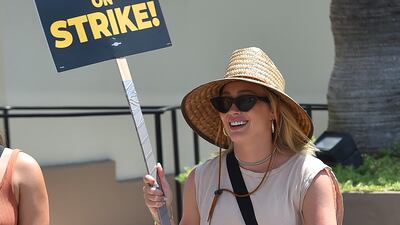
Hilary Duff outside Paramount studios in Los Angeles. AP Photo -
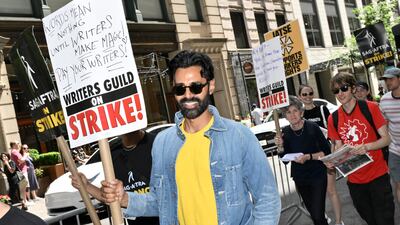
Hasan Minhaj outside Netflix in New York. AP -
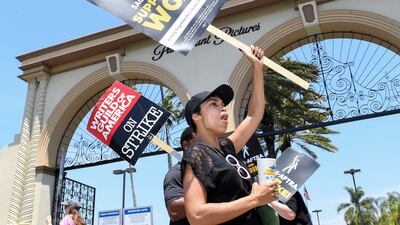
Rosario Dawson on a picket line outside of Paramount Studios in Los Angeles. AFP -
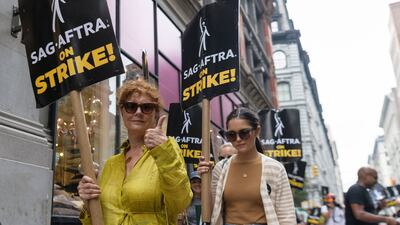
Susan Sarandon, left, protests in New York. AFP -
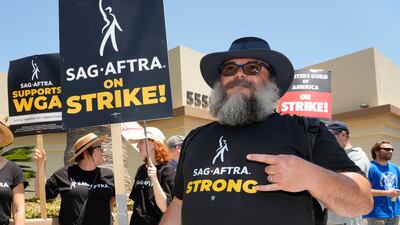
Jack Black protests in Los Angeles. AP -
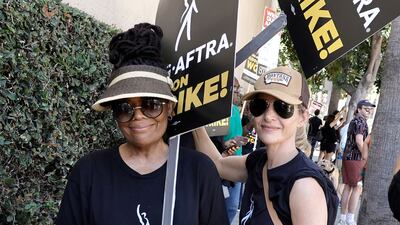
Yvette Nicole Brown, left, protests outside Warner Bros Studios in Burbank, California. Getty Images -
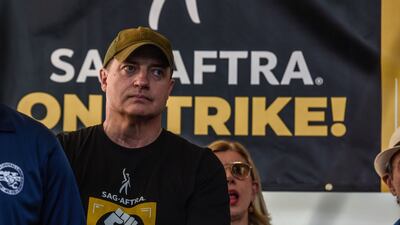
Brendan Fraser at a rally in Times Square, New York. Bloomberg -
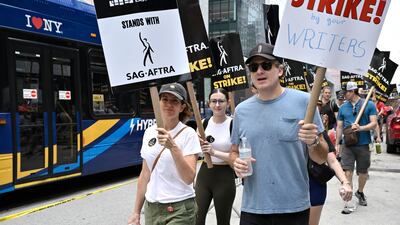
Tina Fey, left, and writer/producer Eric Gurian join protests in New York. AP -
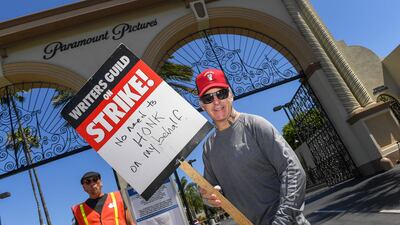
Bob Odenkirk walks the picket line outside Paramount Studios in Los Angeles. AFP -
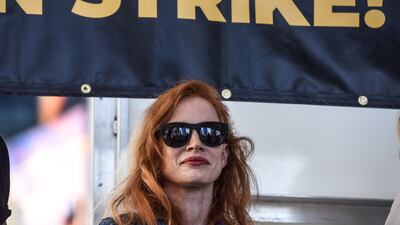
Jessica Chastain joins a rally in Times Square, New York. Bloomberg


These sentiments from more than 100 years ago echo the very same arguments being made against AI art today. In the same way that photographers are seen as a staple of the artistic community, it’s very possible, and perhaps even likely, that “prompt artists” – people who know how to effectively communicate with AI programs to get the images they want – will be regarded as legitimate artists in the future.
In the context of Hollywood, countless actors and filmmakers vehemently rejected the introduction of sound in motion pictures in the late 20s and early 30s, but that technology is the norm today and, without it, art forms such as sound design would not exist. Who knows what avenues the introduction of AI could open for filmmaking in the future?
Understand, though, that this is not a call for us to be glib to contemporary artists’ plight. AI technologies will cause and are currently causing major disruptions, and regulations must be put in place to protect artists. In the same way that photographers cannot sell photographs of other people’s paintings without their permission, AI programs such as Midjourney should only be permitted to draw from a database of art pieces that have been willingly provided by artists. Likewise, the Sag-Aftra actor’s union already stipulates that film studios cannot replicate an actor’s likeness, AI technology or otherwise, without receiving explicit permission to do so.
These rapid, technology-fuelled changes to art and what art means are not indicative of the end of art, but rather the end of art as we know it. This is OK, though; in this sense, art has ended countless times. Art is far from a concrete idea and should be understood as more of an iterative process.
Technology can drive the way the production and perception of art evolve, as highlighted with the introduction of the camera. And aside from technology, the intellectual definition of art is ever changing. The modern understanding of art influenced by artists such as Vincent van Gogh and promoted by critics such as Jameson, for example, was followed by the postmodern understanding of art inspired by artists such as Warhol and promoted by younger critics. AI will surely usher in an even newer understanding of art, which some are calling metamodernism.
While the faces of these threats to art are new, their core principles are centuries old. Yes, we must be vigilant in protecting artists, but we must also trust in the iterative process of art because, as it has shown time and time again, art will survive.

