

The demarcation of Syria's maritime borders has become a matter of concern for the Arab world. Ensuring the security of the Mediterranean Sea is a politically crucial issue, given the oil and gas-rich nature of the Eastern Mediterranean basin and its future centrality to Europe, the US, Russia and Asian countries.
Turkey, naturally, has reasons to be concerned about its maritime and land borders with Syria. Cyprus has an interest in maritime demarcation. Lebanon holds a special place in Arab attention due to the qualitative regional shift towards Syria.
Key Arab countries will look to play a role, too, for economic, diplomatic and strategic reasons. Aiming to act as a bridge between Europe and the Mediterranean Arab states, the Gulf countries have the expertise, management capabilities, and financial resources to extract oil and gas through global companies.
Resolving Syria’s border issues holds strategic advantages within a broader vision.
It would provide an opportunity for Saudi Arabia to establish a presence in the Eastern Mediterranean, benefiting from its abundant oil and gas resources as a means of valuable diversification. Importantly, the task of demarcation would be carried out in co-ordination with both Russia and the US, reflecting a new Arab paradigm in addressing regional problems.
In other words, the Arab countries will go from being passive players to key actors shaping the aspirations of the region. The Arab world’s collective vision, after all, is to foster a region-wide understanding of the significance of sustainable development, effective governance, and the preparation of a prosperous future for the coming generations.

Part of the task is for it to peacefully integrate with the global environment, normalise relations between neighbours, and refrain from opposing the sovereign decisions of any individual Arab state. This strategic approach involves legitimising the steps taken by some Arab countries to resolve conflicts and foster reconciliation and rapprochement throughout the Middle East, whether with Iran, Turkey, or Israel.
This represents a relatively new approach that was absent in the past – an intention to use the language of dialogue and persuasion, complemented by political, economic and developmental support. The reintegration of Syria into the Arab community serves as an example of this approach.
The Saudi leadership, in particular, has demonstrated an ability to maintain historical relationships with the West, while cultivating constructive relationships with the East. It is helping to build an Arab system based on pragmatism rather than ideology. It appears that the Arab region has begun to organise itself and solve its problems away from external interventions.
For example, in sponsoring the Saudi-Iran deal, China’s role has been that of a catalyst rather than an active ingredient. Moreover, what happened in the countdown to the Jeddah summit, including the invitation extended to Syrian President Bashar Al Assad, is an example of Arab decision-making – despite reservations and criticisms within the Arab League – independent from the American, European and Russian roles.
Today, Syria is in a transitional phase, and the burden of proving its leadership has good intentions falls on Mr Al Assad’s shoulders. He must work to build a new Syria, by taking steps internally, as well by allowing for the return of refugees and displaced persons to their homes. This will bolster Arab efforts to lift sanctions on Syria, begin reconstruction, demarcate its maritime borders, and harness its resources. But if his government misses this opportunity, Mr Al Assad will find himself trapped in a cycle of failure.
-

Lebanon's Interior Minister Bassam Mawlawi, left, at a press conference in Beirut that revealed an attempt had been foiled to smuggle a large quantity of Captagon pills in a shipment of tea. AFP -

Lebanese police swooped and seized the boxes of tea containing amphetamines after the smugglers sailed from Beirut’s port. AP -

A member of Lebanon's security forces shows how the drugs were hidden deep within what looked like legitimate cargo. EPA -
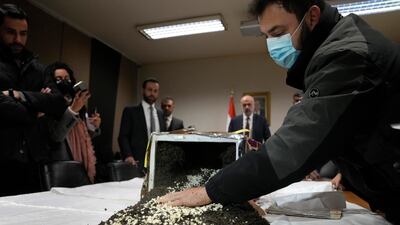
The amphetamines were hidden in 434 boxes mixed with seven tons of tea for export. AP -

Mr Mawlawi said the drugs were being sent to Togo in Africa, to then be shipped to the Gulf. AFP -
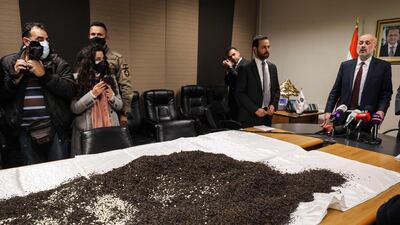
Some of the tea mixed with Captagon pills. Previous consignments have been hidden in fake oranges and lemons, car tyres and even live sheep. AFP -
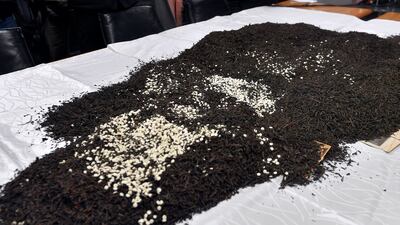
Last year, Saudi Arabia suspended fruit and vegetable imports from Lebanon after more than five million Captagon pills concealed in fruit were confiscated. EPA


Effort are under way to establish institutional relations between Syria and its neighbours. The Joint Arab Ministerial Committee concerned with the Syrian issue – comprising Saudi Arabia, Egypt, Iraq, Jordan and Lebanon – was convened in Cairo before the Jeddah summit and reached an agreement on several provisions. These provisions encompassed not only measures to suppress drug trafficking but also resume dialogue concerning the repatriation of displaced individuals to secure regions within Syria. Collaboration with the UN is under way to identify these safe locations.
The drug trafficking issue specifically will help justify the Arab openness towards Syria. Lebanon deals with Syria through a joint ministerial committee and the Arab League, guided by the principle of "if my neighbour is fine, then I am fine”. Beirut has, at least in theory, also adopted a strategy to tackle Captagon smuggling that includes controlling its borders and ports. Measures are being taken in co-operation with the UN Office on Drugs and Crime.
The Syrian president has not yet committed to implementing the demands placed on him, including curbing drug trafficking. Nor has Damascus presented its positions on any of the other issues. While it has welcomed the recent initiative, it has not officially embraced or rejected its terms.
In sum, however, the Jeddah summit has revitalised the Arab League and given it a renewed purpose. This marks a reactivation of its influence, full with Saudi endorsement and backing from the rest of the Gulf countries. It is a good start for a bloc that has embarked on a path to resolve the region’s myriad challenges and build a better future.

