Dr Rebecca Bradshaw is an award-winning archaeologist, researcher and television presenter
May 19, 2023
It has now been a little more than a month since fighting erupted between the Sudanese military and the Rapid Support Forces. In that time, civilians and combatants across the country have died. Homes and businesses have been destroyed and the cost of basic goods has surged to near-insurmountable levels. Most services, including internet access, have been interrupted.
Amid this chaos – which shows little sign of abating – the preservation of Sudan’s cultural heritage might seem like a low priority. However, as we have seen with conflict before, it is anything but. Cultural heritage is a powerful symbol of identity and, as such, is often the target of violence during conflicts such as this.
Although fighting has taken place in several locations across the nation, it has been concentrated in Sudan’s capital, Khartoum, which hosts a number of historic monuments and has the largest number of museums in the country. On May 12, Unesco said there had been “reports of damage to the Presidential Palace, a historic building which also includes the Republican Palace Museum”, but these have not been verified. So far, then, it seems difficult to confirm whether or not any major damage has been done to sites, monuments or museums in the capital.
The threat of looting – although widespread in post-2003 Iraq and in Egypt during the Arab uprising – seems low. Geoff Emberling, a researcher at the University of Michigan and director of a major project at Sudan’s Unesco World Heritage Site at Jebel Barkal, told me that “Sudan fortunately does not have a history of large-scale looting of archaeological sites”.
The pyramids at Nuri near Karima in Sudan. Stuart Butler
Sadly, the Sudanese have also been rocked by the deaths of beloved cultural figures
“It's true that some pieces have appeared on the international antiquities market … and that there is a network of small-scale antiquities trading [based partly on legal discoveries of antiquities by private people on their own property],” he added. “But I am not concerned in the short term about massive looting of sites as that would require an established network of dealers to make it worthwhile.”
This does not necessarily mean destruction or looting won’t happen in Khartoum in the future. Sara Abdalla Khidir Saeed, director of the Natural History Museum, has said on Twitter that “museums are now without guards or censorship to protect them”. As noted by Tohamy Abulgasim, co-director of community archaeology for Mr Emberling’s project at Jebel Barkal, “the area between the Natural History Museum and the Sudan National Museum is a central fighting ground” between the military and the RSF.
“This means that the museums may become collateral damage,” he added.
Indeed, remembering that cultural heritage is about both the tangible and intangible, the man-made and the natural, the greatest loss of cultural heritage in Khartoum so far is of the live animals at the Natural History Museum. The animals, which included crocodiles, rare snakes and birds, were subject to a slow death because no one was able to give them food or water since the conflict broke out.
Sadly, the Sudanese have also been rocked by the deaths of beloved cultural figures, such as the famous actress Asia Abdelmajid, former footballer Fozi El-Mardi, and most recently, popular singer Shaden Hussein, who was killed in the crossfire between the warring factions in the city of Omdurman last week.
Outside Khartoum, information is thin on the ground, even though River Nile state and Northern State are home to the country’s two Unesco World Heritage Sites – at Meroe and Jebel Barkal.
Sami Elamin, regional director of antiquities in Northern State, has been working at Jebel Barkal for years, where he is also resident manager, and is there now. He told me that the greatest damage being done to the site is the result of the significant influx of people who fled Khartoum for Karima, the town in which Jebel Barkal is located.
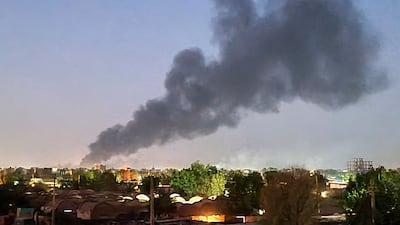
Khartoum burns amid fighting between the forces of two rival generals in Sudan. AFP
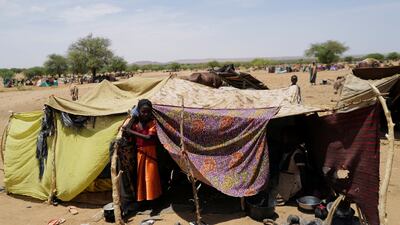
A Sudanese girl at her family's makeshift shelter across the border in Koufroun, Chad. Reuters
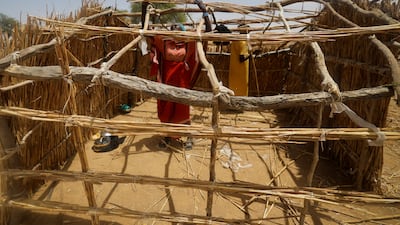
Sudanese refugee women build a makeshift shelter in Koufroun, Chad. Reuters
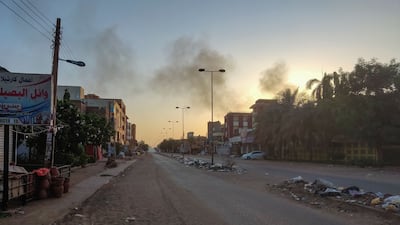
Air strikes battered Khartoum as fighting entered a fourth week. AFP
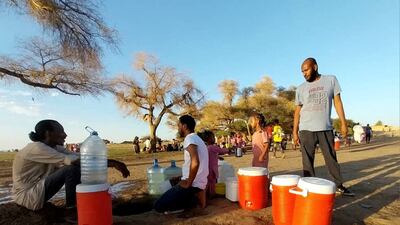
People dig holes to get pure water at the banks of the White Nile in Khartoum. Reuters
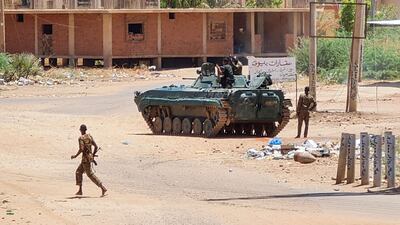
Army sodliers and tanks on a street in Khartoum. AFP
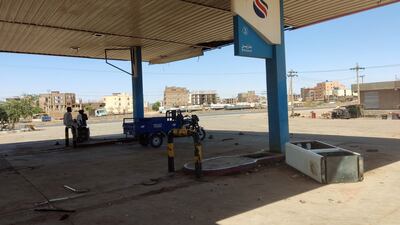
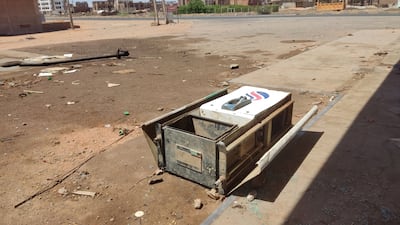
A looted petrol station in southern Khartoum. AFP
Sudan's warring generals have repeatedly failed to honour multiple agreed ceasefires. AFP
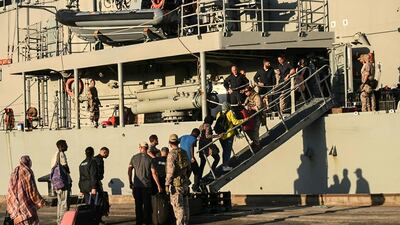
People board the Spanish frigate Reina Sofia during an evacuation from Port Sudan to Saudi Arabia. AFP
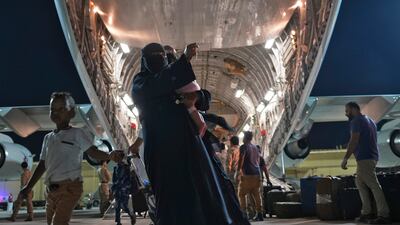
Evacuees disembark at Al Udeid Air Base in Qatar. AP
“The people who have come to Karima are very interested in the ancient site, which is fantastic, but they don’t realise the damage that they do by climbing the pyramids and other parts of the site,” he said. “There are also so many people that they are very difficult to manage with such a small number of guards.”
When I spoke to Mr Elamin, he was at the regional police station asking for more personnel to protect the site. Sustaining sufficient country-wide manpower will no doubt be a challenge for all cultural heritage sites, ancient or modern, as the government of Sudan has imposed "extended leave" without pay on most state employees.
In response, Mr Emberling said that several groups of archaeologists “are urgently raising money to support colleagues in the short term until larger international funding might become available”.
“It is urgent that we find ways to support site managers, inspectors and guards so they can continue to monitor sites and inform the Sudan Antiquities Service and the international community of any issues that may develop,” he added.
Looking to the future, the preservation of cultural heritage depends – like everything else in Sudan – on supporting those who work in the sector, first and foremost, and on a sustainable peace agreement between the armed forces and the RSF.

The chief operating officer of Hyperloop Transportation Technologies, Andres de Leon, said his company's hyperloop technology is “ready” and safe.
He said the company prioritised safety throughout its development and, last year, Munich Re, one of the world's largest reinsurance companies, announced it was ready to insure their technology.
“Our levitation, propulsion, and vacuum technology have all been developed [...] over several decades and have been deployed and tested at full scale,” he said in a statement to The National.
“Only once the system has been certified and approved will it move people,” he said.
HyperloopTT has begun designing and engineering processes for its Abu Dhabi projects and hopes to break ground soon.
With no delivery date yet announced, Mr de Leon said timelines had to be considered carefully, as government approval, permits, and regulations could create necessary delays.
3.30pm Jebel Ali Classic Conditions Dh300,000 1,400m
4pm Maiden Dh75,000 1,600m
4.30pm Conditions Dh250,000 1,400m
5pm Maiden Dh75,000 1,600m
5.30pm Handicap Dh85,000 1,000m
The National selections:
2pm Arch Gold
2.30pm Conclusion
3pm Al Battar
3.30pm Golden Jaguar
4pm Al Motayar
4.30pm Tapi Sioux
5pm Leadership
5.30pm Dahawi
PRO BASH
Thursday’s fixtures
6pm: Hyderabad Nawabs v Pakhtoon Warriors
10pm: Lahore Sikandars v Pakhtoon Blasters
Teams
Chennai Knights, Lahore Sikandars, Pakhtoon Blasters, Abu Dhabi Stars, Abu Dhabi Dragons, Pakhtoon Warriors and Hyderabad Nawabs.
Squad rules
All teams consist of 15-player squads that include those contracted in the diamond (3), platinum (2) and gold (2) categories, plus eight free to sign team members.
Tournament rules
The matches are of 25 over-a-side with an 8-over power play in which only two fielders allowed outside the 30-yard circle. Teams play in a single round robin league followed by the semi-finals and final. The league toppers will feature in the semi-final eliminator.
Who's who in Yemen conflict
Houthis: Iran-backed rebels who occupy Sanaa and run unrecognised government
Yemeni government: Exiled government in Aden led by eight-member Presidential Leadership Council
Southern Transitional Council: Faction in Yemeni government that seeks autonomy for the south
Habrish 'rebels': Tribal-backed forces feuding with STC over control of oil in government territory
Starring: Baneen Ahmad Nayyef, Waheed Thabet Khreibat, Sajad Mohamad Qasem
Rating: 4/5
MATCH INFO
Uefa Champioons League semi-final, first leg:
Liverpool 5
Salah (35', 45 1'), Mane (56'), Firmino (61', 68')
Roma 2
Dzeko (81'), Perotti (85' pen)
Second leg: May 2, Stadio Olimpico, Rome
What sanctions would be reimposed?
Under ‘snapback’, measures imposed on Iran by the UN Security Council in six resolutions would be restored, including:
An arms embargo
A ban on uranium enrichment and reprocessing
A ban on launches and other activities with ballistic missiles capable of delivering nuclear weapons, as well as ballistic missile technology transfer and technical assistance
A targeted global asset freeze and travel ban on Iranian individuals and entities
Authorisation for countries to inspect Iran Air Cargo and Islamic Republic of Iran Shipping Lines cargoes for banned goods
Who are the Sacklers?
The Sackler family is a transatlantic dynasty that owns Purdue Pharma, which manufactures and markets OxyContin, one of the drugs at the centre of America's opioids crisis. The family is well known for their generous philanthropy towards the world's top cultural institutions, including Guggenheim Museum, the National Portrait Gallery, Tate in Britain, Yale University and the Serpentine Gallery, to name a few. Two branches of the family control Purdue Pharma.
Isaac Sackler and Sophie Greenberg were Jewish immigrants who arrived in New York before the First World War. They had three sons. The first, Arthur, died before OxyContin was invented. The second, Mortimer, who died aged 93 in 2010, was a former chief executive of Purdue Pharma. The third, Raymond, died aged 97 in 2017 and was also a former chief executive of Purdue Pharma.
It was Arthur, a psychiatrist and pharmaceutical marketeer, who started the family business dynasty. He and his brothers bought a small company called Purdue Frederick; among their first products were laxatives and prescription earwax remover.
Arthur's branch of the family has not been involved in Purdue for many years and his daughter, Elizabeth, has spoken out against it, saying the company's role in America's drugs crisis is "morally abhorrent".
The lawsuits that were brought by the attorneys general of New York and Massachussetts named eight Sacklers. This includes Kathe, Mortimer, Richard, Jonathan and Ilene Sackler Lefcourt, who are all the children of either Mortimer or Raymond. Then there's Theresa Sackler, who is Mortimer senior's widow; Beverly, Raymond's widow; and David Sackler, Raymond's grandson.
Members of the Sackler family are rarely seen in public.
RESULTS
6.30pm: Longines Conquest Classic Dh150,000 Maiden 1,200m.
Winner: Halima Hatun, Antonio Fresu (jockey), Ismail Mohammed (trainer).
7.05pm: Longines Gents La Grande Classique Dh155,000 Handicap 1,200m.
Winner: Moosir, Dane O’Neill, Doug Watson.
7.40pm: Longines Equestrian Collection Dh150,000 Maiden 1,600m.
Winner: Mazeed, Richard Mullen, Satish Seemar.
Size: 55 employees and 100,000 cleaning requests a month
Funding: The company’s investors include Collective Spark, Faith Capital Holding, Oak Capital, VentureFriends, and 500 Startups.
World Cricket League Division 2
In Windhoek, Namibia - Top two teams qualify for the World Cup Qualifier in Zimbabwe, which starts on March 4.
UAE fixtures
Thursday, February 8 v Kenya; Friday, February 9 v Canada; Sunday, February 11 v Nepal; Monday, February 12 v Oman; Wednesday, February 14 v Namibia; Thursday, February 15 final