


Actions taken at Al Aqsa Mosque last week by Benjamin Netanyahu’s government, the Israeli security forces and racially charged settlers were all violations of international law and basic humanitarian norms. They merit condemnation.
However, by firing rockets towards Israel from southern Lebanon in retaliation, and drawing cross-border counter strikes, Palestinian militants have put the lives of ordinary people – in Palestine and Lebanon – in danger. Israeli jets also hit military targets in Syria.
These events have, once again, brought into sharp focus the role of Hezbollah and its patron, the Iranian regime, in that part of the Middle East and the Arab world.
Tehran insists on war-torn Syria’s territorial integrity, which includes the rebel-held Turkish-Syrian border region. It believes it has been invited by the legitimate government in Damascus to deploy its influence, forces and bases wherever it pleases on Syrian territory. It does not want to give even an inch on these privileges, and wants Russia to continue to be a partner and guarantor of its position in Syria.
However, the Iranian regime is unable to resolve one thorny issue with Moscow. It resents Russia’s refusal to take military action against repeated Israeli raids on Iranian sites inside Syria, bearing in mind that Russia has the ability to do so, including downing Israeli warplanes. This has put Moscow in a bind, as it seeks to leverage its friendship with the Israeli government on the war in Ukraine.
Tehran is incapable of expanding the scope of its skirmishes with Israel despite its threats of direct confrontation, including in Syria. Indeed, following the Chinese-brokered agreement with Saudi Arabia, it is having to curb its military appetite. It has retaliated against Israel, as it has often done, through its proxies Hezbollah and Hamas in Lebanon and Gaza. Unifying the fronts of “resistance”, or leveraging them as required, has become a more urgent need today as it finds its hands tied.

The Hezbollah front is tougher today than other fronts, for two reasons.
First, the explicit and implicit terms of the Saudi-Iranian-Chinese agreement require non-interference in the internal affairs of states, and for Tehran to prove that it has changed its behaviour. Its behaviour in Lebanon is a crucial part of these agreements. Therefore, dragging Lebanon into a war with Israel triggered through Hezbollah attacks is inconsistent with its promise to soften its behaviour.
Second, the agreement demarcating maritime borders between Lebanon and Israel was blessed by Iran and Hezbollah for a number of reasons, including the potential financial windfall from oil and gas reserves in the Eastern Mediterranean.
Over the weekend, Hezbollah rushed to leak remarks that the rockets fired from southern Lebanon towards Israel were not its own. Curiously, Hassan Nasrallah, the Hezbollah chief, hosted Ismail Haniyeh, the Hamas chief, while the rockets were being fired. Given that southern Lebanon is a Hezbollah stronghold, either Nasrallah gave permission for Palestinian militants in the country to fire their rockets, or he was caught off guard.
In both scenarios, a promise was broken, or a blunder was made.
It is possible that internal conflicts within the Iranian regime are part of the explanation. Perhaps, the Islamic Revolutionary Guard Corps and the regime’s moderates are playing a game of “good cop, bad cop” – with Iranian Foreign Minister Hossein Amirabdollahian, who supposedly represents the moderates, meeting Saudi Foreign Minister Prince Faisal bin Farhan in Beijing to start the implementation of the two countries’ diplomatic agreement.
The Beijing summit this week was fruitful, with the two diplomats agreeing to take important practical steps, from opening embassies and consulates and resuming flights to rebuilding economic relations and, crucially, reviving their 2001 security co-operation framework.
Yemen appears to be the first place where their intentions and actions will be tested. The issue of Lebanon has imposed itself more forcefully than the players had intended, on account of the developments over the weekend and the questions and contradictions they have raised.
-
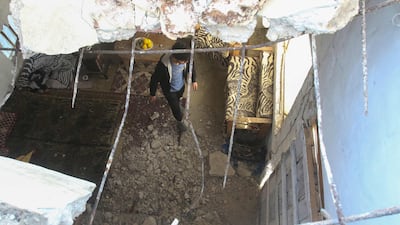
A man inspects damage at his house left by a rocket following Israeli air strikes in Al Qulaylah, on the outskirts of the city of Tyre, south of the Lebanese capital Beirut. AFP -
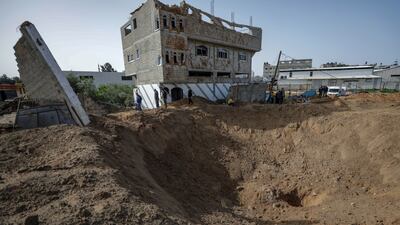
Palestinians inspect the damage after Israeli air strikes in Gaza City. EPA -
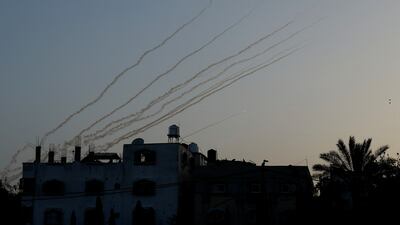
Trails of smoke is seen as rockets are fired from Gaza. Reuters -
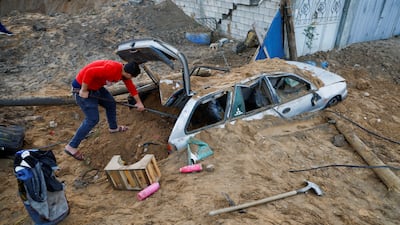
A Palestinian checks a car damaged by Israeli air strikes in Gaza city. Reuters -
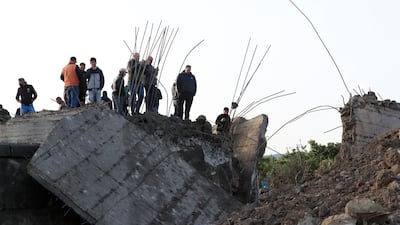
A bridge destroyed by an Israeli air strike in Maaliya village in south Lebanon. AP -
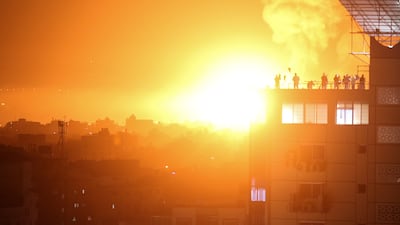
Flames and smoke rise after Israel bombarded south Lebanon and Gaza in the early hours of Friday. EPA -
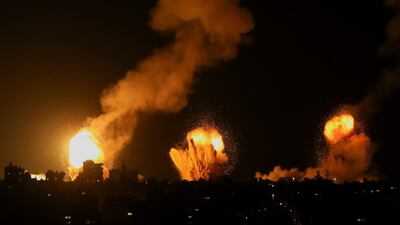
Explosions seen in Khan Younis in the southern Gaza Strip. Reuters -
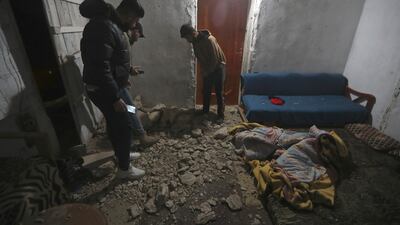
Lebanese residents examine the damage at a house after air strikes in Qalili village in south Lebanon. AP -
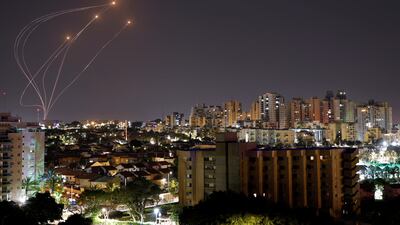
Streaks of light seen from Ashkelon in Israel as rockets fired from the Gaza Strip are intercepted. Reuters -

A Lebanese army unit finds a missile launcher near the towns of Zibqin and Qlaileh. Photo: Lebanese Army -
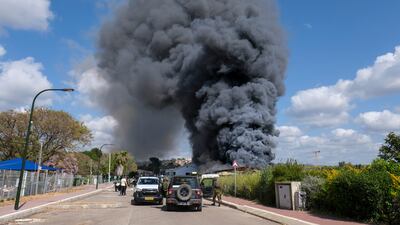
Smoke rises after rockets fired from Lebanon strike Bezet in northern Israel. AP -
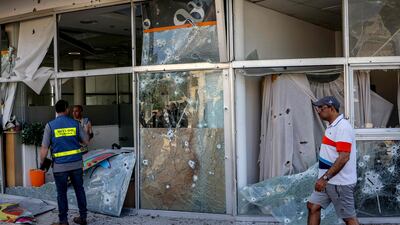
A damaged building in the northern Israeli town of Shlomi. AFP -

The remains of an intercepted rocket fired from Lebanon into the city of Shlomi in northern Israel. AP -
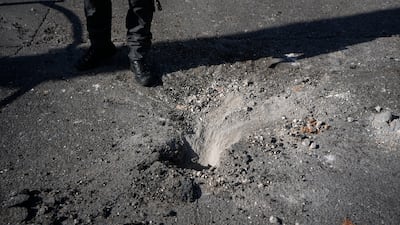
Ruins of a missile intercepted by Israeli military. AP


Saudi Arabia and Iran both agree on condemning the illegal and outrageous actions against worshippers at Al Aqsa Mosque. Clearly, however, Saudi Arabia would not see any justification for Palestinian factions using Lebanon as a launchpad for rockets to implicate it in a cycle of Israeli retaliation, in violation of its sovereignty.
Whoever fired these rockets, it was ultimately an ill-conceived decision because it harmed both the Palestinians and the Lebanese, and exposed Iran’s incoherence and embarrassed Hezbollah on its turf. The obvious questions here are, how and why these Palestinian factions, including Hamas, maintain such rocket capabilities inside Lebanon when they supposedly need them in Palestine to carry out their “resistance” against Israel.
The ill-fated Cairo Agreement of 1969, legitimising Palestinian armed presence in Lebanon, is the root cause of this problem. How can an independent state allow arms outside of its control on its territory, if it truly is a state?
Hezbollah’s weapons justify Hamas’s weapons outside state control in Lebanon, in a flagrant violation of its sovereignty. While Hezbollah is a Lebanese faction with the right to national partnership, it has no right to monopolise decision-making. If Tehran truly intends to reform the logic of its regime and revive its security co-operation in the region, it must start thinking about dismantling its armed proxies in Arab countries, from the Houthis in Yemen to Hezbollah in Lebanon.
Meanwhile, resisting Israel inside Palestine is a Palestinian right, but one that requires ending the divisions and rivalries between its own leaders and factions. It also requires an Arab and international strategy to put pressure on the Israeli government to rein in its actions – not just against worshippers at Al Aqsa Mosque, but, more broadly, against Palestinians by attempting to force them out of their territories. What Hamas and Palestinian groups like it do is give Israel the pretext to carry out those very actions.

