


The far-reaching implications of the Israeli government’s attempted overhaul of the country’s judicial system can be better appreciated if we take a moment to look backwards. Indeed, the history of modern-day Israel illustrates the dangers of the path its government is currently taking, and the international consequences these dangers might unwittingly be unleashing.
The intended judicial overhaul includes a clause that would allow parliament to re-legislate laws that the Supreme Court rejects, and give the government control over the selection of judges. This and other proposed reforms have been met with weeks-long protests across Israel, and alarmed key allies including the US. Protesters say they are tantamount to undermining the country’s liberal democratic system.
Prime Minister Benjamin Netanyahu on Monday announced that his government will delay the process for discussions until next month, when parliamentarians return after the Passover holiday. However, concerns remain that the reforms will eventually go ahead, particularly after Mr Netanyahu dismissed Yoav Gallant as defence minister for speaking out against the proposals over the weekend. All this will have profound ramifications for US-Israel relations going forward, accompanied by wider geopolitical consequences – especially as international controversy grows over the nature of Israel’s occupation of the Palestinian Territories.
Many Israelis today, including policymakers and the public, naively believe that their country’s relationship with the US is a fait accompli, and that their government can act with impunity, without fear of substantive American sanction or censure.
But this is an oversimplification of the reality, as history suggests.
Contrary to popular belief, the US granted only limited recognition to Israel’s provisional government after the latter declared its establishment on May 14, 1948. Washington held back full legal recognition of the country until January 31, 1949 – only after its first elected government was formed.

The US did this partly because the Soviet Union had also been courting Israel, which raised concerns in Washington that the Israeli government, dominated by socialists, would gravitate towards the communist world rather than the West. Even after Israel proved it had all the characteristics of a western-style democracy, relations between the two countries remained distant and strained for years.
In the 1950s, Israel was concerned by the US’s willingness to work with then Egyptian president Gamal Abdel Nasser, which resulted in a failed Israeli sabotage plot in Cairo in 1954. The US then forced a ceasefire on Israel in the Suez Crisis of 1956, forcing it to halt its offensive, thereby handing Mr Nasser a propaganda victory. Prime minister David Ben-Gurion privately raged at the Americans for hampering Israel’s chances of achieving a decisive victory against Egypt.
It’s worth recalling that until 1962, the US maintained a self-imposed arms embargo against Israel. In fact, Israel’s successes in the 1967 Arab-Israeli War were achieved largely with French and British hardware. By then, however, a US-Israel strategic partnership did begin to take shape.
Critics of Israel have often questioned the country’s democratic credentials, but it is a historical reality that its status as a member of the UN, and the international community more broadly, occurred largely due to its status as a liberal democracy of the likes of which the US identified with.
And it is that status, along with the recognition that comes with it, that is now fundamentally under threat.
One might argue that the more than 50-year US-Israeli relationship is too deep and profound to be upended by one crisis. But Israel’s own history shows how short-sighted this potentially is.
There is no legal basis to the US-Israel strategic partnership – there has never been any form of formal military alliance between the two states, let alone anything like a Mutual Defence Pact – and so it is a relationship that can dramatically change, just as Israel’s ties with France deteriorated in 1967.
So strong had France’s support for Israel been that it was not only Israel’s key military supplier until 1967 – providing the Mirage and Mystere fighter jets that played an important role in Israel’s crushing military victory in the Arab-Israeli War – but also had fought a war alongside Israel in the Suez Crisis, and been instrumental in Israel’s initial acquisition of nuclear weapons technology. Yet, after the French assessment that Israel’s “pre-emptive strike” on the Arab world in June 1967 was “unjustified”, Paris dramatically severed all military ties.
Today, the US-Israel dynamic is gradually deteriorating – a fact glossed over by the Israeli right that has been in government for much of the past 20 years. And this now makes an especially ill-judged moment to be testing the foundation of their relations.

A Gallup poll last September found that 61 per cent of American adults under the age of 30 have a favourable view of the Palestinian people, compared with just 56 per cent who have a favourable view of Israel – a remarkable change in public mood since 2001, when a Gallup poll found that only 16 per cent of Americans sympathised more with the Palestinians. The next generation of American leaders, policymakers, diplomats, journalists and tens of millions of ordinary voters are already questioning the relatively unequivocal US support that Israel relies upon. The illusion that Israel can “take for granted” US support could soon be shattered.
The criticism of the proposed judicial legislation by US Secretary of State Antony Blinken might, in time, be seen as the public articulation of a watershed moment in US-Israel relations. Standing next to Mr Netanyahu at a news conference in Israel, Mr Blinken’s warning of the consequences of Israel’s departure from the current democratic path could not have been starker.
“The commitment of people in both our countries to make their voices heard, to defend their rights, is one of the unique strengths of our democracies,” Mr Blinken said. “Another is a recognition that building consensus for new proposals is the most effective way to ensure they’re embraced and that they endure.”
The fundamental basis of the US-Israel relationship is the fact that Israel – which self-consciously chose to call itself Medinat Israel (The State of Israel) rather than Eretz Israel (The Land of Israel), emphasising its status as a modern nation-state, rather than an attempt to recreate the religious “Temple Israel” of the Biblical period – was founded as a modern liberal democracy, even if one with an overt and distinct Jewish character.
Attempts to turn it into a religiously oriented state where “Jewish” takes priority over “democratic” thus changes everything. Add this to how the religious right’s agenda will affect Israeli policy in the West Bank under this government – with the possible annexation of land that the vast majority of the international community, including it should be noted the US itself, considers to be Occupied Territory – no one should be in any doubt that Israel will be jumping on to a slippery slope that leads inexorably to both a crisis in US-Israel relations and to the start of a wider process of de-recognition across the western world and beyond.
This process and the subsequent sea-change in Israel’s foreign relations will almost certainly not be immediate – unlike the break with France in 1967, it may be more a slow-motion collision than a high-speed crash – but no less real or profound will be its medium and long-term effects and consequences.
An old Israeli joke goes that if the Arab world did indeed want to destroy Israel, all it needed to do was leave Israel alone long enough. It is thus a perverse historical irony that what could not be achieved at the height of the Arab-Israeli conflict – which was to undermine Israel’s legitimacy in the eyes of the international community – may be about to be achieved by Israel’s own government.
-

Israeli police disperse demonstrators blocking a road in Tel Aviv during a protest against plans by the government to overhaul the judicial system. AP -

Police arrest a protester in Tel Aviv. EPA -

Demonstrators set up a bonfire on a road. AP -

Israeli security forces use a water cannon to disperse protesters. AFP -
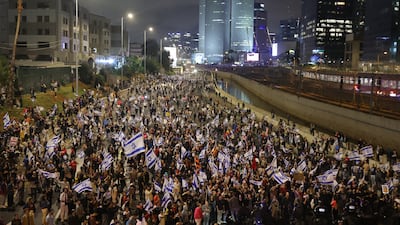
Thousands of protesters block the Ayalon main road. EPA -

The Tel Aviv protest swelled on Saturday to about 200,000 demonstrators, according to Israeli media estimates. AFP -

A roadblock placed by protesters on the Ayalon main road. EPA -

Demonstrations erupted in January after the coalition government announced its package of changes. AFP -

Israeli protesters dislodge a fence. AFP -

Police use a water cannon to disperse protesters. AP -

An aerial view of the protest. Reuters -
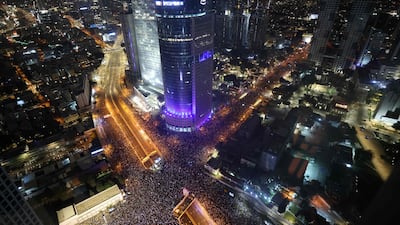
Plans to hand more control to politicians and diminish the role of the court have been questioned by Israel’s allies including the US. AFP -

Protesters with placards of Prime Minister Netanyahu saying 'We will not forget, we will not forgive'. EPA



