


A deep rift has emerged within the G20 intergovernmental forum due to the war in Ukraine.
Its practical translation is the possible unravelling of an otherwise increasingly influential forum, coupled with a renewed focus on the G7, the grouping of the more advanced economies in the West that had accepted Russia into its fold in 1997 to become the G8, before suspending its membership following Moscow’s annexation of Crimea in 2014.
The ongoing rift has implications for the global economy and the international system, not just in terms of the further erosion of Russia’s international status, but also because it shakes the very foundations of international relations and decision-making mechanisms. The G20, after all, has the task of developing policies to promote international financial stability among the major industrialised economies and emerging nations that together represent two thirds of the world’s population and nearly half of the world’s landmass.
This week, a G20 ministerial meeting in New Delhi concluded with differences that prevented agreement on a joint statement, after Russia and China rejected any condemnation of the war. India, the current president of the G20, said that most member states denounced the war and issued a G20 Chair's Summary and Outcome Document that contained the same language used in a statement issued earlier by meeting of G20 ministers of finance and central bank governors.
First, this points to the fragmentation of the G20, now unable to issue international decisions – unlike the G7, which remains united and able to make collective resolutions. Not long ago, these two groupings were the only blocs of their kind on the international arena with significant heft.
Second, Russia has lost a crucial platform due to this rift. Both India and Russia, who were looking forward to a successful summit, face disappointment, with Moscow having lost a major pulpit upon which it had placed much hope.
-
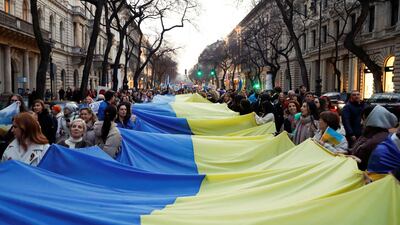
Supporters hold a Ukrainian flag at a solidarity march to mark the first anniversary of the Russian invasion of Ukraine, in Budapest, Hungary. Reuters -
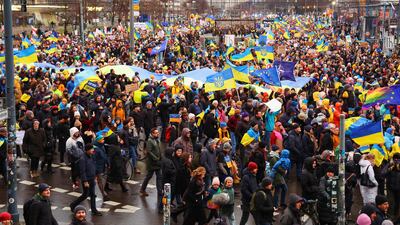
A protest to mark the one-year anniversary of the Russian invasion of Ukraine, in Berlin. Reuters -
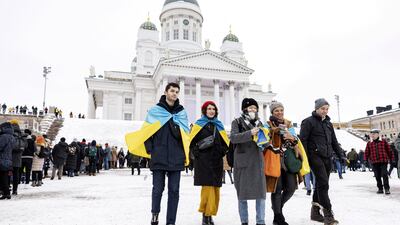
Supporters in front of Helsinki Cathedral during Light for Ukraine candlelight memorial event at Senate Square in Helsinki, Finland. Reuters -
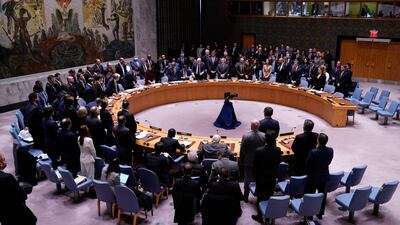
Representatives stand for a moment of silence during the United Nations Security Council meeting on the maintenance of peace and security of Ukraine at the UN headquarters in New York. AFP -
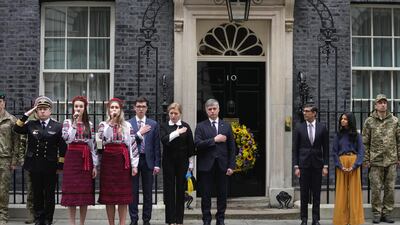
Britain's Prime Minister Rishi Sunak and his wife Akshata Murty, with Ukrainian ambassador to the UK Vadym Prystaiko, centre, his wife Inna and members of the Ukrainian Armed Forces outside 10 Downing Street in London, as they observe a minute's silence. AP -
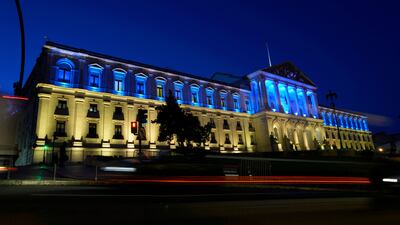
The Portuguese Parliament is lit with the blue and yellow of the Ukrainian flag, in Lisbon AP -
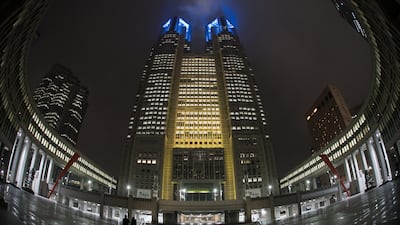
The Tokyo Metropolitan Government building is lit with the Ukraine national flag colours. Getty Images -
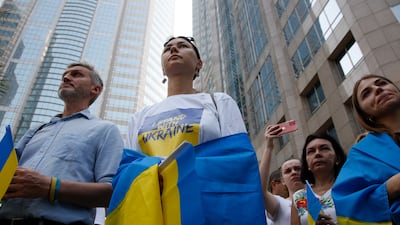
Supporters carry Ukrainian flags during a demonstration in Bangkok. EPA -
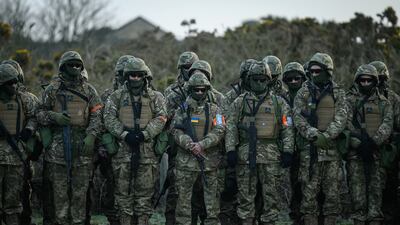
Ukrainian volunteers take part in prayers and observe a minute of silence, in south-east England. Getty -
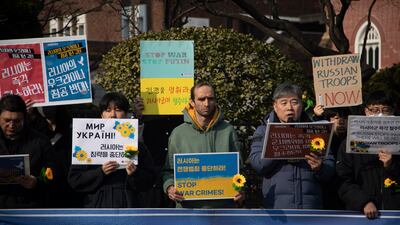
Protesters near the Russian embassy in Seoul, South Korea. EPA -
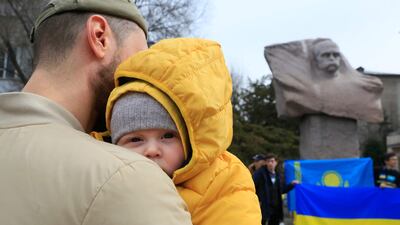
People lay flowers at a monument of Ukrainian poet, writer, artist, public and political figure Taras Shevchenko, in Almaty, Kazakhstan. AFP -
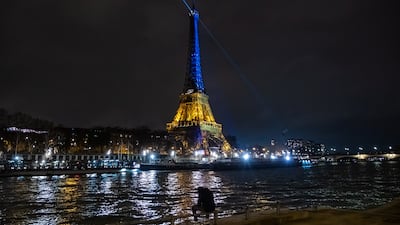
The Eiffel Tower in Paris is lit up in the colours of Ukrainian flag. EPA -
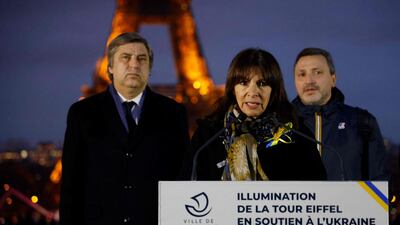
Paris Mayor Anne Hidalgo speaks alongside the Ukrainian ambassador to France, Vadym Omelchenko, during the event. AFP -
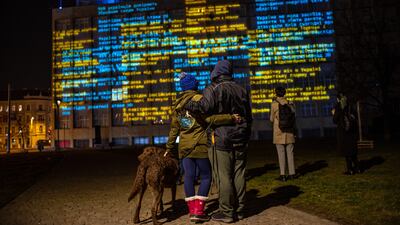
Watching video-mapping on the Czech Interior Ministry building, in Prague. EPA -
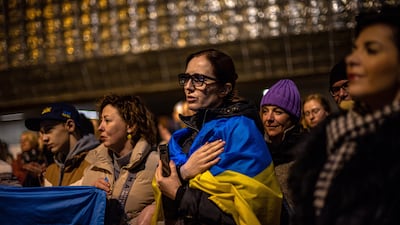
A woman expresses her solidarity with Ukraine at the Czech National Theatre, in Prague. EPA -
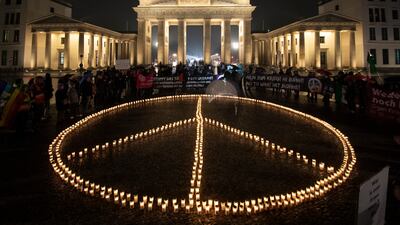
Activists place candles forming the peace sign in front of the Brandenburg Gate, in Berlin. AP -
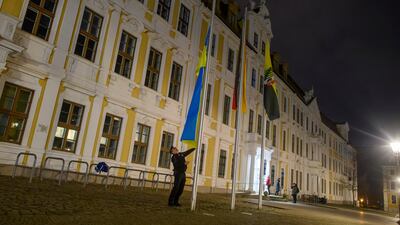
A police officer raises the Ukrainian flag in front of the state parliament of Saxony-Anhalt in Magdeburg, Germany. AP -
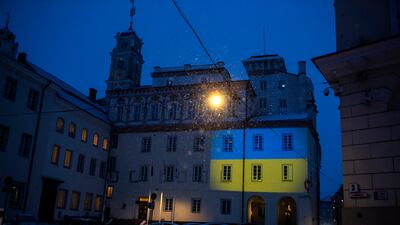
A Vilnius University building is illuminated in blue and yellow in support of Ukraine, in Vilnius, Lithuania. AP -
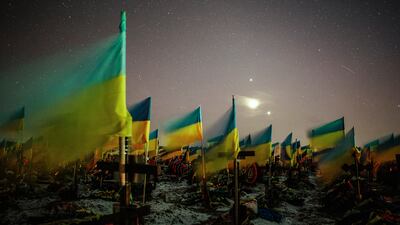
Ukrainian flags placed over the graves of fallen Ukrainian soldiers in a military cemetery in Kharkiv, north-eastern Ukraine. EPA -

A commemoration event with a light installation at the Field of Mars cemetery where hundreds of Ukrainian soldiers are buried, in Lviv, western Ukraine. Getty -
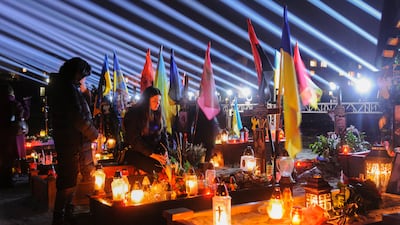
Friends and relatives of fallen Ukrainian soldiers take part in a prayer as Rays of Memory illuminate the night sky over Lychakiv military cemetery in Lviv. EPA -
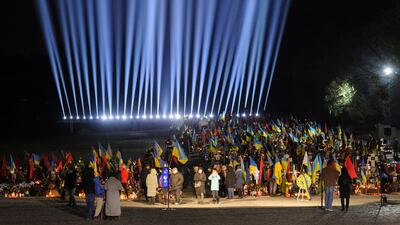
Rays of memory illuminate the sky over Lychakiv military cemetery in Lviv. EPA -
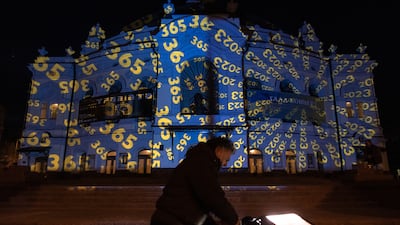
The National Opera of Ukraine building illuminated by Swiss artist Gerry Hofstetter in the colours of the Ukrainian flag, in Kyiv. Getty -
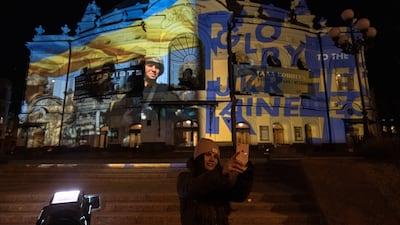
A woman takes selfies in front of The National Opera of Ukraine, illuminated by Swiss artist Gerry Hofstetter. Getty -

A candlelit vigil in front of the Russian consulate, in New York. Reuters -
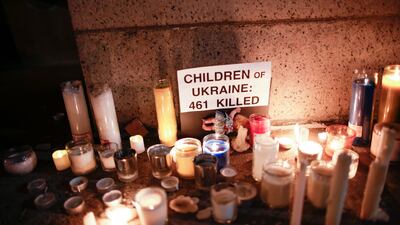
Candles lit outside the Russian consulate in New York during a vigil to commemorate children killed in Ukraine. AFP -

A silent candlelit vigil in New York. Reuters -
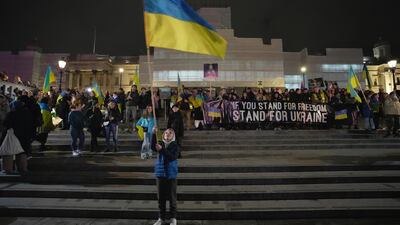
A Trafalgar Square vigil organised by the Ukrainian and US embassies in London. AP -
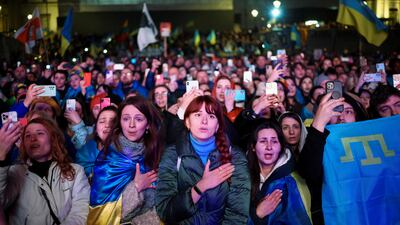
A vigil for Ukraine at Trafalgar Square in London. Reuters -
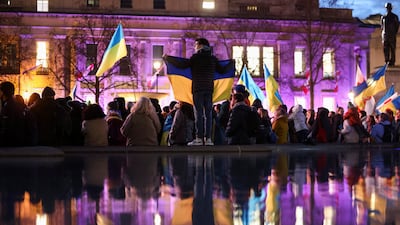
The Trafalgar Square vigil. Reuters -
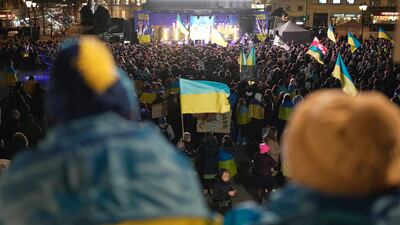
Crowds gather at Trafalgar Square. AP -
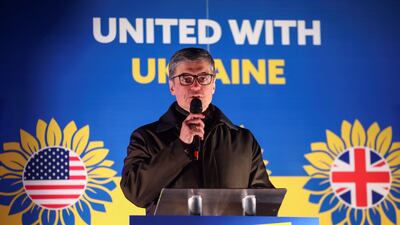
The Ukrainian ambassador to the UK, Vadym Prystaiko, addresses the London vigil. Reuters -
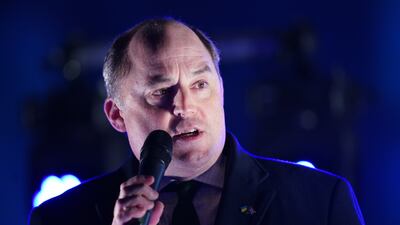
British Defence Secretary Ben Wallace speaks at the vigil. PA -
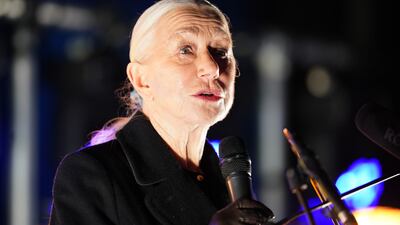
Actress and activist Helen Mirren addresses the London vigil. PA -
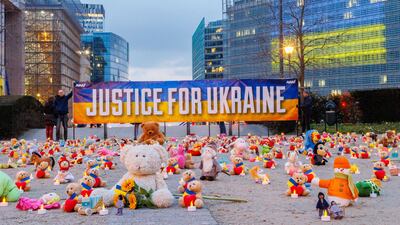
Teddy bears and other toys left by Ukrainian refugees and members of the Avaaz global activist network at Schuman Roundabout, in front of the European Commission, in Brussels. AP -
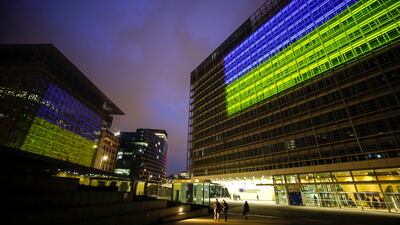
The EU Council and Commission buildings illuminated in the colours of the Ukrainian flag. EPA -
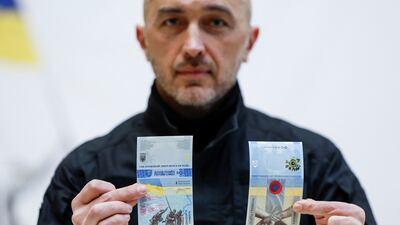
Governor of the National Bank of Ukraine Andriy Pyshnyi holds banknotes marking the first anniversary of Russia's invasion on Ukraine, in Kyiv. Reuters -
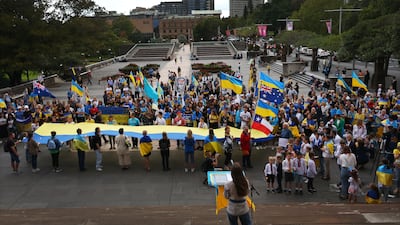
Supporters gather at St Mary's Cathedral Square during the 365 Days Strong rally and candlelight vigil in Sydney. Getty -

France's ambassador to Ukrain Etienne de Poncins, left, and the French Culture Minister Rima Abdul-Malak visit Independence Square in central Kyiv. AFP


In recent days, Russia has seen a gradual shift in stands taken by some countries on the war.
Last week, for example, Saudi Foreign Minister Prince Faisal bin Farhan visited Ukraine, where the two countries reportedly signed a memorandum of understanding worth $400 million. The visit was the first of its kind for a Saudi and Arab official and opened a new page between the two nations. Saudi Arabia’s message to Moscow appears to be that, while it is keen to join efforts to find a political solution to the Ukraine crisis, the kingdom does not want to be seen as backing the Russian war effort.
At the UN General Assembly, meanwhile, up to 141 countries voted in favour of ending the war and calling for Russia to leave Ukraine. All this, coupled with what transpired in New Delhi earlier in the week, possibly translate to a new phase of international isolation for Russia, and a setback to international decision-making as a virtue.
Yet, it is the developments on the battlefield that have brought the most alarming news for Moscow.
On Tuesday, an unknown group carried out drone attacks inside Russian territory, metres away from a natural gas pumping station owned by Russian energy giant Gazprom in Kolomna, more than 100 kilometres from central Moscow. On Wednesday, attacks using drones were launched elsewhere in Russia and Crimea. And on Thursday, an armed attack was carried out in the Russian oblast of Bryansk near the Ukraine border.
The news prompted Dmitry Medvedev, deputy chairman of the Russian Security Council, to accuse leaders of the US, UK and EU countries of being direct accomplices of “terrorists”. The US Department of Defence has denied giving Ukraine intelligence to carry out attacks inside Russian territory.
These are all indications of new dynamics emerging in the Ukraine war, at a time when several experts anticipate the start of major operations, including a Ukrainian offensive. But the situation remains unpredictable. March is likely, therefore, to be a month of the kind of surprises that worry all stakeholders.
Europe is politically and militarily primed and ready, with weapons supplies streaming into Ukraine. For the continent, the war is fateful. Its powers understand, and are anxious, that their territory is where the war and its fallout could ultimately expand into. This has led to a European stance even tougher than that of the US when it comes to punishing Russia’s allies in the war, notably Iran.
It includes even those countries, such as Germany, that were previously more sympathetic towards Iran. Indeed, Berlin is today leading the European camp ready to sanction Tehran, particularly after the collapse of the Vienna nuclear talks, thereby reflecting more broadly Europe’s changing course.
There, of course, continues to be disagreement between the US and the European powers over how to respond to Iran’s enrichment of uranium to the level that allows it to produce nuclear weapons. Tehran seems to have crossed a new threshold, with the International Atomic Energy Agency announcing that it had detected uranium enriched at more than 80 per cent purity. In its letter to the IAEA denying any intention to develop nuclear weapons, Iran claimed it was an unintended accumulation because of technical difficulties in its centrifuges.
The IAEA will convene next week, with The Wall Street Journal quoting sources in a report that the Biden administration is hesitant to publicly censure Iran, while Germany, the UK and France want to officially blame Iran at the meeting. This is truly remarkable, even if the European powers do not end up pushing for a decision without Washington’s support.
A rift is also appearing in Russian-Israeli relations, which the Kremlin had hoped to avoid following the return to power of the presumably friendlier Benjamin Netanyahu. Instead, Israel is now entering the Ukrainian fray alongside the West, in part because of the Russia-Iran alliance. This could result in regional ripples that might not exclude an Iran-Israel war triggered by progress in Tehran’s nuclear programme.
Iran’s recent military exercises sought to highlight its serious capabilities in the air and underground. In a belligerent mood, the regime appears to be priming itself for pre-emptive action. Meanwhile, for Moscow, defeat in Ukraine is not an option. This, then, sets up the potential for surprise moves in the near future.

