


When I first saw the images of overturned train cars, fire and black smoke billowing up into the sky above East Palestine, Ohio, I was immediately transported back to the nightmare scene of a wet July morning nearly 10 years ago, when a train carrying crude oil derailed in Lac-Megantic, Quebec.
In the early hours of July 6, 2013, 73 train carriages parked for the night on the outskirts of town broke free from their moorings and began barrelling downhill, picking up speed on the way.
After hitting a bend in the track as they entered the centre of town, the cars — loaded with the highly flammable and toxic fuel — slammed into the ground and buildings, killing nearly 50 people, some as they slept, others as they danced the night away at a popular bar.
As a cub reporter for the Canadian Broadcasting Corporation, I was there, witnessing the shocking aftermath.
I’ll never forget the thick, black smoke that hovered over the once picturesque village of 6,000 people.
In those early hours, it was not yet apparent that this would be one of the worst disasters in Canadian history, nor that it would reverberate across the country for years to come, as questions of rail safety still linger.
As I pulled my car to a stop next to a ribbon of red caution tape signifying that this was as close to the burning village that I would be able to get, the severity of the situation quickly became apparent.
-
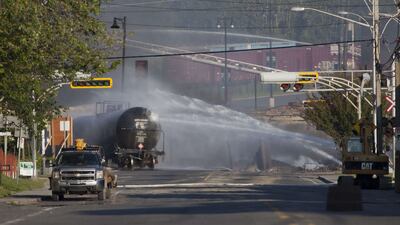
Firefighters douse a blaze after a train loaded with oil derailed in Lac-Megantic, Quebec, on June 6, 2013. AFP -

The accident in Lac-Megantic killed 47 people. AP -

The derailment was a precursor to a similar incident in East Palestine, Ohio, last week. AFP -
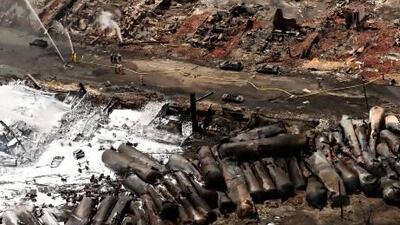
Smouldering rubble in Lac-Megantic. AP -
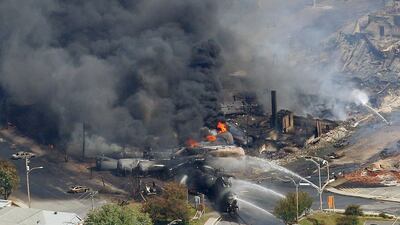
The wreckage of the train after the explosion in Lac-Megantic. Reuters -
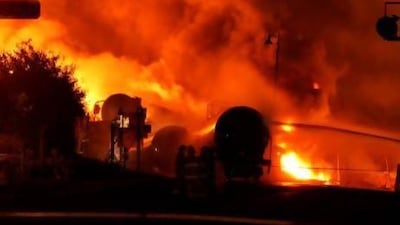
The Lac-Megantic accident triggered debate about whether rail is a safe method by which to transport oil. AFP -
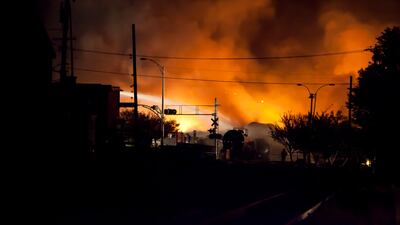
Explosions engulfed about 30 buildings in the small Canadian town. AFP -
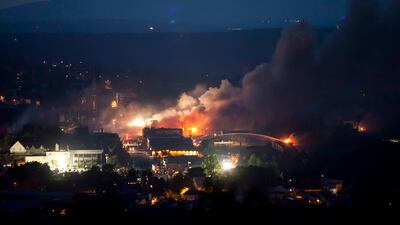
Have lessons from Lac-Megantic been learnt? AFP


Helicopters circled above as throngs of firefighters ran helplessly towards the blaze, which by that point had already been burning for more than six hours.
Acrid smoke hung in the thick summer air, enveloping building after building and masking the pristine lake that gives the town its name.
I started to talk to the handful of residents who were lingering by the cordon trying to see what remained of their town.
Everyone I spoke to that morning knew someone yet to be accounted for.
For more than a century, the railway ran through the heart of downtown Lac-Megantic, connecting Montreal to eastern Canada. In the late 19th century when the railway was built, it was an economic lifeline that allowed the village to grow and prosper into a thriving tourist town.
It was a huge victory for burgeoning communities across Canada to get a rail line. It would often mean the difference between withering up or blossoming into a real destination.
But that lifeline turned into a fiery inferno that changed Lac-Megantic and the country forever.
In the aftermath of the explosion, the town’s then-mayor Colette Roy-LaRoche and other officials called for tighter regulations on rail safety across North America.
Ms Roy-LaRoche even travelled to Washington in 2014 to ask the US Congress to act.
She attended an event at the Capitol with other North American mayors and, according to Canadian media at the time, no members of Congress bothered to show up, choosing instead to send staffers.
In 2015, the US Department of Transportation and Transport Canada agreed to phase out the DOT-111 tankers that were involved in the Lac-Megantic tragedy and widely used to carry fuel and other flammable substances across North America.
But now, nearly 10 years later, another tragedy has unfolded on the continent's criss-crossing tracks, once again raising questions about rail safety.
Roughly 25 million Americans live near rail tracks where crude oil and other chemicals are transported.
Why are trains carrying toxic chemicals allowed to travel along tracks that go through town after town after town, exposing these populations to potential danger?
Derailments are more common than one might think, with 1,093 occurring in the US last year.
-
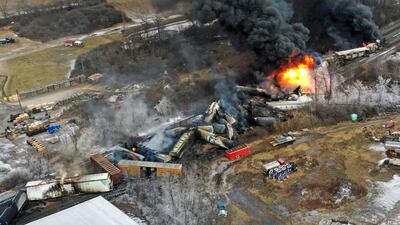
Portions of a Norfolk and Southern freight train on fire after it derailed in East Palestine, Ohio. AP -
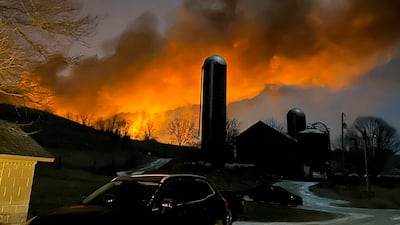
The fire is seen from Melissa Smith's farm in East Palestine. AP -

The train on fire. AP -

Smoke rises from the derailed cargo train. AFP -
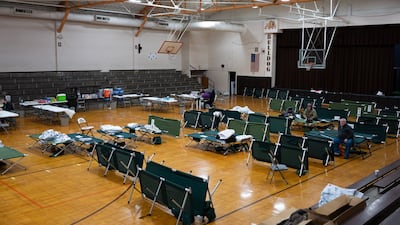
People take shelter at an American Red Cross evacuation support centre. AFP -
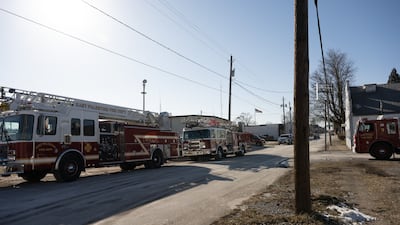
Firefighters attend the scene. AFP


While the vast majority of derailments are simply minor nuisances for the rail companies, some have the potential to cause great harm.
In the case of East Palestine, fortunately no one was killed but the environmental and health implications are extremely troubling.
Federal and state officials have said it is safe for residents to return to their homes, but locals appear distrustful of that assessment with some complaining of “mystery illnesses” — about 45,000 animals have died in the area.
Some residents are reportedly suffering from nausea, headaches, rashes and other symptoms believed to linked to the incident. Others say their house pets are sick or have died.
“I think this should be a wake-up call for the value of investing in prevention in terms of people's lives and economic costs,” said Mathy Stanislaus, executive director of the Environmental Collaboratory at Drexel University and a former assistant administrator at the Environmental Protection Agency under Barack Obama.
The rail industry may not have adequately heeded the wake-up call from Lac-Megantic, but it gets another chance to from East Palestine. Until it does, how many more will needlessly suffer?

