• Women wash freshly dyed silk in a factory in Herat province. Whether Afghan girls receive an education under the Taliban is turning into an issue of wealth, young women living under the regime say. AFP
    Women wash freshly dyed silk in a factory in Herat province. Whether Afghan girls receive an education under the Taliban is turning into an issue of wealth, young women living under the regime say. AFP
  • Afghan women walk in a Kandahar market. Even if Afghan girls can receive an education, the likelihood they will be able to put it to any use is low. AFP
    Afghan women walk in a Kandahar market. Even if Afghan girls can receive an education, the likelihood they will be able to put it to any use is low. AFP
  • An Afghan women weaves silk to make scarfs and other products inside a workshop in the Zandajan district of Herat province. Many Afghan girls fear the longer they stay away from school, the more pressure will build to conform to patriarchal standards and marry. AFP
    An Afghan women weaves silk to make scarfs and other products inside a workshop in the Zandajan district of Herat province. Many Afghan girls fear the longer they stay away from school, the more pressure will build to conform to patriarchal standards and marry. AFP
  • Burqa-clad women work in a shampoo factory in Kandahar. AFP
    Burqa-clad women work in a shampoo factory in Kandahar. AFP
  • Women make flatbread in a factory in Kandahar. AFP
    Women make flatbread in a factory in Kandahar. AFP
  • An Afghan woman begs as Taliban fighters stand guard in Kabul. Amnesty International says the Taliban have breached women's and girls' rights to education, work and free movement since they took control of the government. EPA
    An Afghan woman begs as Taliban fighters stand guard in Kabul. Amnesty International says the Taliban have breached women's and girls' rights to education, work and free movement since they took control of the government. EPA
  • Afghan women take a selfie at a park in Kabul. The rates of child, early and forced marriage in Afghanistan are increasing under Taliban rule, Amnesty International has said. EPA
    Afghan women take a selfie at a park in Kabul. The rates of child, early and forced marriage in Afghanistan are increasing under Taliban rule, Amnesty International has said. EPA
  • Afghan girls paint at a workshop class in Herat. The World Bank estimates that for each year of secondary education, the likelihood of marrying before the age of 18 decreases by five percentage points or more. AFP
    Afghan girls paint at a workshop class in Herat. The World Bank estimates that for each year of secondary education, the likelihood of marrying before the age of 18 decreases by five percentage points or more. AFP
  • Afghan women protest in Kabul. The lives of Afghan women and girls are being destroyed by the Taliban’s crackdown on their human rights, Amnesty has said. AP
    Afghan women protest in Kabul. The lives of Afghan women and girls are being destroyed by the Taliban’s crackdown on their human rights, Amnesty has said. AP
  • An Afghan woman walks in a graveyard in Kabul. EPA
    An Afghan woman walks in a graveyard in Kabul. EPA
  • Shgofe, an Afghan newscaster, presents a programme on private channel 1TV in Kabul. Female TV presenters and reporters in Afghanistan continue to appear with their faces covered to comply with a mandate issued by the Taliban. EPA
    Shgofe, an Afghan newscaster, presents a programme on private channel 1TV in Kabul. Female TV presenters and reporters in Afghanistan continue to appear with their faces covered to comply with a mandate issued by the Taliban. EPA
  • An Afghan family walk past a market near the Pul-e Khishti Mosque in Kabul. AFP
    An Afghan family walk past a market near the Pul-e Khishti Mosque in Kabul. AFP
  • People at Wazir Akbar Khan Hill in Kabul. Whether Afghan girls receive an education under the Taliban is turning into an issue of wealth, young women living under the regime say. AFP
    People at Wazir Akbar Khan Hill in Kabul. Whether Afghan girls receive an education under the Taliban is turning into an issue of wealth, young women living under the regime say. AFP
  • Women browse through garments and fabrics for sale in a stall at a women's handicraft market in Herat. AFP
    Women browse through garments and fabrics for sale in a stall at a women's handicraft market in Herat. AFP
  • Brides wait for the start of a mass wedding in Kabul. Dozens of Afghan women, concealed in thick green shawls, were married off in an austere ceremony attended by hundreds of guests and gun-toting Taliban fighters. AFP
    Brides wait for the start of a mass wedding in Kabul. Dozens of Afghan women, concealed in thick green shawls, were married off in an austere ceremony attended by hundreds of guests and gun-toting Taliban fighters. AFP


By halting aid over Afghanistan's absurd gender rules, agencies let the Taliban win


  • English
  • Arabic

January 12, 2023

Should we stop funding all education in Afghanistan because the Taliban prohibited girls from school? To seek an answer was why I was in Afghanistan in 1997. This was during the first coming of the Taliban and I was leading an EU team as head of the pre-Brexit UK government’s humanitarian department.

A crystal-clear answer came from Afghan mothers: “Don’t stop educating our boys; otherwise, they only have religious schools. We don’t want them to grow up like the Taliban." What followed was re-doubled educational effort – if mostly with boys’ schools. But boys shared learning materials with sisters and mothers who showed immense bravery in setting up networks of hidden home schools.

It was these girls who became literate enough to enter secondary schools, colleges and universities after the Taliban were removed in 2001. In fact, female education enrollment shot up from 5,000 shortly after the Taliban’s removal to nearly 4 million before the group's second coming in 2021, according to data made available by Afghanistan's education ministry. Many women went on to become doctors, nurses, teachers, parliamentarians and civil servants. Afghanistan remained unstable and aid-dependent but progressed.

That has shuddered to a stop. This time around, Taliban gender policies are even more restrictive. In past weeks, they have banned all higher female education, most employment, access to parks and gyms, and leaving home without a male chaperone.

The Taliban justify this by their interpretation of Sharia concerning female dress and public mixing of genders. Islamic theologians overwhelmingly disagree with them but this carries no weight with the group. Their latest blow prohibits employing women in NGOs ostensibly because they do not wear the hijab correctly. This appears to be an excuse for continuing a wider ideological drive to squeeze women out of public life. The potential impact is huge because NGOs are at the frontline of humanitarian delivery. As their most needy and vulnerable clients are women and children, NGOs are hugely dependent on female staff. They are also often sole breadwinners for their impoverished families.

Taliban edicts have been universally condemned and major powers such as the US are considering tighter sanctions. But it will be the Afghan population that will suffer most. With 97 per cent of Afghans living below the poverty line, according to UN estimates, the morality of punitive measures is questionable. The proponents of sanctions should recall Iraq’s experience where aggressive sanctions caused extraordinary hardship while doing nothing to remove Saddam Hussein's regime.

The uncomfortable reality is that we have little leverage against a Taliban theocracy that considers itself divinely inspired and has demonstrated that it is impervious to external pressure. Alternative military solutions have already been tried and repeatedly failed.

It is inescapable that change in Afghanistan must come from within – whenever Afghans feel capable of doing that. Considering the country’s repeated cycles of violence from internal divisions and external interventions, gradual evolution is best. The international community needs strategic patience while investing in building resilient Afghan communities, and keeping them hopeful and connected to the outside world.

The corollary is that current policies on isolating Afghanistan are counter-productive and bring greater pain to its people while making its rulers more recalcitrant. Of course, western powers that fled Afghanistan precipitously feel humiliated. But pragmatic realpolitik, not bruised ego, is the better basis for relations with the Taliban.

Currently, there are 15 embassies open in Kabul. Twenty-five others, including the US and Europeans, closed in 2021. Fitful liaison from distant Islamabad or Doha is a poor substitute for diplomatic presence in the Afghan capital. This does not mean recognising the Taliban’s governance approach or accepting its policies. It is, instead, a form of signalling peaceful disapproval of Taliban hegemony while encouraging more progressive opinions within its divided ranks.

Neither can engagement with the Taliban be sub-contracted to the UN, which is ineffective in its endeavours without strong states holding its hand. We know this from countless peace negotiations or humanitarian programming such as the recent food-shipping deal with Ukraine and Russia.

When humanitarian agencies withdraw their services, that is a political stance contrary to the principle of neutrality

Regular in-country contact with senior Taliban echelons should be accompanied by lifting blanket bans on trade, unfreezing $9 billion central Afghan assets to benefit people, and re-establishing banking links for individuals and private businesses. This could strengthen the taxation base and, therefore, the Taliban administration. But this is trifling compared to the wider gains of relieving the suffering of ordinary Afghans.

By resuming and increasing selective development aid, donors would signal moral ascendancy over bizarre Taliban policies and show that our quarrel is not with the Afghan people. That would bring practical value to the rare show of unanimity at the recent UN Security Council calling for full female participation in Afghanistan.

Humanitarians are justifiably outraged by the Taliban prohibition on women staffing, with about 150 agencies having suspended their work. But is it right for humanitarians – who are guided by fundamental principles of humanity, neutrality and impartiality – to stop work like this?

It is a complex moral dilemma. On one hand, without female staffing, agencies are less effective in reaching vulnerable female clients. But stopping all work penalises all beneficiaries. That is neither a proportionate nor an ethically defensible response. It contravenes the principle of humanity, if withdrawing life-saving aid hurts the very families and communities from which female employees come.

Expressing solidarity with women is commendable, as protesting Afghan men did in Herat and Kandahar, echoing comparable sentiments in neighbouring Iran. At least they demonstrated the courage of their convictions by risking getting beaten up by Taliban police. But when humanitarian agencies go down the solidarity protest route by withdrawing their services, that is an explicitly political stance contrary to the principle of neutrality.

Besides, have aid agencies asked their female staff and beneficiaries how they wish to receive solidarity? Almost certainly they would say no to aid stoppage because they would not wish greater pain inflicted on their own people.

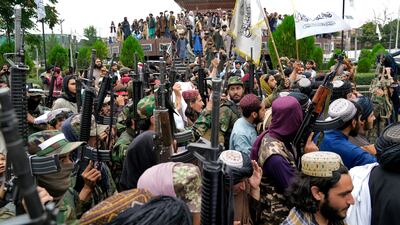
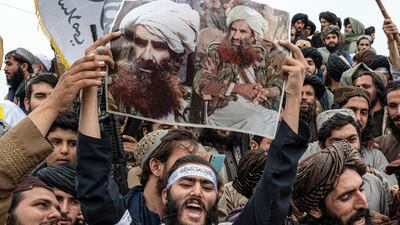
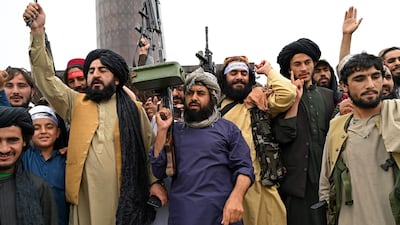
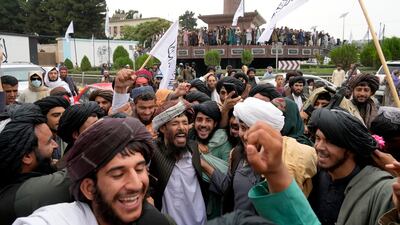
  • Taliban fighters celebrate the first anniversary of their return to power in Afghanistan, in front of the former US embassy in Kabul. AP
    Taliban fighters celebrate the first anniversary of their return to power in Afghanistan, in front of the former US embassy in Kabul. AP
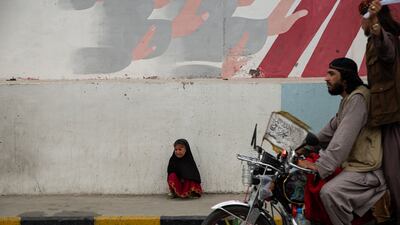
  • A girl cries on the pavement as men ride by on a motorbike, during celebrations in Kabul marking the first anniversary of Taliban's return to power. Getty
    A girl cries on the pavement as men ride by on a motorbike, during celebrations in Kabul marking the first anniversary of Taliban's return to power. Getty
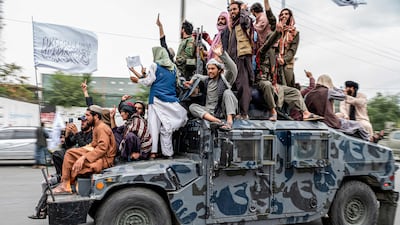
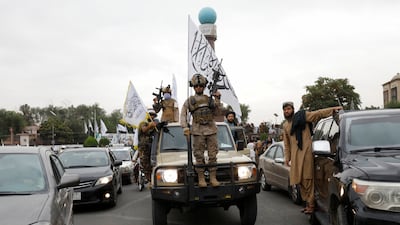
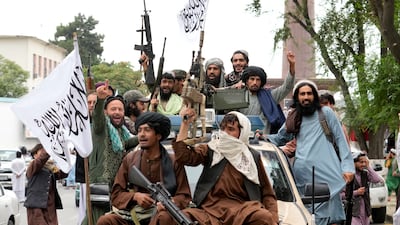
  • Taliban fighters hold weapons as they ride on a humvee in Kabul as during celebrations marking a year since their return to power in Afghanistan. AFP
    Taliban fighters hold weapons as they ride on a humvee in Kabul as during celebrations marking a year since their return to power in Afghanistan. AFP
  • On August 15, 2021, the Taliban took control of Kabul after an 11-day blitz through Afghanistan. AP
    On August 15, 2021, the Taliban took control of Kabul after an 11-day blitz through Afghanistan. AP
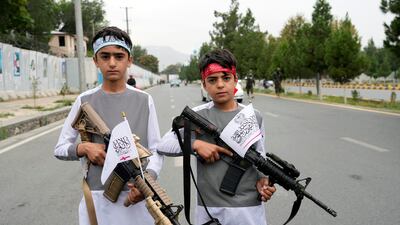
  • Afghan boys hold weapons as they join the celebrations. AP
    Afghan boys hold weapons as they join the celebrations. AP
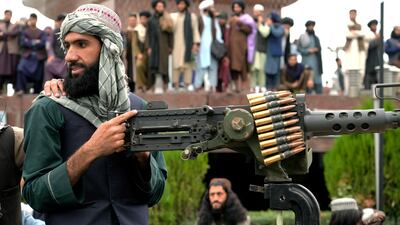
  • A Taliban fighter mans his weapon during the mass gathering in Kabul. AP
    A Taliban fighter mans his weapon during the mass gathering in Kabul. AP
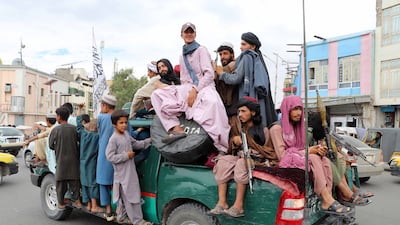
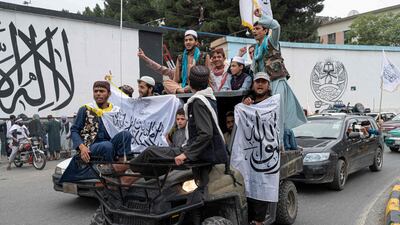
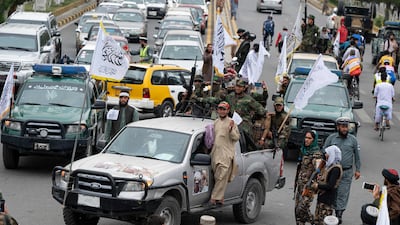
  • Taliban fighters drive in procession through the streets of the Afghan capital. Reuters
    Taliban fighters drive in procession through the streets of the Afghan capital. Reuters
  • There were also celebrations in Kandahar, the extremists' seat of power. EPA
    There were also celebrations in Kandahar, the extremists' seat of power. EPA
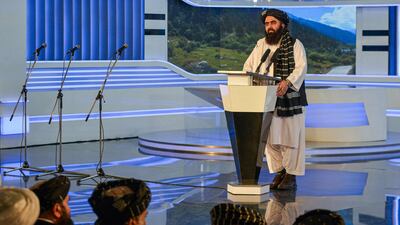
  • Foreign Minister Amir Khan Muttaqi gives a speech at an event in Kabul marking the first anniversary of the Taliban's return to power in Afghanistan. AFP
    Foreign Minister Amir Khan Muttaqi gives a speech at an event in Kabul marking the first anniversary of the Taliban's return to power in Afghanistan. AFP
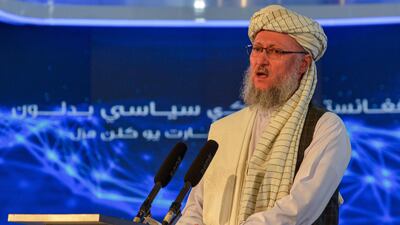
  • Deputy Prime Minister Abdul Salam Hanafi at the podium at an event in Kabul marking the first anniversary of the Taliban's return to power. AFP
    Deputy Prime Minister Abdul Salam Hanafi at the podium at an event in Kabul marking the first anniversary of the Taliban's return to power. AFP
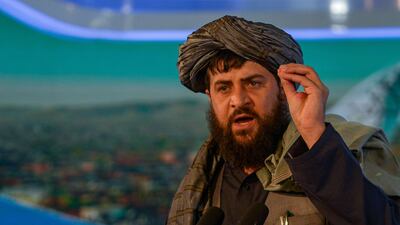
  • Acting Defence Minister Mohammad Yaqoob speaks at a gathering in Kabul to mark the first anniversary of the Taliban's return to power. AFP
    Acting Defence Minister Mohammad Yaqoob speaks at a gathering in Kabul to mark the first anniversary of the Taliban's return to power. AFP
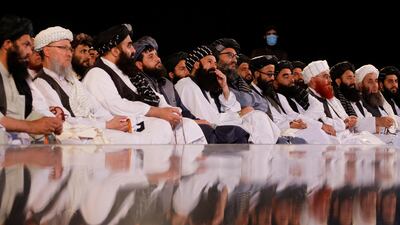
  • Taliban leaders attended an anniversary ceremony in Kabul. Reuters
    Taliban leaders attended an anniversary ceremony in Kabul. Reuters
  • Outside the US embassy, fighters chanted victory slogans. AFP
    Outside the US embassy, fighters chanted victory slogans. AFP
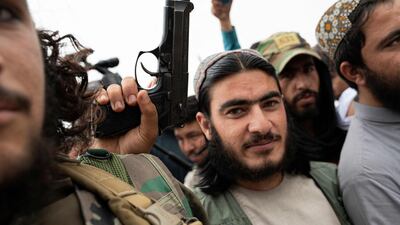
  • The fighters' show of force. AP
    The fighters' show of force. AP
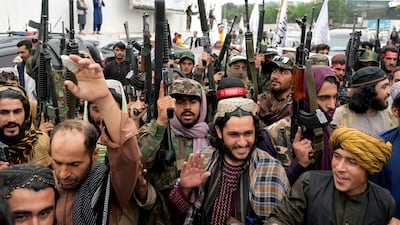
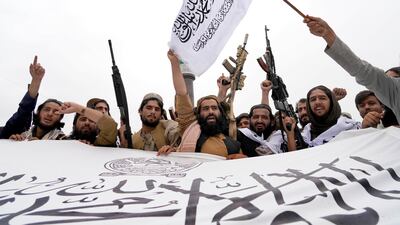
  • Taliban fighters hold rifles while chanting victory slogans at Ahmad Shah Massoud Square near the US embassy. AFP
    Taliban fighters hold rifles while chanting victory slogans at Ahmad Shah Massoud Square near the US embassy. AFP
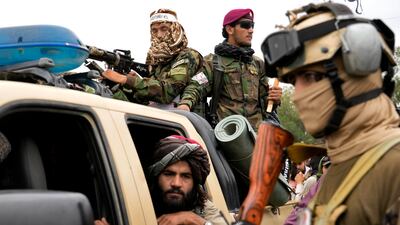
  • Taliban fighters ride in a convoy near the US embassy in Kabul. AFP
    Taliban fighters ride in a convoy near the US embassy in Kabul. AFP
  • A year ago, the country's western-backed government fled and the Afghan military crumbled in the face of the Taliban advance. AP
    A year ago, the country's western-backed government fled and the Afghan military crumbled in the face of the Taliban advance. AP
  • The chaotic withdrawal of foreign forces continued until August 31, as tens of thousands of Afghans and foreigners clamoured to board flights out of the country. AP
    The chaotic withdrawal of foreign forces continued until August 31, as tens of thousands of Afghans and foreigners clamoured to board flights out of the country. AP
  • The Taliban authorities have so far not announced any official celebrations to mark the anniversary, but state television said it would air special programmes. AP
    The Taliban authorities have so far not announced any official celebrations to mark the anniversary, but state television said it would air special programmes. AP
  • For ordinary Afghans, especially women, the return of the Taliban has increased hardships. Aid agencies say that half the country's 38 million people face extreme poverty. AFP
    For ordinary Afghans, especially women, the return of the Taliban has increased hardships. Aid agencies say that half the country's 38 million people face extreme poverty. AFP
  • Initially, the Taliban promised a softer version of their harsh interpretation of Islamist rule that characterised their first stint in power from 1996 to 2001. But many restrictions have been imposed on women. AFP
    Initially, the Taliban promised a softer version of their harsh interpretation of Islamist rule that characterised their first stint in power from 1996 to 2001. But many restrictions have been imposed on women. AFP
  • Tens of thousands of girls have been shut out of secondary schools, while women have been barred from returning to many government jobs. AFP
    Tens of thousands of girls have been shut out of secondary schools, while women have been barred from returning to many government jobs. AFP

It is true that compliance with the humanitarian principle of impartiality is difficult if the exclusion of women workers reduces outreach to female beneficiaries. But impartiality also requires humanitarians to never turn away from people they can help – regardless of gender – on the grounds of inability to reach others on gender grounds.

Back to the EU humanitarian mission I led in 1997. Mullah Omar’s Taliban leadership refused to meet us at their Kandahar headquarters because I had women on my team.

My Dutch and Swedish female colleagues offered to stand aside. Of course, I could not accept that but neither was I going to abort our precious mission to negotiate UN humanitarian access and, especially, women's healthcare provision by the World Health Organisation. The solution came in getting the Taliban to meet our gender-balanced team in UN diplomatic premises where their rule-bound logic acknowledged that “international rules” prevailed.

Today’s Taliban might be more difficult than the ones I dealt with. If so, humanitarians must find stronger creative approaches to help as many as possible of Afghanistan’s 28 million people in need of aid. These include workarounds and indirect local channelling. Although the Taliban’s gender obstacles are unique, access problems occur in all humanitarian contexts such as Syria, Tigray, Myanmar and Ukraine. By now, we have learnt many tricks of the trade.

Humanitarians are also well-practised in working with all types of regimes while crossing many red lines along the way, including previously in Afghanistan. While it is high time to take a principled stand and tackle the inconsistencies of modern humanitarianism, fighting on the Taliban-selected battleground of its women and girls will not lead to victory – even a pyrrhic one – by any side.

Neither is the vital global cause of gender equality served by symbolic gestures such as withdrawing aid and further isolating Afghanistan. If we do that, increased suffering for the people we seek to help is certain.


Rebel%20Moon%20%E2%80%93%20Part%20Two%3A%20The%20Scargiver%20review%20
%3Cp%3E%3Cstrong%3EDirector%3A%3C%2Fstrong%3E%20Zack%20Snyder%3Cbr%3E%3Cstrong%3EStarring%3A%3C%2Fstrong%3E%20Sofia%20Boutella%2C%20Charlie%20Hunnam%2C%20Ed%20Skrein%2C%20Sir%20Anthony%20Hopkins%3Cbr%3E%3Cstrong%3ERating%3A%3C%2Fstrong%3E%202%2F5%3Cbr%3E%3Cbr%3E%3C%2Fp%3E%0A

Company Profile

Company name: Yeepeey

Started: Soft launch in November, 2020

Founders: Sagar Chandiramani, Jatin Sharma and Monish Chandiramani

Based: Dubai

Industry: E-grocery

Initial investment: $150,000

Future plan: Raise $1.5m and enter Saudi Arabia next year

Four%20scenarios%20for%20Ukraine%20war
%3Cp%3E1.%20Protracted%20but%20less%20intense%20war%20(60%25%20likelihood)%3C%2Fp%3E%0A%3Cp%3E2.%20Negotiated%20end%20to%20the%20conflict%20(30%25)%3C%2Fp%3E%0A%3Cp%3E3.%20Russia%20seizes%20more%20territory%20(20%25)%3C%2Fp%3E%0A%3Cp%3E4.%20Ukraine%20pushes%20Russia%20back%20(10%25)%3C%2Fp%3E%0A%3Cp%3E%3Cem%3EForecast%20by%20Economist%20Intelligence%20Unit%3C%2Fem%3E%3C%2Fp%3E%0A
The biog

Name: Abeer Al Shahi

Emirate: Sharjah – Khor Fakkan

Education: Master’s degree in special education, preparing for a PhD in philosophy.

Favourite activities: Bungee jumping

Favourite quote: “My people and I will not settle for anything less than first place” – Sheikh Mohammed bin Rashid.

Cry Macho

Director: Clint Eastwood

Stars: Clint Eastwood, Dwight Yoakam

Rating:**

Secret Nation: The Hidden Armenians of Turkey
Avedis Hadjian, (IB Tauris)
 

UAE currency: the story behind the money in your pockets
The%C2%A0specs%20
%3Cp%3E%3Cstrong%3EEngine%3A%3C%2Fstrong%3E%204-cylinder%202.0L%20TSI%0D%3Cbr%3E%3Cstrong%3ETransmission%3A%3C%2Fstrong%3E%20Dual%20clutch%207-speed%0D%3Cbr%3E%3Cstrong%3EPower%3A%3C%2Fstrong%3E%20320HP%20%2F%20235kW%0D%3Cbr%3E%3Cstrong%3ETorque%3A%3C%2Fstrong%3E%20400Nm%0D%3Cbr%3E%3Cstrong%3EPrice%3A%20%3C%2Fstrong%3Efrom%20%2449%2C709%20%0D%3Cbr%3E%3Cstrong%3EOn%20sale%3A%3C%2Fstrong%3E%20now%3C%2Fp%3E%0A
Living in...

This article is part of a guide on where to live in the UAE. Our reporters will profile some of the country’s most desirable districts, provide an estimate of rental prices and introduce you to some of the residents who call each area home.

COMPANY%20PROFILE
%3Cp%3E%3Cstrong%3EName%3A%20%3C%2Fstrong%3ESmartCrowd%0D%3Cbr%3E%3Cstrong%3EStarted%3A%20%3C%2Fstrong%3E2018%0D%3Cbr%3E%3Cstrong%3EFounder%3A%20%3C%2Fstrong%3ESiddiq%20Farid%20and%20Musfique%20Ahmed%0D%3Cbr%3E%3Cstrong%3EBased%3A%20%3C%2Fstrong%3EDubai%0D%3Cbr%3E%3Cstrong%3ESector%3A%20%3C%2Fstrong%3EFinTech%20%2F%20PropTech%0D%3Cbr%3E%3Cstrong%3EInitial%20investment%3A%20%3C%2Fstrong%3E%24650%2C000%0D%3Cbr%3E%3Cstrong%3ECurrent%20number%20of%20staff%3A%3C%2Fstrong%3E%2035%0D%3Cbr%3E%3Cstrong%3EInvestment%20stage%3A%20%3C%2Fstrong%3ESeries%20A%0D%3Cbr%3E%3Cstrong%3EInvestors%3A%20%3C%2Fstrong%3EVarious%20institutional%20investors%20and%20notable%20angel%20investors%20(500%20MENA%2C%20Shurooq%2C%20Mada%2C%20Seedstar%2C%20Tricap)%3C%2Fp%3E%0A
In numbers: China in Dubai

The number of Chinese people living in Dubai: An estimated 200,000

Number of Chinese people in International City: Almost 50,000

Daily visitors to Dragon Mart in 2018/19: 120,000

Daily visitors to Dragon Mart in 2010: 20,000

Percentage increase in visitors in eight years: 500 per cent

Biography

Favourite Meal: Chicken Caesar salad

Hobbies: Travelling, going to the gym

Inspiration: Father, who was a captain in the UAE army

Favourite read: Rich Dad Poor Dad by Robert Kiyosaki and Sharon Lechter

Favourite film: The Founder, about the establishment of McDonald's

Updated: January 12, 2023, 5:00 AM