Divers assemble a piece of biodegradable material with several coral colonies on it. EPA


The world cannot afford to lose its coral reefs


Paul Sullivan
Paul Sullivan
  • English
  • Arabic

August 04, 2022

Coral reefs cover 1 per cent of the ocean floor, but support 25 per cent of the known marine life of the planet. They are the nurseries for much of the fish and marine life that we enjoy and consume.

One billion people rely on coral reefs for employment, income, food and protection, either directly or indirectly. Hundreds of millions of jobs are associated with reefs, such as diving, tourism and fishing. As well as being a major source of protein for many people, coral reefs are also potential sources of important medicines for arthritis, cancer and blood diseases.

They add $36 billion to world tourism income and they may add as much as $3 trillion to the world economy. Coral reefs protect land, properties and ecosystems surrounding them. As they are superb wave breaks, many coastal communities, hotel chains, industries and governments rely on them. But the world has lost 50 per cent of its reefs since 1950, and their biodiversity has dropped by 63 per cent. If this trend continues we may lose 90 per cent of them by 2050.

The greatest threats to reefs are global warming, pollution, overbuilding, overfishing and illegal fishing, population growth and the increased acidity of the ocean; 25 per cent of carbon dioxide emissions are absorbed by the ocean, making it more acidic. More than 90 per cent of increased heat as a result of climate change is absorbed by the sea.

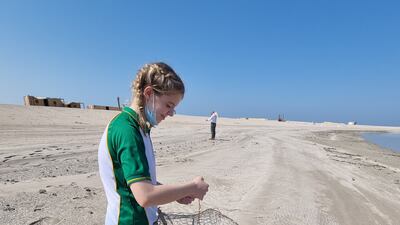
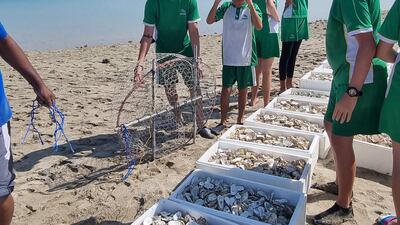
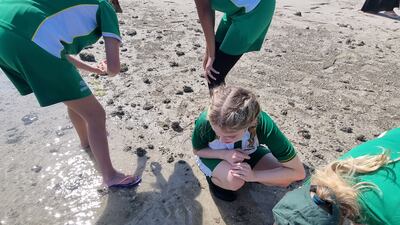
  • The shells will help to form biological building blocks to create artificial reefs. All photos: Dubai Oyster Project
    The shells will help to form biological building blocks to create artificial reefs. All photos: Dubai Oyster Project
  • Pupils from The Arbor School in Dubai have teamed up with a restaurant group for the Dubai Oyster Project.
    Pupils from The Arbor School in Dubai have teamed up with a restaurant group for the Dubai Oyster Project.
  • They are using used oyster shells from The Maine restaurants in Dubai, which are usually just thrown out and end up in landfills, to create artificial reefs.
    They are using used oyster shells from The Maine restaurants in Dubai, which are usually just thrown out and end up in landfills, to create artificial reefs.
  • They placed more than 250,000 of the used shells near the Ghantoot border.
    They placed more than 250,000 of the used shells near the Ghantoot border.
  • They used illegal fishing nets seized by authorities to help transport the shells to the water's edge.
    They used illegal fishing nets seized by authorities to help transport the shells to the water's edge.
  • The project will also help to reduce the amount of food waste.
    The project will also help to reduce the amount of food waste.

The subsequent rise in temperature and acidity cause coral bleaching and disease. The massive bleaching events in the Great Barrier Reef are horrific examples of this. Corals in the GCC have suffered a similar fate. Fortunately, some northern Red Sea corals have so far not been harmed as much by rising temperatures, but that does not mean they won’t be if the trend continues.

The population of the GCC has grown vastly, especially since the 1970s. Along with this rise in population came the growth of industry, shipping and cities. All of this has put pressure on reefs. Tourism, another sector that has seen significant expansion in the region, can be damaging to reefs.

Fortunately, laws and regulations have changed in many areas of the GCC. And ecotourism in some places is now actually becoming a means to help protect reefs.

In the years ahead, tourism as a percentage of GDP has the potential to be much more than the present 8 per cent in Oman, as much as 10 per cent for Saudi Arabia, more than 12 per cent for the UAE and almost 17 per cent for Bahrain.

Saudi Arabia has great plans for ecotourism. Neom, a vast new and futuristic city the government is investing in, will have coral reefs as part of its tourism plan. The UAE is also developing marine ecotourism. In 2021, the ecotourism sector in the GCC was worth more than $500 million, with the UAE and Saudi Arabia dominating.

The region’s fishing sector is relatively small, but its imports are huge. GCC consumers, therefore, can also help fragile reefs by using their purchasing power to move exporters to more sustainable methods of fishing.

Australia's Great Barrier Reef. Getty

In terms of official initiatives to protect marine ecosystems, Saudi Arabia is pursuing the huge investment of the Saudi Green Initiative. Vision 2030, the county’s development plan up until 2030, also has provisions for the environment, and the kingdom is currently pursuing eco-partnerships with Unesco and Monaco’s Prince Albert II Foundation, among many other international organisations. The Red Sea Development Corporation is also taking up the mantle.

For the UAE’s part, the country has been taking action: from sinking boat hulls to create artificial reefs, to outlawing sand removal and certain types of fishing that damage reefs. The country has also developed many marine protected areas and parks and has toughened up laws and regulations to protect reefs.

There is important work also being done in other parts of the GCC. Petroleum Development Oman and Sultan Qaboos University have some significant coral development projects, among many other legal, regulatory and research efforts.

Bahrain is rebuilding coral reefs ruined by the dredging of canals with the help of The Rotary Club, an international humanitarian organisation.

The G20’s Coral Research and Development Accelerator Platform, the Kuwait Convention for the Protection and Development of the Marine Environment and Coastal Areas, as well as the Regional Organisation for the Protection of the Marine Environment, based in Kuwait, are other examples of GCC multinational approaches to this important issue.

Each of these countries could benefit massively from protecting their reefs. Future ecotourism incomes could be many times what they are now, and many jobs could be created. Most of all, protecting reefs is an important responsibility for safeguarding the region’s natural heritage for future generations. Can any country afford to lose these delicate and life-sustaining places? The answer is a resounding no.

Dr Paul Sullivan is a senior non-resident fellow at the Atlantic Council

French business

France has organised a delegation of leading businesses to travel to Syria. The group was led by French shipping giant CMA CGM, which struck a 30-year contract in May with the Syrian government to develop and run Latakia port. Also present were water and waste management company Suez, defence multinational Thales, and Ellipse Group, which is currently looking into rehabilitating Syrian hospitals.

How much do leading UAE’s UK curriculum schools charge for Year 6?
  1. Nord Anglia International School (Dubai) – Dh85,032
  2. Kings School Al Barsha (Dubai) – Dh71,905
  3. Brighton College Abu Dhabi - Dh68,560
  4. Jumeirah English Speaking School (Dubai) – Dh59,728
  5. Gems Wellington International School – Dubai Branch – Dh58,488
  6. The British School Al Khubairat (Abu Dhabi) - Dh54,170
  7. Dubai English Speaking School – Dh51,269

*Annual tuition fees covering the 2024/2025 academic year

In-demand jobs and monthly salaries
  • Technology expert in robotics and automation: Dh20,000 to Dh40,000 
  • Energy engineer: Dh25,000 to Dh30,000 
  • Production engineer: Dh30,000 to Dh40,000 
  • Data-driven supply chain management professional: Dh30,000 to Dh50,000 
  • HR leader: Dh40,000 to Dh60,000 
  • Engineering leader: Dh30,000 to Dh55,000 
  • Project manager: Dh55,000 to Dh65,000 
  • Senior reservoir engineer: Dh40,000 to Dh55,000 
  • Senior drilling engineer: Dh38,000 to Dh46,000 
  • Senior process engineer: Dh28,000 to Dh38,000 
  • Senior maintenance engineer: Dh22,000 to Dh34,000 
  • Field engineer: Dh6,500 to Dh7,500
  • Field supervisor: Dh9,000 to Dh12,000
  • Field operator: Dh5,000 to Dh7,000
Countries recognising Palestine

France, UK, Canada, Australia, Portugal, Belgium, Malta, Luxembourg, San Marino and Andorra


The specs

Engine: 2.9-litre, V6 twin-turbo

Transmission: seven-speed PDK dual clutch automatic

Power: 375bhp

Torque: 520Nm

Price: Dh332,800

On sale: now

Results

Ashraf Ghani 50.64 per cent

Abdullah Abdullah 39.52 per cent

Gulbuddin Hekmatyar 3.85 per cent

Rahmatullah Nabil 1.8 per cent

Avatar: Fire and Ash

Director: James Cameron

Starring: Sam Worthington, Sigourney Weaver, Zoe Saldana

Rating: 4.5/5

Results

2.30pm: Expo 2020 Dubai – Conditions (PA) Dh80,000 (Dirt) 1,600m; Winner: Barakka, Ray Dawson (jockey), Ahmad bin Harmash (trainer)

3.05pm: Now Or Never – Maiden (TB) Dh82,500 (Turf) 1,600m; Winner: One Idea, Andrea Atzeni, Doug Watson

3.40pm: This Is Our Time – Handicap (TB) Dh82,500 (D) 1,600m; Winner: Perfect Balance, Tadhg O’Shea, Bhupat Seemar

4.15pm: Visit Expo 2020 – Handicap (TB) Dh87,500 (T) 1,600m; Winner: Kaheall, Richard Mullen, Salem bin Ghadayer

4.50pm: The World In One Place – Handicap (TB) Dh95,000 (T) 1.900m; Winner: Castlebar, Adrie de Vries, Helal Al Alawi

5.25pm: Vision – Handicap (TB) Dh95,000 (D) 1,200m; Winner: Shanty Star, Richard Mullen, Rashed Bouresly

6pm: Al Wasl Plaza – Handicap (TB) Dh95,000 (T) 1,200m; Winner: Jadwal, Dane O’Neill, Doug Watson

Tearful appearance

Chancellor Rachel Reeves set markets on edge as she appeared visibly distraught in parliament on Wednesday. 

Legislative setbacks for the government have blown a new hole in the budgetary calculations at a time when the deficit is stubbornly large and the economy is struggling to grow. 

She appeared with Keir Starmer on Thursday and the pair embraced, but he had failed to give her his backing as she cried a day earlier.

A spokesman said her upset demeanour was due to a personal matter.

Libya's Gold

UN Panel of Experts found regime secretly sold a fifth of the country's gold reserves. 

The panel’s 2017 report followed a trail to West Africa where large sums of cash and gold were hidden by Abdullah Al Senussi, Qaddafi’s former intelligence chief, in 2011.

Cases filled with cash that was said to amount to $560m in 100 dollar notes, that was kept by a group of Libyans in Ouagadougou, Burkina Faso.

A second stash was said to have been held in Accra, Ghana, inside boxes at the local offices of an international human rights organisation based in France.

Other acts on the Jazz Garden bill

Sharrie Williams
The American singer is hugely respected in blues circles due to her passionate vocals and songwriting. Born and raised in Michigan, Williams began recording and touring as a teenage gospel singer. Her career took off with the blues band The Wiseguys. Such was the acclaim of their live shows that they toured throughout Europe and in Africa. As a solo artist, Williams has also collaborated with the likes of the late Dizzy Gillespie, Van Morrison and Mavis Staples.
Lin Rountree
An accomplished smooth jazz artist who blends his chilled approach with R‘n’B. Trained at the Duke Ellington School of the Arts in Washington, DC, Rountree formed his own band in 2004. He has also recorded with the likes of Kem, Dwele and Conya Doss. He comes to Dubai on the back of his new single Pass The Groove, from his forthcoming 2018 album Stronger Still, which may follow his five previous solo albums in cracking the top 10 of the US jazz charts.
Anita Williams
Dubai-based singer Anita Williams will open the night with a set of covers and swing, jazz and blues standards that made her an in-demand singer across the emirate. The Irish singer has been performing in Dubai since 2008 at venues such as MusicHall and Voda Bar. Her Jazz Garden appearance is career highlight as she will use the event to perform the original song Big Blue Eyes, the single from her debut solo album, due for release soon.

Meg%202%3A%20The%20Trench
%3Cp%3E%3Cstrong%3EDirector%3A%20%3C%2Fstrong%3EBen%20Wheatley%3Cbr%3E%3Cstrong%3EStars%3A%20%3C%2Fstrong%3EJason%20Statham%2C%20Jing%20Wu%2C%20Cliff%20Curtis%2C%20Page%20Kennedy%2C%20Cliff%20Curtis%2C%20Melissanthi%20Mahut%20and%20Shuya%20Sophia%20Cai%3Cbr%3E%3Cstrong%3ERating%3A%20%3C%2Fstrong%3E2%2F5%3C%2Fp%3E%0A
The specs: 2018 Jaguar E-Pace First Edition

Price, base / as tested: Dh186,480 / Dh252,735

Engine: 2.0-litre four-cylinder

Power: 246hp @ 5,500rpm

Torque: 365Nm @ 1,200rpm

Transmission: Nine-speed automatic

Fuel consumption, combined: 7.7L / 100km

HWJN
%3Cp%3EDirector%3A%20Yasir%20Alyasiri%3C%2Fp%3E%0A%3Cp%3EStarring%3A%20Baraa%20Alem%2C%20Nour%20Alkhadra%2C%20Alanoud%20Saud%3C%2Fp%3E%0A%3Cp%3ERating%3A%203%2F5%3C%2Fp%3E%0A%3Cp%3E%3C%2Fp%3E%0A
The Sand Castle

Director: Matty Brown

Stars: Nadine Labaki, Ziad Bakri, Zain Al Rafeea, Riman Al Rafeea

Rating: 2.5/5

Company%C2%A0profile
%3Cp%3E%3Cstrong%3ECompany%20name%3A%20%3C%2Fstrong%3ELeap%0D%3Cbr%3E%3Cstrong%3EStarted%3A%20%3C%2Fstrong%3EMarch%202021%0D%3Cbr%3E%3Cstrong%3EFounders%3A%3C%2Fstrong%3E%20Ziad%20Toqan%20and%20Jamil%20Khammu%0D%3Cbr%3E%3Cstrong%3EBased%3A%3C%2Fstrong%3E%20Dubai%0D%3Cbr%3E%3Cstrong%3ESector%3A%20%3C%2Fstrong%3EFinTech%0D%3Cbr%3E%3Cstrong%3EInvestment%20stage%3A%20%3C%2Fstrong%3EPre-seed%0D%3Cbr%3E%3Cstrong%3EFunds%20raised%3A%3C%2Fstrong%3E%20Undisclosed%0D%3Cbr%3E%3Cstrong%3ECurrent%20number%20of%20staff%3A%20%3C%2Fstrong%3ESeven%3C%2Fp%3E%0A
The%20specs
%3Cp%3E%3Cstrong%3EPowertrain%3A%20%3C%2Fstrong%3ESingle%20electric%20motor%0D%3Cbr%3E%3Cstrong%3EPower%3A%20%3C%2Fstrong%3E201hp%0D%3Cbr%3E%3Cstrong%3ETorque%3A%20%3C%2Fstrong%3E310Nm%0D%3Cbr%3E%3Cstrong%3ETransmission%3A%20%3C%2Fstrong%3ESingle-speed%20auto%0D%3Cbr%3E%3Cstrong%3EBattery%3A%20%3C%2Fstrong%3E53kWh%20lithium-ion%20battery%20pack%20(GS%20base%20model)%3B%2070kWh%20battery%20pack%20(GF)%0D%3Cbr%3E%3Cstrong%3ETouring%20range%3A%20%3C%2Fstrong%3E350km%20(GS)%3B%20480km%20(GF)%0D%3Cbr%3E%3Cstrong%3EPrice%3A%20%3C%2Fstrong%3EFrom%20Dh129%2C900%20(GS)%3B%20Dh149%2C000%20(GF)%0D%3Cbr%3E%3Cstrong%3EOn%20sale%3A%3C%2Fstrong%3E%20Now%3C%2Fp%3E%0A
Five famous companies founded by teens

There are numerous success stories of teen businesses that were created in college dorm rooms and other modest circumstances. Below are some of the most recognisable names in the industry:

  1. Facebook: Mark Zuckerberg and his friends started Facebook when he was a 19-year-old Harvard undergraduate. 
  2. Dell: When Michael Dell was an undergraduate student at Texas University in 1984, he started upgrading computers for profit. He starting working full-time on his business when he was 19. Eventually, his company became the Dell Computer Corporation and then Dell Inc. 
  3. Subway: Fred DeLuca opened the first Subway restaurant when he was 17. In 1965, Mr DeLuca needed extra money for college, so he decided to open his own business. Peter Buck, a family friend, lent him $1,000 and together, they opened Pete’s Super Submarines. A few years later, the company was rebranded and called Subway. 
  4. Mashable: In 2005, Pete Cashmore created Mashable in Scotland when he was a teenager. The site was then a technology blog. Over the next few decades, Mr Cashmore has turned Mashable into a global media company.
  5. Oculus VR: Palmer Luckey founded Oculus VR in June 2012, when he was 19. In August that year, Oculus launched its Kickstarter campaign and raised more than $1 million in three days. Facebook bought Oculus for $2 billion two years later.
Total eligible population

About 57.5 million people
51.1 million received a jab
6.4 million have not

Where are the unvaccinated?

England 11%
Scotland 9%
Wales 10%
Northern Ireland 14% 

Updated: August 04, 2022, 9:26 AM