


On Tuesday evening, Westminster was on tenterhooks.
Two down, one more to go. Would Nadhim Zahawi follow the other two "big beasts", Rishi Sunak and Sajid Javid, out of the UK Cabinet?
The thinking among Conservative members of Parliament was that Prime Minister Boris Johnson might attempt to ride out the departure of his Chancellor and Health Secretary, but the exit of the Education Secretary would prove fatal.
It was more to do with Mr Zahawi’s steep ascent and the position he was thought to hold, as someone who had been implacably loyal to the Prime Minister throughout, becoming a regular apologist for Mr Johnson’s behaviour on the round of broadcast interviews, than his ministerial role.
In the end, he stayed, seeing off an attempt to promote Liz Truss, and moving into Mr Sunak’s seat in the Treasury.
Ever one to turn the threat of disaster into an opportunity, Mr Johnson and his cohorts were quick to seize the moment. Mr Sunak, who was resolutely opposed to tax cuts, had gone, to be replaced by someone who is in favour of lowering taxes and likes to be seen as an experienced voice of business and, therefore, more appealing to his party’s traditions (already, Mr Zahawi, with Mr Johnson’s blessing, is letting it be known he will review the proposed raising of corporation tax).
Mr Javid, who was regarded by the Johnson camp as ideologically weak, had also quit and his successor, Steve Barclay, too, is viewed as stronger, firmer, more "on message".
-

British Prime Minister Boris Johnson has succumbed to a rebellion in his ruling Conservative Party and said he would stand down as leader. Reuters -
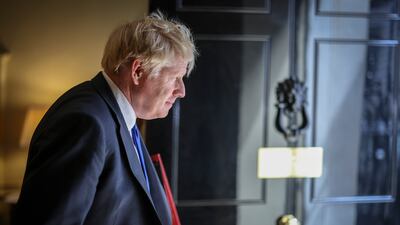
Several crises, including sleaze allegations against a Conservative MP, had increased the pressure on Mr Johnson. Tim Hammond / No 10 Downing Street -
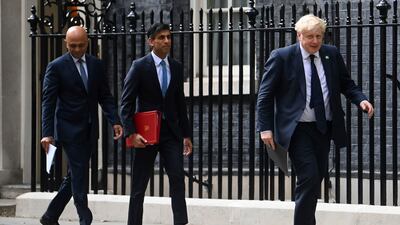
More than 50 members of his government, including health secretary Sajid Javid and chancellor of the exchequer Rishi Sunak, have quit. AP -
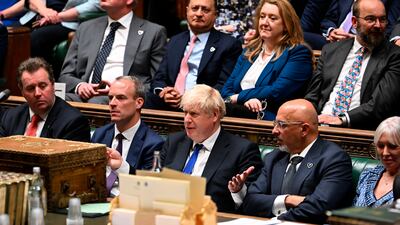
A new Conservative leader will be selected before a party conference is held in October. AP -
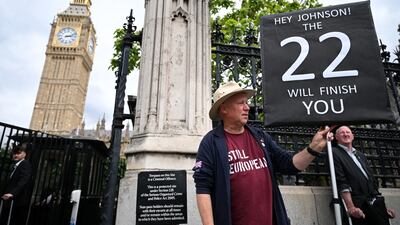
A protester outside Parliament in London. Getty -
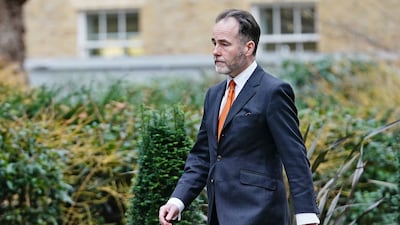
Questions are mounting over how much Mr Johnson knew about accusations of misconduct against MP Christopher Pincher. PA -
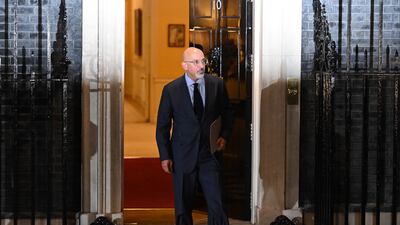
Nadhim Zahawi leaves No 10 Downing Street after being named as the new Chancellor of the Exchequer. Getty -
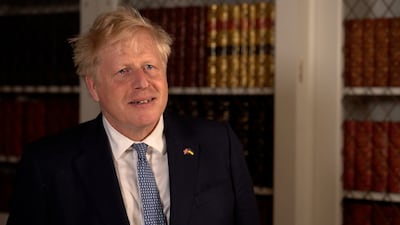
Mr Johnson survived an attempt by Tory MPs to oust him in a vote of confidence in June. PA -
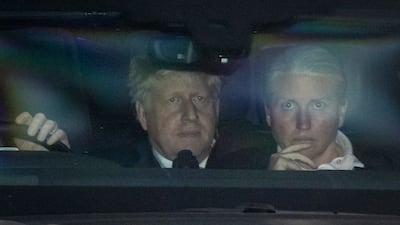
Mr Johnson leaves the Houses of Parliament after the vote. Tory MPs voted by 211 to 148 in the secret ballot in Westminster. EPA -
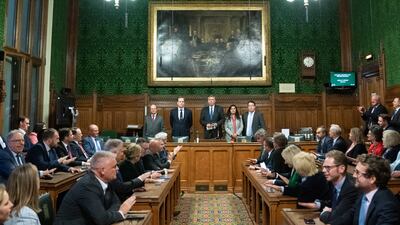
Sir Graham Brady, chairman of the 1922 Committee of Tory backbenchers, announcing the result of the vote. PA -
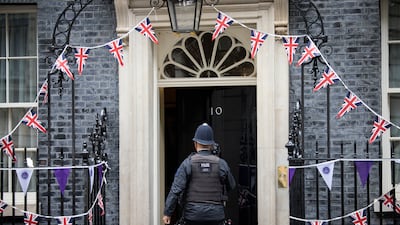
A police officer patrols Downing Street on Monday. The vote of no confidence marked the most serious challenge yet to Mr Johnson's three-year tenure as prime minister. EPA -
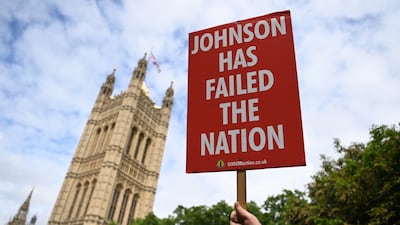
A protester holds up an anti-Boris Johnson placard outside parliament in London. EPA -
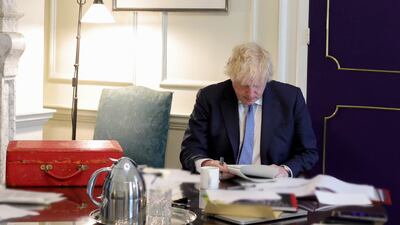
Boris Johnson reads the long-awaited report by senior civil servant Sue Gray into the Downing Street party scandal. Photo: Andrew Parsons / No 10 Downing Street -
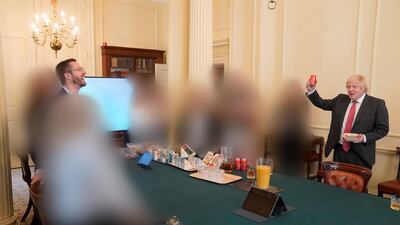
A gathering in the Cabinet Room at No 10 Downing Street on Mr Johnson's birthday. Photo: Cabinet Office -
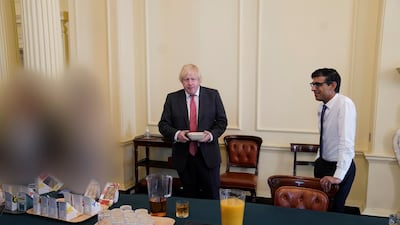
Mr Johnson during a gathering held while lockdown rules were in force across the UK. Photo: Cabinet Office -
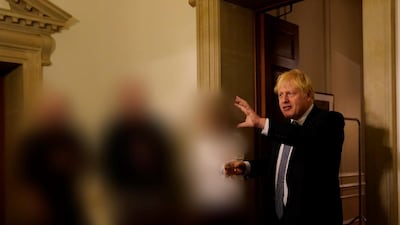
Another gathering at No 10 Downing Street to mark the departure of a special adviser. Photo: Cabinet Office -

Mr Johnson apologises to MPs in the House of Commons in April, having been fined after a police probe for attending a party during coronavirus lockdowns imposed by his own government. AFP -
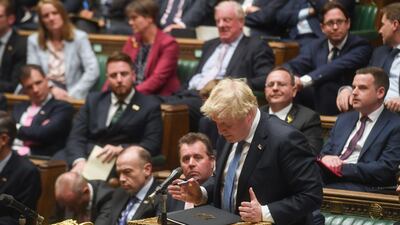
Mr Johnson was no more than 30 seconds into his speech when the first shout of 'resign' was heard from the opposition benches, followed by 'you’re an embarrassment' and 'just go'. Reuters -
'I take this opportunity on the first available sitting day to repeat my wholehearted apology to the House,' he said, admitting that 'people had a right to expect better of their prime minister'. AFP -
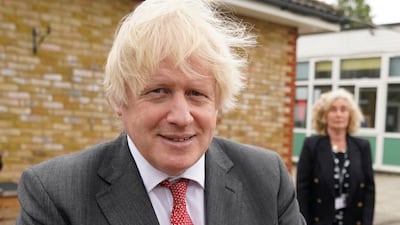
The prime minister, pictured with a birthday cake baked for him by school staff at Bovingdon Primary Academy in Hemel Hempstead, said it ‘didn't occur’ to him that a gathering on June 19, 2020 to mark his 56th birthday broke coronavirus rules. AFP -
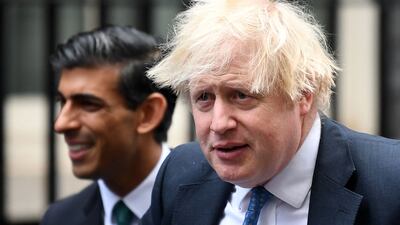
Former Chancellor Rishi Sunak, left, was also fined for attending lockdown parties held in and around Downing Street. AFP -
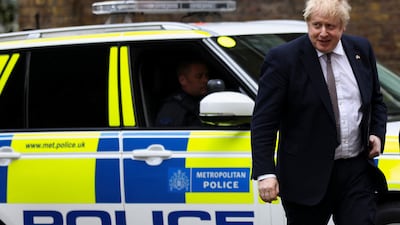
Mr Johnson is the first sitting prime minister to be censured for breaking the law, sparking calls from all sides of parliament, including some in his own party, to step down. Reuters -

A lone protester demonstrates at Downing Street in London. EPA -
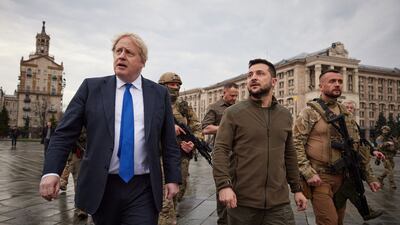
Before the war broke out in Ukraine, Mr Johnson appeared vulnerable to the Partygate controversy. He has been praised by some for his response to the conflict. AFP -
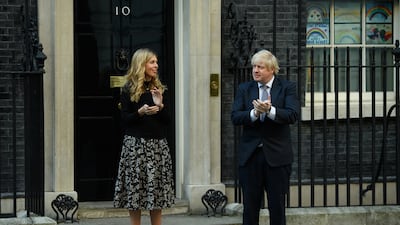
Mr Johnson and his wife Carrie applaud health workers outside No 10 Downing Street in May 2020. Getty -
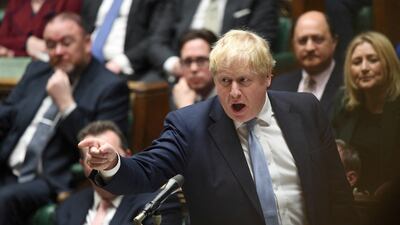
Mr Johnson makes a statement in the House of Commons in January on a report regarding the Downing Street parties during lockdown. Reuters -
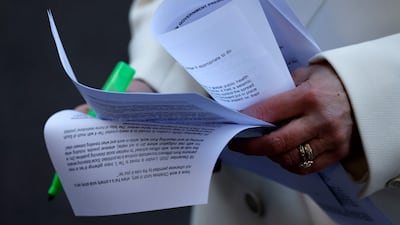
A journalist highlights sections of the Sue Gray report. AFP -
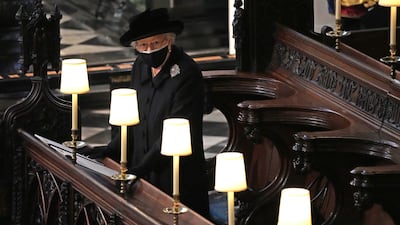
Mr Johnson is understood to have been present at six of at least 12 'partygate' events under investigation. One occurred on the eve of Prince Philip’s funeral, at which Queen Elizabeth II had to grieve away from other mourners because of social distancing protocol. Getty


In fact, what’s not to like? The pair of troublemakers in the Cabinet, who were suspected of working in tandem – a suspicion confirmed for Johnsonians by the manner of their joint leaving – are no longer in government. Now the Cabinet has a more robust, stronger look about it.
It says much about the febrile atmosphere surrounding Downing Street that such views are given credence, that every straw is there to be clutched. It also points yet again to the character of Mr Johnson, as someone who refuses to budge, who possesses the thickest of skins. Like the character of the Black Knight in Monty Python, his limbs are torn from him, yet he remains utterly defiant.
Such stoicism would be admirable, except that what Mr Johnson is accused of – and shown to have committed – is serial lying, dissembling and obfuscating. The result is a diminution of authority, a weakening of high office that trickles down, right through the public service and across society.
He is the Prime Minister and he cannot be trusted. No one knows if he is speaking the truth. That is a terrible indictment and one that has repercussions internationally. Thanks to Mr Johnson’s flaws, Britain’s standing on the global stage is becoming akin to that of the US in the era of Donald Trump. Other leaders are listening, but behind the facade they’re disbelieving and sometimes even laughing.
For a nation that has set a new course, dropping its EU partners and seeking to develop friendships elsewhere, that is a dangerous path. One made even more treacherous by the current state of the global economy. Just when the UK should wish to appear confident and command respect and attention, striking trade deals and attracting investment, all the impetus in government is devoted not to selling the country but to shoring up its leader.
Everything is about survival, so the preservation of Mr Johnson takes priority over the national interest. Over the Tory party, too. This is where he is at his weakest. His MPs put first and foremost their chances of being re-elected at the top of their watch lists. From the moment they stand victorious as the votes cast are read out, their number one aim is to keep their job.

So far on his roller-coaster ride, Mr Johnson has been able to persuade them that he is still the person with the most likelihood of delivering that objective. Private party polling has consistently revealed that while a large swathe of the public disapproves of Mr Johnson’s cavalier approach to the lockdown rules, sufficient numbers will vote for him – on the basis they retain some fondness and admiration for him, they have faith that he remains the best Tory choice for Prime Minister and they prefer him to the Labour party’s Keir Starmer.
What’s changed is that the Chris Pincher episode highlighted that despite overtures to the contrary, Mr Johnson has not made amends. He promised to reform his ways, that his administration would henceforth be founded upon honesty and integrity. The claim that he did not know there was an issue with Mr Pincher, followed by the admission that he did, put paid to that.
Worse, it suggests not only that Mr Johnson has not made amends but that he never will, that he can’t and won’t. As he said himself in a recent interview, his psychological make-up cannot be altered.
So, Tory MPs have realised they will go into the next election having to defend someone proven to be a serial peddler of falsehoods. That’s not balanced either by evidence of a resilient economy or delivery of his much-vaunted goal of “levelling up”.
The irony, then, is that it’s all to do with survival – of Mr Johnson in his bunker and the MPs in their constituencies. In their desire to go before the electorate with a standard-bearer who is credible, who will enable them to retain their seats, they will ditch Mr Johnson. He won’t concede. So, the battlelines are drawn and on the fight goes. At the same time, Britain’s government is frozen and its standing overseas continues to slip.
It is a grim state of affairs. The end might be nearer but there could still be some distance to go.


