


US President Joe Biden’s decision to send missiles to Ukraine is to help Kyiv’s war effort against Russia. But the time it has taken the White House to agree to send the weapons means there is a real danger that they could arrive too late to make a significant difference on the battlefield.
For weeks Ukrainian leaders have been calling on the West to provide heavy weapons to enable them to hold off Russia’s huge military offensive in the Donbas region. In particular, they have been asking for American-made Multiple Launch Rocket Systems (MLRS), which have a top range of almost 300 kilometres – 10 times Ukraine’s current capabilities. The MLRS are meant to help Kyiv's forces target Russian artillery, which is playing a key role in Moscow's latest offensive.
Ukraine’s appeals to the Biden administration have been coming thick and fast ever since Moscow abandoned its original offensive to seize Kyiv in favour of concentrating its military strength in the country's eastern region.
Moscow has long harboured ambitions of controlling Donbas, given its sizeable Russian-speaking population. Doing so would also enable it to establish a land corridor to the Crimean Peninsula, to Ukraine's south, which Russia occupied and annexed in 2014. To achieve this aim, Russia has mounted a deadly artillery barrage against key cities in the Donbas, with the aim of forcing their submission through constant bombardment.
-
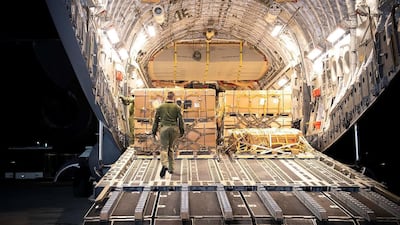
Workers unloading a Royal Canadian Air Force military transport plane to assist Ukraine at Lviv airport. AFP -
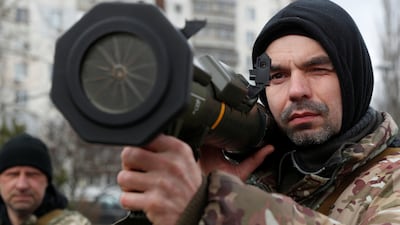
A new member of the Territorial Defence Forces trains to operate an AT4 anti-tank launcher in Kyiv. Reuters -

A plane loaded with military equipment for Ukrainian forces takes off from Albacete, Spain. EPA -
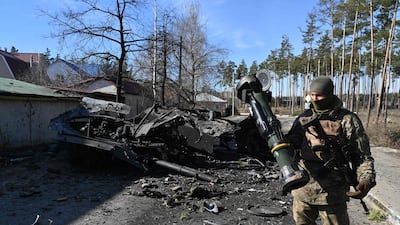
A Ukrainian soldier holds a Next Generation Light Anti-tank Weapon used to destroy a Russian armoured personal carrier in Irpin, north of Kyiv. AFP -
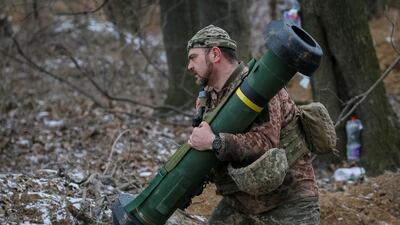
A Ukrainian serviceman with a Javelin missile system on the front line near Kyiv. Reuters -

A soldier holds a Panzerfaust 3 anti-tank rocket launcher at the Munster military training area in Germany in 2016. Getty Images -
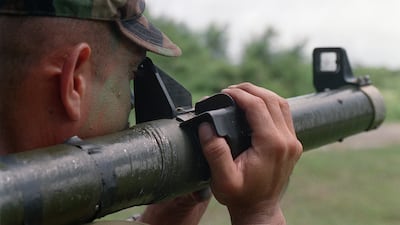
A US Marine Corps staff sergeant aims a M72 Light Anti-tank Weapon. Photo: US National Archives -

The Switchblade is a camera-equipped, remote-controlled flying bomb with a reputation for pinpoint delivery. AP Photo -

A coalition forces member fires a Carl Gustav recoilless rifle system during weapons practice on a range in Helmand province, Afghanistan, in 2013. US Army Photo -

A Starstreak surface-to-air missile system. PA


The surrender of the port city of Mariupol last month was accomplished only after Russian artillery had reduced large parts of this once thriving community to rubble. In order to prevent other territory, such as the strategically important city of Severodonetsk, from suffering a similar fate, Ukrainian commanders say they urgently need the MLRS to target Russian artillery positions and reduce their firepower.
But despite repeated requests, Mr Biden initially proved reluctant to sanction delivery of the missiles for fear of further escalating the conflict with the Kremlin. Washington expressed concern that Ukraine might use the missiles, which have a longer range than the Moscow's versions, to target positions inside Russia.
This week, Mr Biden appeared to have ruled out sending the missiles. Mr Biden sought to quash media speculation that the US was leaning towards sending the MLRS to Kyiv. “We are not going to send Ukraine rocket systems that strike into Russia,” he said. White House officials emphasised their policy of sustaining the flow of arms to Ukraine without provoking retaliation from Moscow against US forces or allies in the region.
The next day, however, Mr Biden appeared to have changed his mind when he announced that Washington would, after all, be providing Ukraine with sophisticated rocket systems, albeit ones with a more limited range. These weapons, capable of hitting targets 80km away, will be delivered now that Washington has received “assurances” from Kyiv that its forces will not target Russian territory.
Explaining his decision in a New York Times opinion piece, Mr Biden stressed his belief that the conflict would ultimately end through diplomatic means, but that the US must provide significant weapons and ammunition to give the Ukrainian government the highest leverage at the negotiating table. "That’s why I’ve decided that we will provide the Ukrainians with more advanced rocket systems and munitions that will enable them to more precisely strike key targets on the battlefield in Ukraine," he wrote.

Following Washington’s decision this week, Britain announced that it will also supply Ukraine with long-range missile systems. In a statement issued by the Foreign, Commonwealth and Development Office, officials said the British missiles, the medium-range M142 High Mobility Artillery Rocket System – commonly referred to as Himars – would allow Ukraine to hit targets around 80km away, and would provide a “significant boost in capability for the Ukrainian forces".
Ukrainian troops will be trained in the UK on how to use the launchers, and the supply of the weapons will be “co-ordinated closely” with Washington.
While Ukrainian commanders will be relieved by this development, there will also be concerns that delays in the decision-making could help Moscow. British intelligence reports, as well as other other reports from the front line, claim that Russian forces are in control of most of Severodonetsk, even though it has reportedly lost about half of its combat firepower since the conflict began 100 days ago on Friday.
The fact that the Russians, relying heavily on their superior artillery firepower, are still able to maintain their advance should alert western leaders to the fact that, when it comes to making difficult decisions about supplying Kyiv with arms, time is not a luxury they can afford.
At last month’s World Economic Forum in Davos, Ukrainian Foreign Minister Dmytro Kuleba said: “Every day of someone sitting in Washington, Berlin, Paris and other capitals, and considering whether they should or should not do something, costs us lives and territories.”

