


Two weeks into the war in Ukraine, Turkey appears to have converted its diplomatic tightrope walk into a minor coup: the combatants have accepted Ankara's long-standing offer to mediate and the Russian and Ukrainian foreign ministers are set to meet for peace talks on Thursday on the sidelines of the Antalya Diplomatic Forum.
Moscow's demands of Kyiv are said to be considerable – swearing off Nato and EU membership and rubber-stamping the handover of Crimea and the occupied regions of eastern Ukraine, for starters – so a peace deal seems unlikely for now.
But it's worth taking a closer look at how Turkey got here: for every embrace of Ukraine and its Nato allies, Ankara has also nodded in the direction of Moscow.
Turkish President Recep Tayyip Erdogan has called the Russian invasion "unacceptable", vowed to stand by Ukraine and urged Nato to take "a more decisive step". Yet, he's also stressed the importance of preserving ties with Moscow and last week approved a trade deal with Belarus, a key Russian ally.
When the Council of Europe voted to suspend Russia's membership, Turkey abstained. Then Ankara turned around and sponsored a UN motion to condemn the aggression against Ukraine.
Turkey's geopolitical two-step extends to the high seas. Under the 1936 Montreux Convention, Turkey controls maritime access to the Black Sea via the Bosporus and Dardanelles straits, and can during wartime halt nearly all traffic. Hours after Russian troops entered Ukraine, Kyiv urged Ankara to do just that.
A few days later, Turkey declared the conflict a war and vowed to block warships. In the days ahead, Ankara is likely to limit the passage of naval vessels, but, as per Montreux, it cannot bar Russian vessels coming from the Mediterranean from entering the Black Sea to return to their home bases.
Turkish-made Bayraktar TB2 drones have played a key role in Ukraine's staunch defence, keeping Russia from controlling the skies and helping slow the nearly 65-kilometre-long Russian convoy inching its way towards Kyiv. Videos of devastating Bayraktar strikes have been widely shared online and the drones are fast attaining legendary status. A lemur born in the Kyiv zoo last week and a puppy born to the Kyiv police canine unit have been named Bayraktar, and Ukraine's ground forces produced a catchy song celebrating the drones' achievements.
Back home, meanwhile, Turkey has sought to minimise their impact. "When we sold Bayraktars, we didn't know they would be used like this," Turkish billionaire Ethem Sancak, a former journalist who shares a hometown with Mr Erdogan's wife and is said to be close to the President, said last week. "We're allies with Russia."
Some pro-government pundits have lately been hewing to the Russian line, that Ukraine is run by neo-Nazis, and ramping up the anti-western rhetoric, blaming Nato for the conflict.
As recently detailed in this column, Ankara's anti-western stance is akin to Kyiv's anti-Russian stance, as these emerging democracies move to assert greater independence. But right now, criticising the West reads much like standing against Ukraine and in support of Russia.
As in 2014, when Russia annexed Crimea, Turkey has again refrained from joining western sanctions against Moscow. Yet, while this may help Ankara avoid direct punishment from Moscow, even Mr Erdogan's supporters concede that Turkey is likely to suffer economically as a result of Russia's sanctions-driven downturn.
Russia supplies one third of Turkey's tourists, 40 per cent of its natural gas and two thirds of its grain imports. It has invested $1.2 billion in Turkey's showcase Akkuyu nuclear plant, to cite just one high-profile project. On a call with Russian President Vladimir Putin on Sunday, Mr Erdogan is thought to have urged him to end the conflict.
-
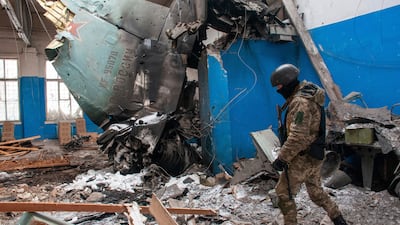
A Ukrainian serviceman walks past the vertical tail fin of a Russian Su-34 bomber lying in a damaged building in Kharkiv, Ukraine. AP Photo -
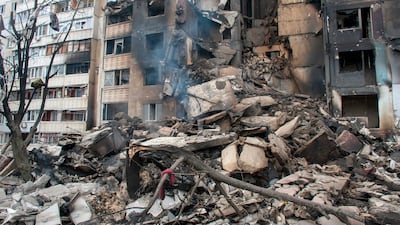
An apartment building damaged after shelling in Kharkiv, Ukraine. AP Photo -
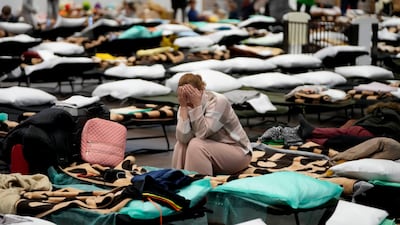
A woman puts her head in her hands as she sits on a cot in a shelter, set up for displaced persons fleeing Ukraine, inside a school gymnasium in Przemysl, Poland. AP Photo -
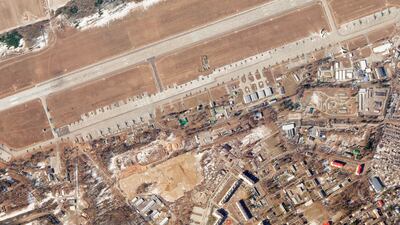
Belarussian and suspected Russian helicopters on the flight line at Machulishchy Air Base outside Minsk, Belarus. AP Photo -
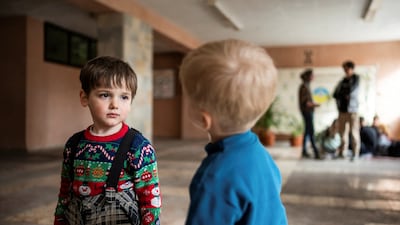
Children look on as people fleeing Russia's invasion of Ukraine shelter in a school, in Drohobych, Ukraine. Reuters -
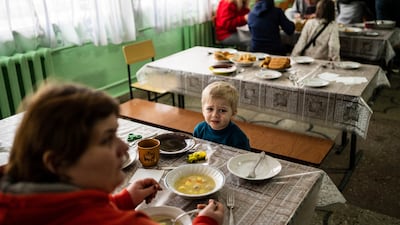
Families eat in the shelter. Reuters -
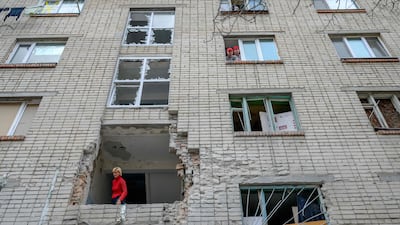
A woman looks out from a building damaged by Russian shelling in Mykolaiv, 100 kilometres away from Odesa, western Ukraine. AFP -
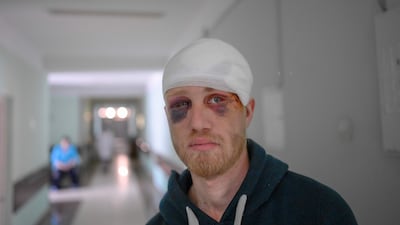
A wounded Ukrainian man waits in the corridor of the central hospital of Mykolaiv. AFP -
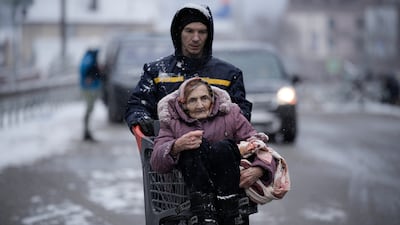
An elderly woman is carried in a shopping cart after being rescued from Irpin, on the outskirts of Kyiv, Ukraine. AP -
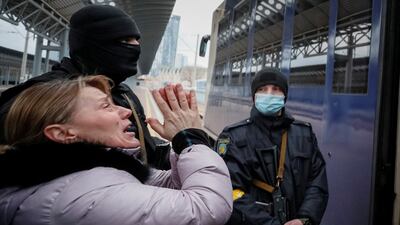
A woman reacts as a train carrying children from Kyiv's Central Children's Hospital leaves the Ukrainian capital on its way to Lviv. Reuters -
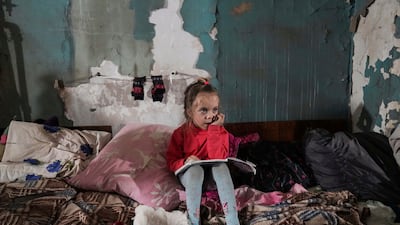
A girl sits in an improvised bomb shelter in Mariupol, Ukraine. AP -
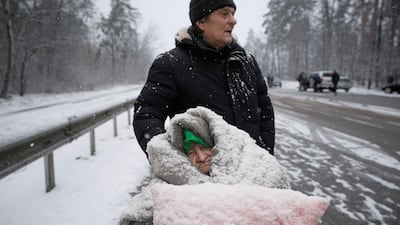
An elderly woman is coated in snow as she sits in a wheelchair after being rescued from Irpin. AP -
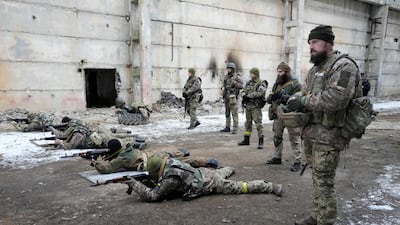
Belarusian volunteers take part in military exercises at the Belarusian Company base in Kyiv. AP -
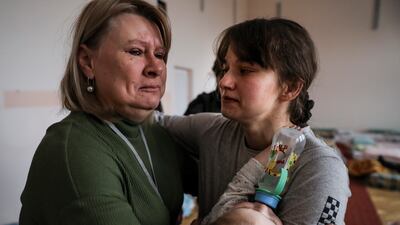
Lessa, left, director of a nursery school turned into a refugee shelter, cries as she hugs Olega, who arrived from Kyiv with her baby, near Lviv. EPA -
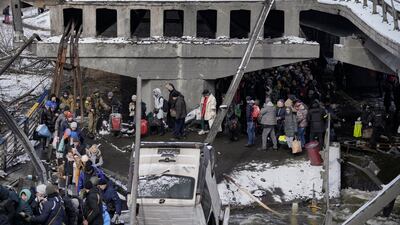
Ukrainians pass a damaged bridge as they flee from Irpin. AP -
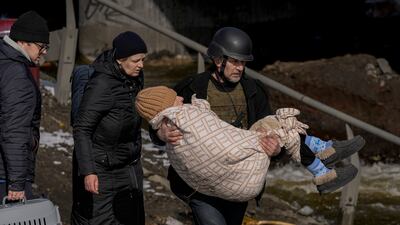
A man carries an elderly woman as people continue to leave Irpin. AP -
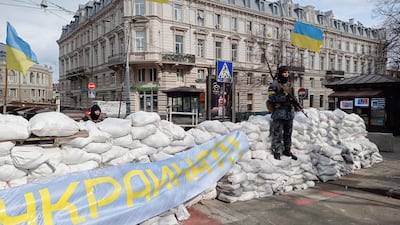
A soldier stands on a barricade made of sandbags in central Odesa, Ukraine. Reuters -
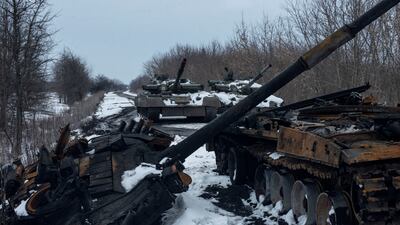
A charred Russian tank and captured tanks in the Sumy region. Reuters -
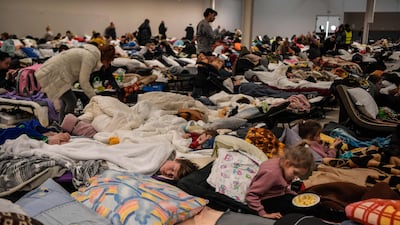
People rest at a temporary shelter for Ukrainian refugees in Przemysl, Poland. AFP -
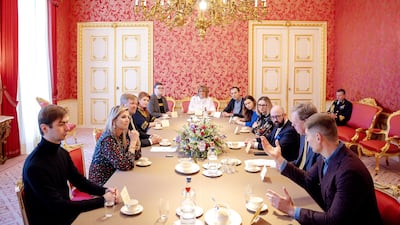
Ukraine's ambassador to the Netherlands, Maksym Kononenko, third right, and his wife Tetiana Doroshenko, fourth left, attend a meeting of members of the Ukrainian community with Dutch King Willem-Alexander, third left, and Queen Maxima, second left, to discuss the situation in Ukraine, in The Hague. EPA -
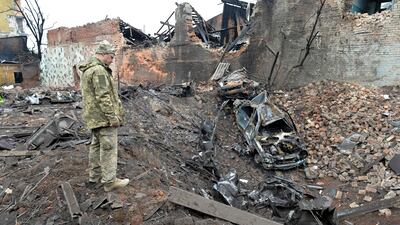
A Ukrainian soldier looks at the destruction after shelling in Ukraine's second-largest city of Kharkiv. AFP -
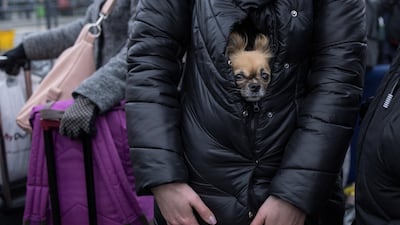
A refugee holds her dog as they wait for trains to Poland in Lviv, Ukraine. Reuters -
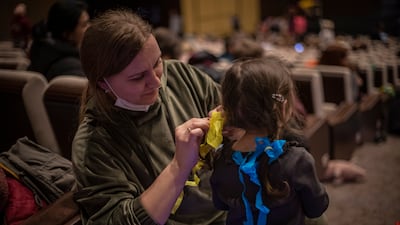
A woman ties ribbons in Ukrainian national flag colours in a girl's hair as people wait at a refugee assistance centre in Prague, Czech Republic. EPA -
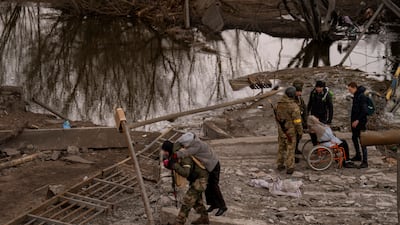
A Ukrainian soldier carries an elderly woman crossing the Irpin river on the outskirts of Kyiv. AP -
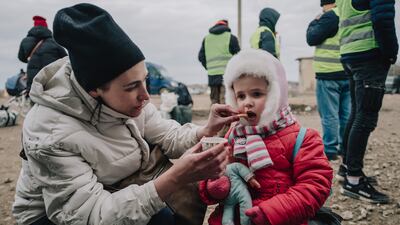
Lena, who had never left Ukraine before fleeing into Moldova, feeds Dasha, 3, soon after crossing the border. Erin Clare Brown for The National -
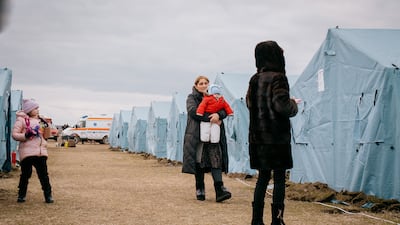
Refugees without immediate plans to move further inland can stay the night in tents set up on Moldova's side of the border. Erin Clare Brown for The National -
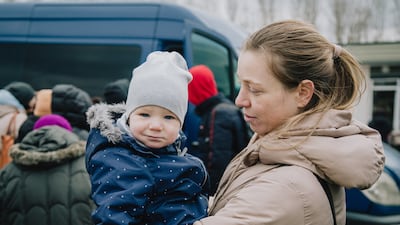
Tatiana and her son wait for a van that will carry them from the Moldovan border to Chisinau. Erin Clare Brown for The National -
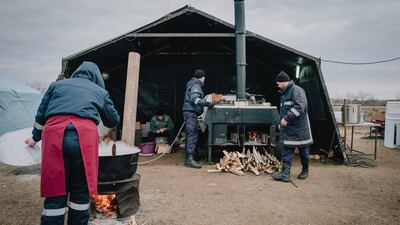
Each night, the Palanca refugee camp in Moldova feeds up to 300 people who arrive with no onward plans. Erin Clare Brown for The National -
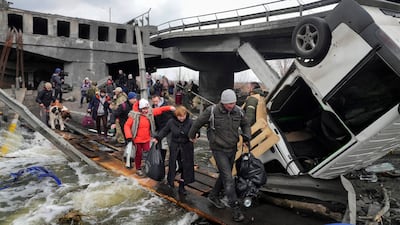
People pass a damaged bridge while fleeing the town of Irpin, close to the Ukrainian capital of Kyiv. AP -
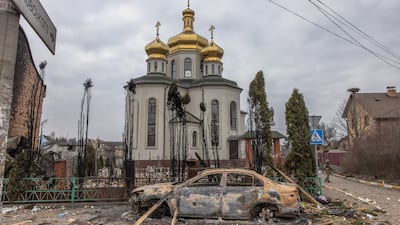
A Ukrainian soldier stands guard next to a church in Irpin. EPA -
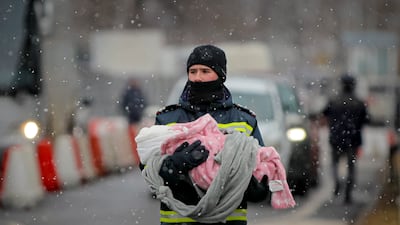
A firefighter holds the baby of a Ukrainian refugee at the border in Romania. AP -
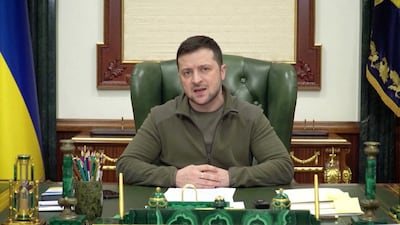
Ukrainian President Volodymyr Zelenskyy speaks in Kyiv. Reuters -
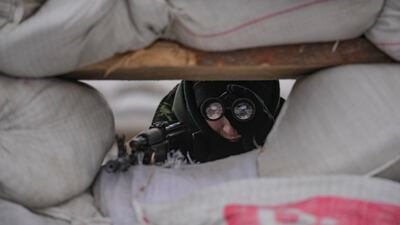
A Ukrainian soldier at a checkpoint in Kyiv. AP -
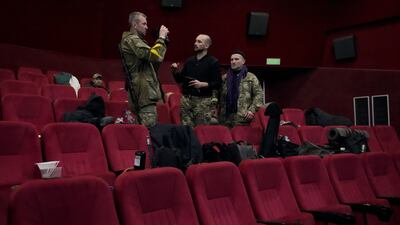
Ukrainian activist Ihor Mazur, left, a veteran of the war in the country's east, looks at a night-vision device in Kyiv. AP -
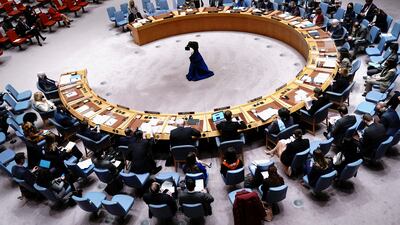
Ambassadors attend a UN Security Council meeting on threats to international security after Russia's invasion of Ukraine, in New York. Reuters -
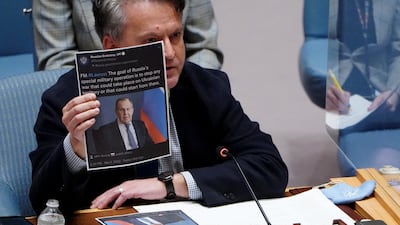
Ukraine's UN ambassador Sergey Kyslytsya holds a paper with an image of Russia's Foreign Minister Sergey Lavrov as he addresses the Security Council in New York. Reuters -
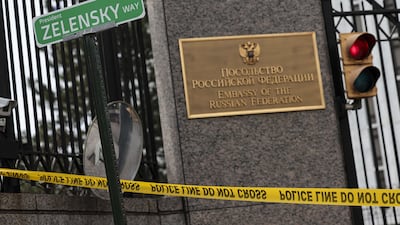
A road sign put up in support of Mr Zelenskyy outside Russia's embassy in Washington. AFP -
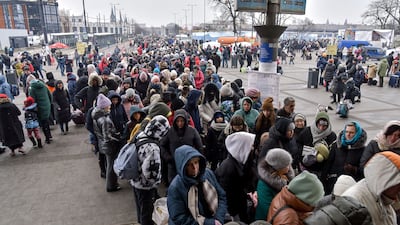
Ukrainian refugees at the train station in Lviv, western Ukraine. EPA -
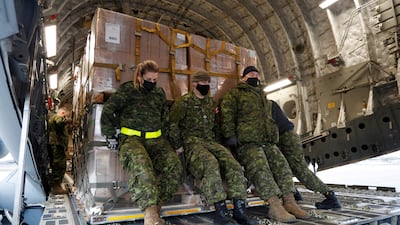
Lethal and non-lethal Ukrainian aid is loaded on to a plane bound for Poland by Canadian soldiers in Trenton, Ontario. Reuters -
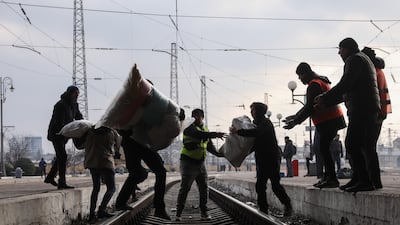
Volunteers carry medical aid and necessities at a train station in Lviv. EPA -
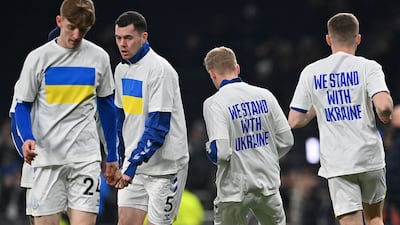
Everton players wear T-shirts in support of Ukraine as they warm up for an English Premier League football match against Tottenham Hotspur. AP -
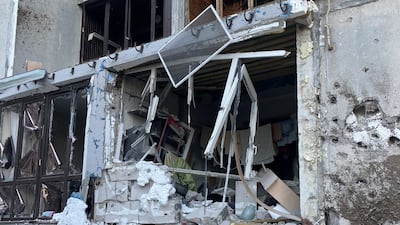
A residential building damaged by Russian shelling in Chernihiv, Ukraine. Reuters -
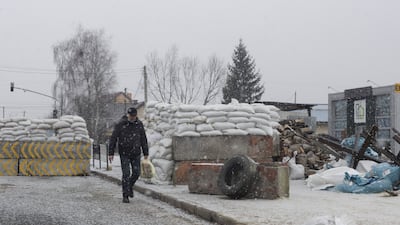
A man walks past a checkpoint in heavy snow in Lviv. Getty -
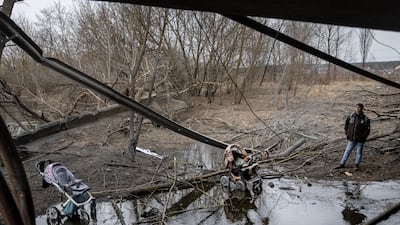
A man fleeing fighting in Irpin waits to cross a river after Russian forces entered the city. Getty -
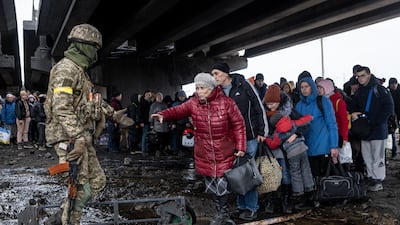
Soldiers assist Irpin residents underneath a damaged bridge as they flee. Getty -
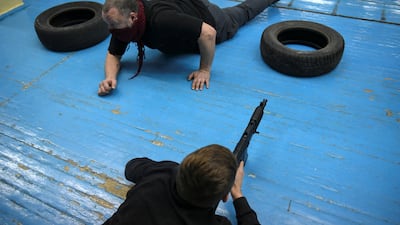
Ukrainian civilians who volunteered to join the Territorial Defence Forces take part in a training exercise in Odesa after Russia's invasion. Reuters -
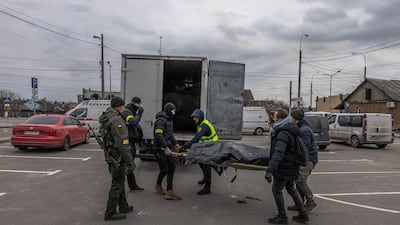
Men carry a body to a lorry as people flee from the frontline town of Irpin. EPA -
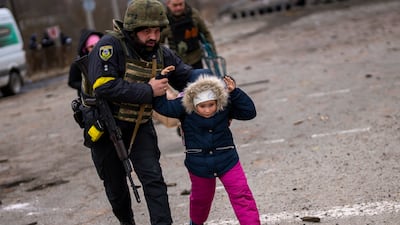
A Ukrainian police officer runs with a child as the sound of shelling echoes nearby in Irpin. AP -
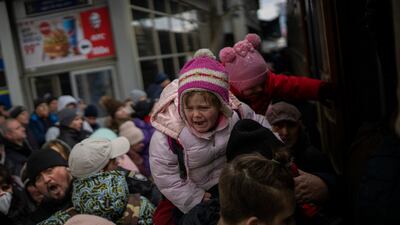
Parents and children struggle to board a train in Lviv. AP


Everyday a broader conflagration seems more likely. Several foreign-listed ships – Estonian, Bangladeshi, Panamanian, Moldovan and Turkish – have already been struck by Russian defences along Ukraine's Black Sea coast.
The US has moved the USS Truman aircraft carrier into the northern Aegean, just south of the Dardanelles, and the US and Poland are said to be in talks to deliver F-16 fighter jets to Ukraine, which would require Congressional approval.
On the weekend, Mr Putin said western sanctions on Russia were essentially a declaration of war. If the Russian economy craters and the pressure builds, deeper western involvement may be inevitable. World wars have started over less.
Already the conflict has accomplished the near-impossible and unified Europe. About 20 countries are sending weapons to Ukraine, including stingers from Germany, machine guns from the Czechs, rocket launchers from the Dutch and javelin missiles from Estonia.
But none of those countries recently bought advanced missile systems from Moscow or inaugurated a major pipeline carrying Russian gas. Germany notably cancelled Nord Stream 2, which has since declared bankruptcy, and made the stunning move of allocating an additional $100bn to defence.
Turkey remains on an island of its own making. It has some company – Armenia, India, and Israel have all been similarly non-committal. But none of them is as geographically and economically close to both combatants, or a Nato member. "It isn't possible to abandon Russia or Ukraine," the Turkish leader said last week. "Our challenge is to proceed so that we can resolve this matter without abandoning either of them."
Mr Erdogan, who is set to welcome Israeli President Isaac Herzog on Wednesday and Greek Prime Minister Kyriakos Mitsotakis on Saturday, has always said he wanted an independent foreign policy. Well, he has got his wish. For the moment it seems a good stance domestically, as eight out of 10 Turks prefer that their country remain neutral in this conflict, according to a new survey by Aksoy Research.
But if Thursday's peace talks fail and the war drags on and escalates, drawing in western powers, there will be no room for strategic ambiguity. One can only hope that the Turkish leader chooses wisely – or even better, never needs to choose at all.

