

It seems to some Americans that Russia played a game of "chicken" with the West and, because it was the only one on the road, it appears to have won. This prompts the question as to whether it would have been a different story had Nato sent troops into Ukraine, thereby making it clear that any threat to that country's sovereignty would not be tolerated. One could argue that it wasn't necessary for Ukraine to be a member of Nato, just that it was threatened and needed to be defended.
Moscow, many will have surmised, read the West's hesitation to respond, beyond words and now sanctions, as weakness. The words mean nothing, and Russia has been able to withstand sanctions before. What Russia may not have been able to face down was a direct challenge to its military. As it is, Russia has been able to send troops into Ukraine without any meaningful challenge from western nations.
In fact, throughout the past several weeks, as the conflict was brewing, American political leaders and commentators were busy arguing over what the appropriate US response should be to Russia's threat to Ukraine's sovereignty. Instead of the expected and years-long "Republican hawks versus Democratic doves" compartmentalisation, debates raged within both parties and focused on a number of important but still somewhat-peripheral matters – not on the issues at stake.
Former president Donald Trump praised Vladimir Putin, the Russian leader, as a genius and a savvy operator, with many Republicans in his camp arguing, as one did: "Why should we defend Ukrainians? Would they fight to defend us?"
Some of Mr Trump's acolytes in the US Congress, ignoring their leader's praise for Mr Putin, incongruously argued: "If Trump were president, Putin wouldn't have dared do this."
Fearful of alienating what is now called "the Trump base", more mainstream Republicans tried to make do with criticising President Joe Biden's weakness without offering an alternative.
Most mainstream Democrats, meanwhile, lined up behind Mr Biden's hesitancy to commit military forces and the fallback position of sanctions on key Russian oligarchs and institutions. Some liberal Democrats and a few conservative Republicans focused their attention on a demand that Mr Biden seek congressional approval before committing troops to defend Ukraine. More "left-leaning" Democrats engaged in a perverse type of self-flagellation, arguing, in effect: "How dare we say or do anything against what Russia is doing, given our history of violating international law and invading sovereign countries?"
-

Damage after the shelling of buildings in central Kharkiv, Ukraine. EPA -
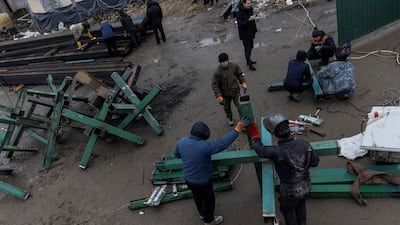
Workers from a local construction company weld anti-tank obstacles to be placed on roads around Kyiv as Russia's invasion of Ukraine continues. Reuters -
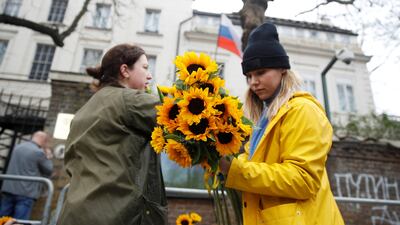
Anti-war protesters attach sunflowers to barriers in front of the Russian embassy. Reuters -
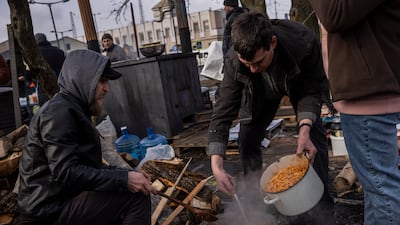
Ukrainian volunteers prepare food for displaced people outside Lviv railway station in western Ukraine. AP -
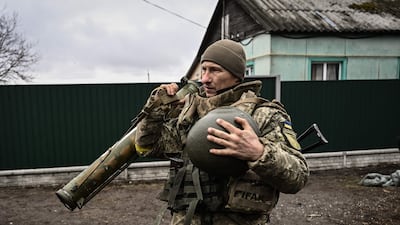
A Ukrainian soldier holds an anti-tank launcher north-east of Kyiv. AFP -
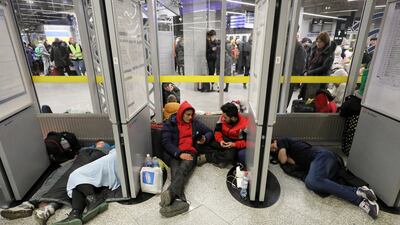
Ukrainian refugees rest at Warsaw East train station in Poland. EPA -
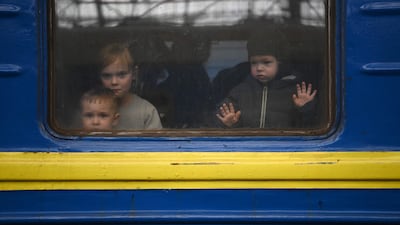
Children look out from a carriage window as a train prepares to depart from a station in Lviv to the town of Uzhhorod near the border with Slovakia. AFP -
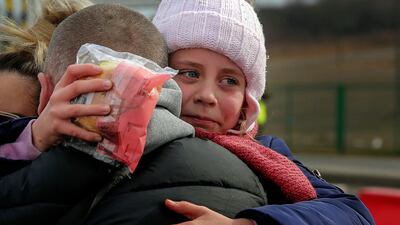
A girl who fled Ukraine is reunited with her father in Medyka, south-eastern Poland. AP Photo -
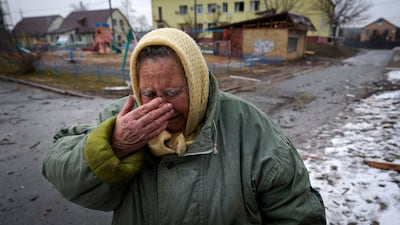
Tears outside a house damaged by a Russian airstrike in Gorenka, on the outskirts of Kyiv. AP Photo -
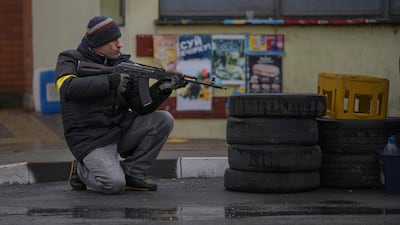
A civil defence member is poised to shoot as a vehicle approaches a checkpoint in Gorenka. AP Photo -

A Ukrainian civil defence member in the garden of a house damaged by a Russian airstrike. AP Photo -

Members of the US Army 3rd Infantry Division board a plane bound for Germany in Savannah, Georgia. EPA -
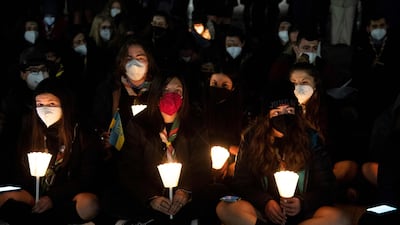
Prayers for peace in Ukraine at the Vatican's Saint Peter's Square. AFP -
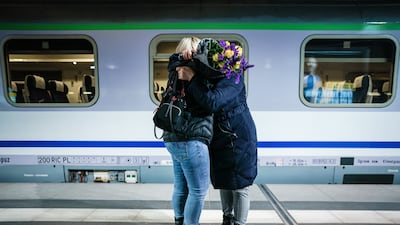
A woman (right) hugs an arriving passenger from a train carrying refugees at Berlin's central station. EPA -

Firefighters battle a blaze in a Kharkiv police building hit by shelling. AFP -
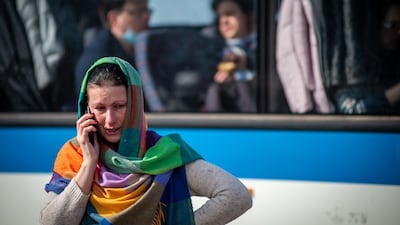
A Ukrainian woman makes a phone call after crossing the Slovakian border. AFP -

A doctor takes shelter in the basement of a Kyiv perinatal centre. Reuters -

Debris which locals say was caused by shelling in separatist-controlled Horlivka, Donetsk. Reuters -
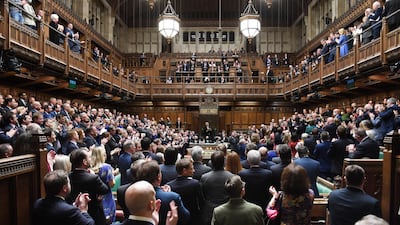
MPs in London give a standing ovation to Ukraine ambassador Vadym Prystaiko, who was in the public gallery. AP -
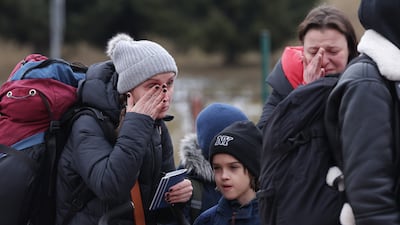
Distraught women and children fleeing Ukraine wait to enter Poland at the Korczowa crossing. Getty -
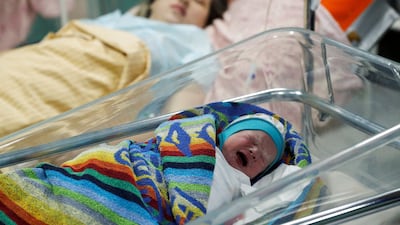
Newborn Ivan lies next to his mother as they shelter in the basement of a Kyiv perinatal centre. Reuters -
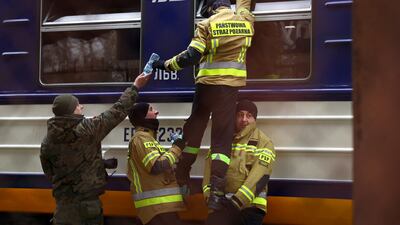
Firefighters hand water to people in a Ukrainian train full of refugees in Przemysl, Poland. Reuters -
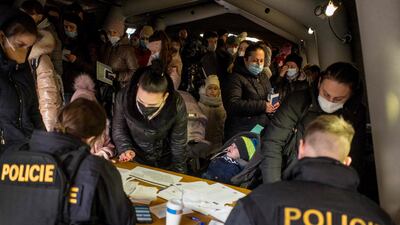
Ukrainian refugees queue to file for residency permits at Prague's police headquarters. AFP -
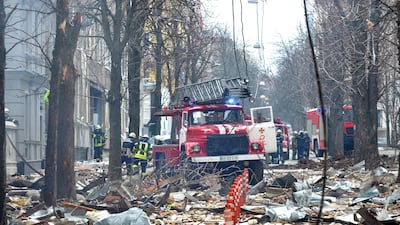
Firefighters work to contain a blaze in buildings housing the Kharkiv regional police department. AFP -
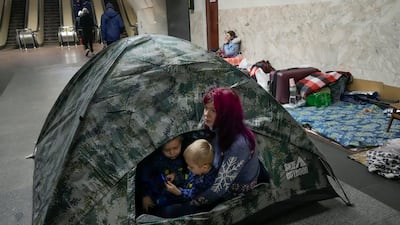
A woman and her children sit in a tent in the Kyiv subway, using it as a bomb shelter. AP -
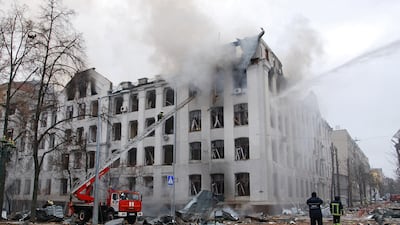
Firefighters work to extinguish a blaze at the Kharkiv National University building, which city officials said was damaged by Russian shelling. Reuters -
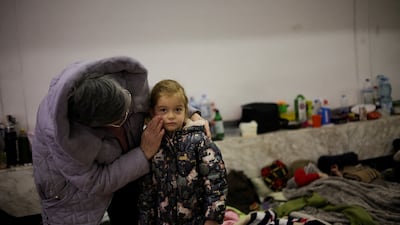
An elderly woman comforts a child as they take shelter inside an underground station in Kyiv. Reuters -
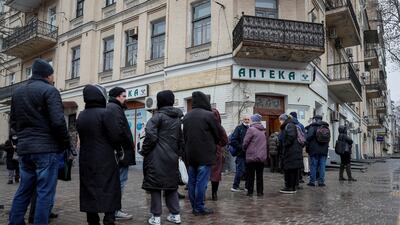
People queue at a pharmacy in central Kyiv. Reuters -
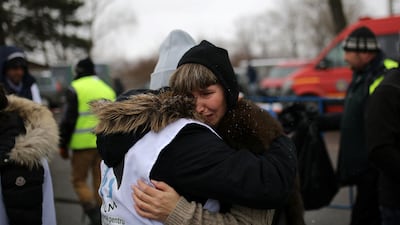
A woman is consoled by a volunteer after fleeing from Russia's invasion of Ukraine, at the border crossing in Siret, Romania. Reuters -

A Ukrainian civilian in the city of Zhytomyr practises throwing petrol bombs. Reuters -
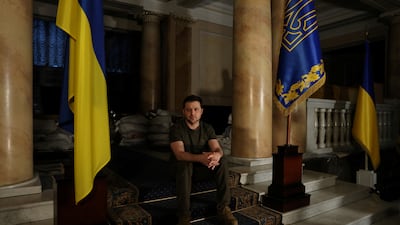
Ukrainian President Volodymyr Zelenskyy poses after an interview with Reuters in Kyiv. Reuters -
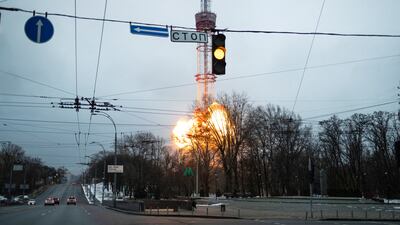
A blast is seen at Kyiv's TV tower. Reuters -
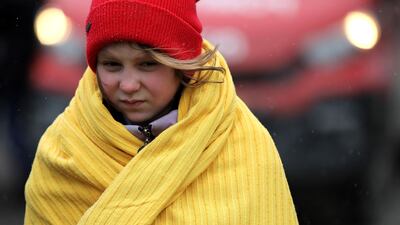
A girl in Siret, Romania, covers herself with a blanket after fleeing from Ukraine. Reuters -
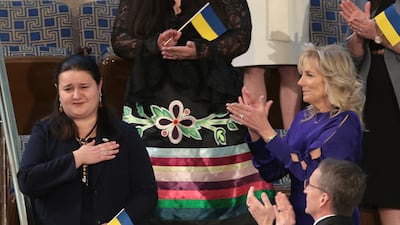
Ukraine's ambassador to the US, Oksana Markarova, acknowledges applause from US first lady Jill Biden as they attend President Joe Biden's first State of the Union address in Washington. AFP -
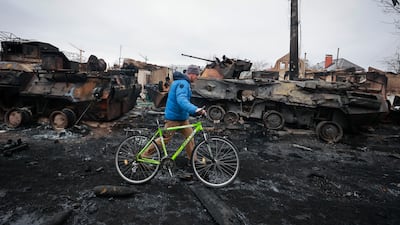
A man walks past the remains of Russian military vehicles in Bucha, close to Kyiv. AFP -
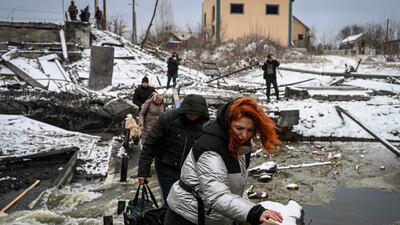
Civilians cross a river on a blown-up bridge on Kyiv's northern front. Defending the capital is a 'key priority', Ukraine's president has said. AFP -
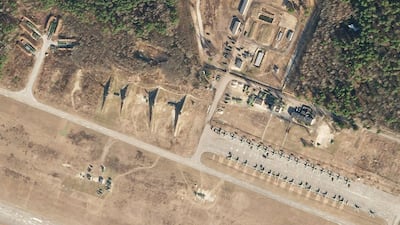
Russian aircraft on the ground at Luninets Airbase, Belarus, about 50 kilometres north of the Ukrainian border. AFP -
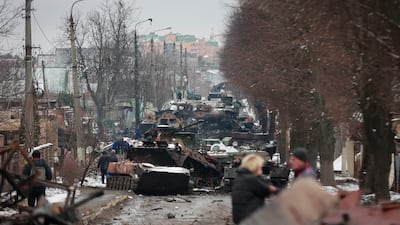
People look at the gutted remains of Russian military vehicles on a road in the town of Bucha. AP -
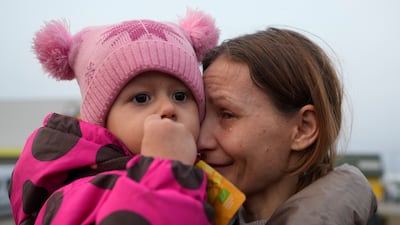
A woman with a child who fled from the war in Ukraine reunite with their family after crossing the border in Medyka, Poland. AP -
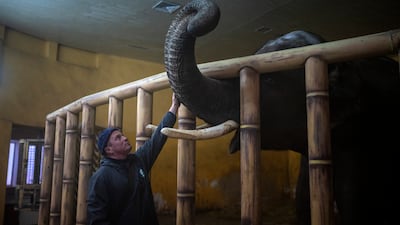
Animal keeper Kirilo Trantin comforts an elephant at Kyiv Zoo. AP -
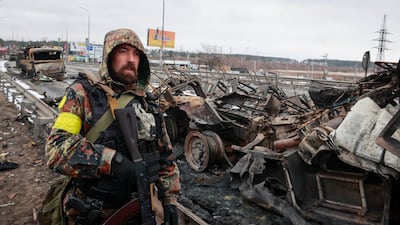
An armed man stands by the remains of a Russian military vehicle in Bucha. AP -
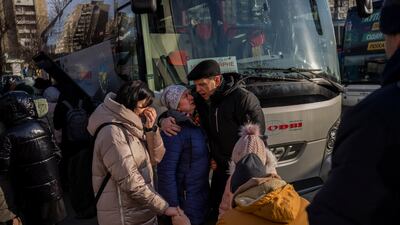
Ukrainian families say goodbye as they prepare to board a bus to Poland at Lviv, western Ukraine. AP -
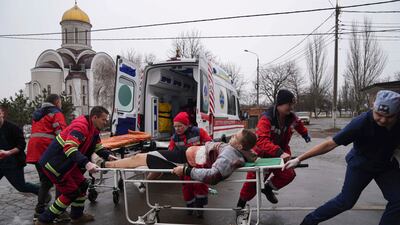
Paramedics move a man who was wounded by shelling in a residential area of Mariupol, south-eastern Ukraine. AP -
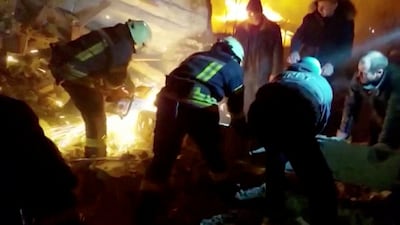
Rescuers work at the site of a Russian strike in Zhytomyr. Reuters -
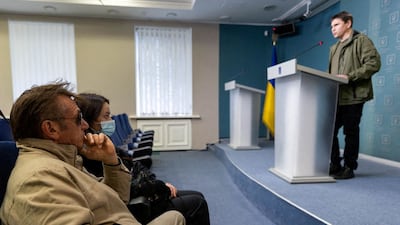
US actor and director Sean Penn attends a press briefing at the Presidential Office in Kyiv. Reuters -
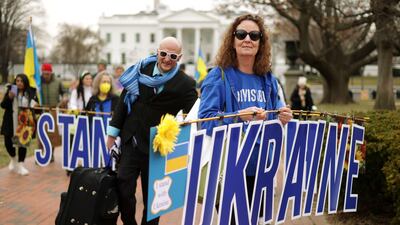
Demonstrators participate in a protest against Russia’s invasion of Ukraine at Lafayette Square in Washington. AFP -
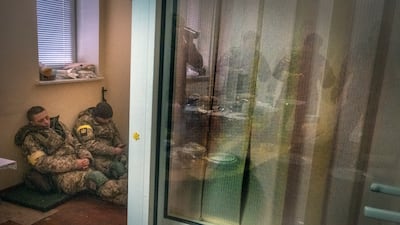
Ukrainian soldiers rest while others eat near the front line with Russian troops in northern Kyiv. AP -
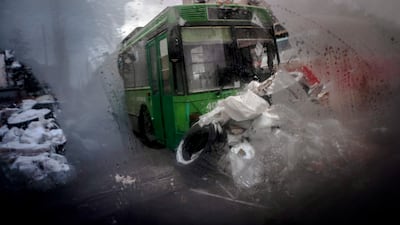
A barricade made of trams, buses and sand bags is seen through the window of car in the northern part of Kyiv. AP -
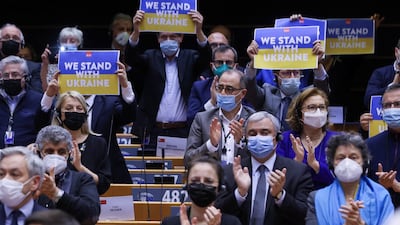
Members of the European Parliament applaud after Ukrainian President Volodymyr Zelenskyy's speech at a special session to debate its response to the Russian invasion of Ukraine. Reuters -
Ambassadors and diplomats walk out as Russia's Foreign Minister Sergey Lavrov (on screen) speaks during a recorded message at the 49th session of the UN Human Rights Council in Geneva. EPA


While all this talk passing for a serious policy debate continues, there are several deeply troubling aspects of the Ukraine conflict that are receiving short shrift.
First and foremost among them is the past, present and future of the Ukrainian people. The policy debate ignores them. Instead, the conflict is framed as either a "Russia versus Nato" rivalry, or a "Putin versus Biden" game of one-upmanship.
The Ukrainian-American community numbers more than 1.5 million. They are proud of their country, their heritage and culture, and their independence. And they are fearful of the consequences of the war and Moscow's version of Ukraine's history, which many western historians note is infused with some mythology. Certain chapters in their history are, in fact, tragic and continue to be a source of national trauma, including the 1930s Soviet government-imposed Holodomor, or forced starvation, and the Great Terror that took the lives of millions. Little of this finds its way into policy discussions.
What is also overlooked in much of these discussions is how the world got to this point, just three decades after the end of the Cold War. Back then, America appeared victorious over the Soviet Union and policymakers and pundits proclaimed the beginning of a "new world order", with the US as the world's sole superpower.

When Iraq's Saddam Hussein invaded and occupied Kuwait, then US president George HW Bush played by the rules seeking UN support to liberate Kuwait. He then spent months building an international coalition to free that country. Succeeding US administrations, without exception, have been less respectful of the international order – the most significant example being the administration led by Bush's son, George W Bush, which oversaw the US's 2003 invasion of Iraq and the occupation of that country for a number of years.
Not only did the Iraq war weaken the US militarily, making Americans wary and weary of more foreign interventions, it also damaged American prestige, weakening relations with other countries. More far-reaching was the impact American behaviour had on the "world order". The US’s reduced capacity and its hubris resulted in ushering in a multi-polar world in which other global and regional powers began to act unilaterally to project their power where they felt their interests required it and where they could get away with it. Gone was the "new world order" and diminished was the role of the UN and international rule of law. Post Iraq, all this was replaced by the law of the jungle.
Finding fault with the past behaviour of the US – which contributed to the unravelling of the rule of law – in no way places liberals on the side of the "left isolationists". America's past sins do not absolve it from facing current responsibilities. The Ukrainian people deserve more than prayers and guilty abstention. The better course of action would be to admit past faults, commit to re-establish respect for the rule of law and act to correct the damage being done here and now to a country and people who deserve more than being pawns in a "game of nations".

