Dr Justin Thomas is a chartered health psychologist with the British Psychological Society, the author of 'Psychological Well-being in the Gulf States' and a columnist for The National
January 09, 2022
Since January 1, the UAE's public sector has had a new working week, with much of the rest of the country expected to follow suit. The new schedule is Monday to Thursday with a half-day on Friday. This will bring a new weekend and a shorter working week for many people.
It is not the first time the weekend has had a makeover. Back in 2006, when I first arrived in the UAE, it shifted from Thursday-Friday, to Friday-Saturday. Far more radical changes have occurred at other times and in other places. For example, in France, shortly after the 1789 revolution, a 10-day week was introduced with a one-day weekend (decadi). Fortunately, this revolutionary calendar with its nine-day working week never caught on.
Whichever way we choose to slice time, the days of the week become more than just names or numbers on a calendar. Each day has its own meaning; this can be a personal association or one the broader community shares. For example, as a child I detested Sundays. It was the last day of the weekend; it symbolised the end of fun, the end of good TV. It meant early to bed and school the next day. I was never a huge fan of Monday either. In fact, everyone I knew hated Mondays, a sentiment immortalised by the Irish pop group, The Boomtown Rats, in their 1979 hit song I don't like Mondays.
In the UK, dislike of Mondays was further implanted in the popular imagination by the bogus idea of "Blue Monday". Its origins are tied to a winter-sun promotional campaign by an unscrupulous travel company. Blue Monday is claimed to be the unhappiest day of the year, falling on the last Monday of the last full week of January, supposedly a good time to get away.
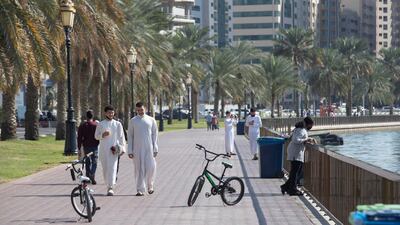
People take a walk on the Buhaira Corniche in Sharjah on Friday as the emirate ushered in its first three-day weekend. All photos: Antonie Robertson / The National
A man tries to fly a colourful kite on the Buhaira Corniche.
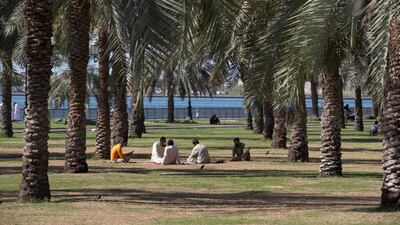
People relaxing on the first day of the weekend. Government employees in the emirate now have a three-day weekend; Friday, Saturday and Sunday.
Many took advantage of the long weekend and good weather to enjoy the outdoors.
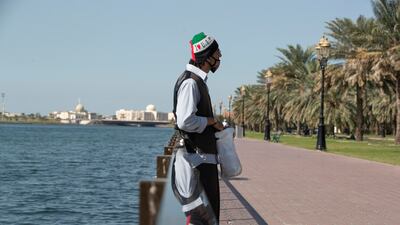
A man relaxes on the Buhaira Corniche.
Some decided to spend their time fishing on Friday.
A man takes a short nap on the Buhaira Corniche.
Unhappy Mondays are a feature of life in the UAE, too, at least for some people. A few years ago, I worked with talented data scientist Dr Amna Al Shehhi on a study we published in the journal Big Data in 2019. Our study used an algorithm known as "hedonometer 2.0", designed to measure "happiness" or, more accurately, expressions of positive sentiment. Our data set included over 17 million tweets by residents of the UAE between 2013 and 2017. When looking at Arabic tweets, Sunday was the most miserable day of the week. However, Monday was the least happy when analysing the English tweets. We suspect many English-speaking Twitter users brought their historic dislike of Mondays to the UAE. Friday was the happiest day in both languages.
Beyond pleasant and unpleasant feelings, Monday also shows up as a particularly deadly day of the week in many nations. Data from the US Centres for Disease Control and Prevention (CDC) shows a spike in heart-attack deaths on Mondays. An international review study published in the European Journal of Epidemiology concurs. After reviewing 27 previous studies, the authors concluded that: "The incidence of sudden cardiac death is markedly increased on Monday, similar for men and women, and for individuals below and above 65 years of age." One possible contributor to the Monday increase in cardiac deaths is the work-leisure cycle. Activities such as weekend binge drinking and even watching football matches are cited as possible precursors or precipitating triggers to Monday cardiac events.
A similar pattern of mortality emerges when we look at the data for suicide. A study published in the Journal of Affective Disorders in 2016examined England's suicide data over 15 years. The study identified Monday as the day of the week people most frequently took their lives. This finding has been explained as the "new beginning" hypothesis, the idea that people are more likely to become suicidal at the transition into a new time period: the start of a new week, the beginning of a new year. Almost like a line in the sand: "if things haven't improved by next week, they never will."
Understanding the association between disease, days of the week and even emotional distress can be helpful. For example, we can use such information to improve cardiac care, inform patient discharge planning and suicide prevention strategies. Additionally, understanding the work-leisure cycle and the meanings behind days of the week can help us fine tune social policy and public health initiatives.
The Germans have an excellent word (they always do), "zeitgeber", meaning time-giver. Zeitgebers are external or environmental cues, such as light and dark, heat and cold, which help reset and regulate our biological rhythms – our body clocks. I see the days of the week as psychological zeitgebers; they reset our moods and help regulate our emotional clocks.
For people who grew up in the UAE, Monday probably has generally neutral associations. However, now that Monday signals the start of the working week – the end of the weekend – it may begin to take on a new emotional significance. Whichever way these recent changes play out, a shorter working week – an extended weekend – is generally very welcome.

Results
5pm: UAE Martyrs Cup (TB) Conditions Dh90,000 2,200m
Winner: Mudaarab, Jim Crowley (jockey), Erwan Charpy (trainer).
5.30pm: Wathba Stallions Cup (PA) Handicap Dh70,000 1,400m
Winner: Jawal Al Reef, Richard Mullen, Hassan Al Hammadi.
6pm: UAE Matyrs Trophy (PA) Maiden Dh80,000 1,600m
Winner: Salima Al Reef, Jesus Rosales, Abdallah Al Hammadi.
Start-up hopes to end Japan's love affair with cash
Across most of Asia, people pay for taxi rides, restaurant meals and merchandise with smartphone-readable barcodes — except in Japan, where cash still rules. Now, as the country’s biggest web companies race to dominate the payments market, one Tokyo-based startup says it has a fighting chance to win with its QR app.
Origami had a head start when it introduced a QR-code payment service in late 2015 and has since signed up fast-food chain KFC, Tokyo’s largest cab company Nihon Kotsu and convenience store operator Lawson. The company raised $66 million in September to expand nationwide and plans to more than double its staff of about 100 employees, says founder Yoshiki Yasui.
Origami is betting that stores, which until now relied on direct mail and email newsletters, will pay for the ability to reach customers on their smartphones. For example, a hair salon using Origami’s payment app would be able to send a message to past customers with a coupon for their next haircut.
Quick Response codes, the dotted squares that can be read by smartphone cameras, were invented in the 1990s by a unit of Toyota Motor to track automotive parts. But when the Japanese pioneered digital payments almost two decades ago with contactless cards for train fares, they chose the so-called near-field communications technology. The high cost of rolling out NFC payments, convenient ATMs and a culture where lost wallets are often returned have all been cited as reasons why cash remains king in the archipelago. In China, however, QR codes dominate.
Cashless payments, which includes credit cards, accounted for just 20 per cent of total consumer spending in Japan during 2016, compared with 60 per cent in China and 89 per cent in South Korea, according to a report by the Bank of Japan.
Ten tax points to be aware of in 2026
1. Domestic VAT refund amendments: request your refund within five years
If a business does not apply for the refund on time, they lose their credit.
2. E-invoicing in the UAE
Businesses should continue preparing for the implementation of e-invoicing in the UAE, with 2026 a preparation and transition period ahead of phased mandatory adoption.
3. More tax audits
Tax authorities are increasingly using data already available across multiple filings to identify audit risks.
4. More beneficial VAT and excise tax penalty regime
Tax disputes are expected to become more frequent and more structured, with clearer administrative objection and appeal processes. The UAE has adopted a new penalty regime for VAT and excise disputes, which now mirrors the penalty regime for corporate tax.
5. Greater emphasis on statutory audit
There is a greater need for the accuracy of financial statements. The International Financial Reporting Standards standards need to be strictly adhered to and, as a result, the quality of the audits will need to increase.
6. Further transfer pricing enforcement
Transfer pricing enforcement, which refers to the practice of establishing prices for internal transactions between related entities, is expected to broaden in scope. The UAE will shortly open the possibility to negotiate advance pricing agreements, or essentially rulings for transfer pricing purposes.
7. Limited time periods for audits
Recent amendments also introduce a default five-year limitation period for tax audits and assessments, subject to specific statutory exceptions. While the standard audit and assessment period is five years, this may be extended to up to 15 years in cases involving fraud or tax evasion.
8. Pillar 2 implementation
Many multinational groups will begin to feel the practical effect of the Domestic Minimum Top-Up Tax (DMTT), the UAE's implementation of the OECD’s global minimum tax under Pillar 2. While the rules apply for financial years starting on or after January 1, 2025, it is 2026 that marks the transition to an operational phase.
9. Reduced compliance obligations for imported goods and services
Businesses that apply the reverse-charge mechanism for VAT purposes in the UAE may benefit from reduced compliance obligations.
10. Substance and CbC reporting focus
Tax authorities are expected to continue strengthening the enforcement of economic substance and Country-by-Country (CbC) reporting frameworks. In the UAE, these regimes are increasingly being used as risk-assessment tools, providing tax authorities with a comprehensive view of multinational groups’ global footprints and enabling them to assess whether profits are aligned with real economic activity.
Contributed by Thomas Vanhee and Hend Rashwan, Aurifer
How to apply for a drone permit
Individuals must register on UAE Drone app or website using their UAE Pass
Add all their personal details, including name, nationality, passport number, Emiratis ID, email and phone number
Upload the training certificate from a centre accredited by the GCAA
Submit their request
What are the regulations?
Fly it within visual line of sight
Never over populated areas
Ensure maximum flying height of 400 feet (122 metres) above ground level is not crossed
Users must avoid flying over restricted areas listed on the UAE Drone app
Only fly the drone during the day, and never at night
Should have a live feed of the drone flight
Drones must weigh 5 kg or less
RESULTS
5pm: Maiden (PA) Dh 80,000 (Turf) 1,200m Winner: AF Majalis, Tadhg O’Shea (jockey), Ernst Oertel (trainer).
5.30pm: Maiden (PA) Dh 80,000 (T) 1,400m Winner: Sawt Assalam, Szczepan Mazur, Ibrahim Al Hadhrami.
6pm: Maiden (PA) Dh 80,000 (T) 1,400m Winner: Foah, Fabrice Veron, Eric Lemartinel.
6.30pm: Wathba Stallions Cup Handicap (PA) Dh 70,000 (T) 1,400m Winner: Faiza, Sandro Paiva, Ali Rashid Al Raihe.
7pm: Handicap (PA) Dh 80,000 (T) 1,600m Winner: RB Dixie Honor, Antonio Fresu, Helal Al Alawi.
7.30pm: Rated Conditions (TB) Dh 100,000 (T) 1,600m Winner: Boerhan, Ryan Curatolo, Nicholas Bachalard.
How much do leading UAE’s UK curriculum schools charge for Year 6?
Nord Anglia International School (Dubai) – Dh85,032
Kings School Al Barsha (Dubai) – Dh71,905
Brighton College Abu Dhabi - Dh68,560
Jumeirah English Speaking School (Dubai) – Dh59,728
Gems Wellington International School – Dubai Branch – Dh58,488
The British School Al Khubairat (Abu Dhabi) - Dh54,170
Dubai English Speaking School – Dh51,269
*Annual tuition fees covering the 2024/2025 academic year
AUSTRALIA SQUAD
Aaron Finch, Matt Renshaw, Brendan Doggett, Michael Neser, Usman Khawaja, Shaun Marsh, Mitchell Marsh, Tim Paine (captain), Travis Head, Marnus Labuschagne, Nathan Lyon, Jon Holland, Ashton Agar, Mitchell Starc, Peter Siddle
Girls full-contact rugby may be in its infancy in the Middle East, but there are already a number of role models for players to look up to.
Sophie Shams (Dubai Exiles mini, England sevens international)
An Emirati student who is blazing a trail in rugby. She first learnt the game at Dubai Exiles and captained her JESS Primary school team. After going to study geophysics at university in the UK, she scored a sensational try in a cup final at Twickenham. She has played for England sevens, and is now contracted to top Premiership club Saracens.
----
Seren Gough-Walters (Sharjah Wanderers mini, Wales rugby league international)
Few players anywhere will have taken a more circuitous route to playing rugby on Sky Sports. Gough-Walters was born in Al Wasl Hospital in Dubai, raised in Sharjah, did not take up rugby seriously till she was 15, has a master’s in global governance and ethics, and once worked as an immigration officer at the British Embassy in Abu Dhabi. In the summer of 2021 she played for Wales against England in rugby league, in a match that was broadcast live on TV.
----
Erin King (Dubai Hurricanes mini, Ireland sevens international)
Aged five, Australia-born King went to Dubai Hurricanes training at The Sevens with her brothers. She immediately struck up a deep affection for rugby. She returned to the city at the end of last year to play at the Dubai Rugby Sevens in the colours of Ireland in the Women’s World Series tournament on Pitch 1.
Who has lived at The Bishops Avenue?
George Sainsbury of the supermarket dynasty, sugar magnate William Park Lyle and actress Dame Gracie Fields were residents in the 1930s when the street was only known as ‘Millionaires’ Row’.
Then came the international super rich, including the last king of Greece, Constantine II, the Sultan of Brunei and Indian steel magnate Lakshmi Mittal who was at one point ranked the third richest person in the world.
Turkish tycoon Halis Torprak sold his mansion for £50m in 2008 after spending just two days there. The House of Saud sold 10 properties on the road in 2013 for almost £80m.
Other residents have included Iraqi businessman Nemir Kirdar, singer Ariana Grande, holiday camp impresario Sir Billy Butlin, businessman Asil Nadir, Paul McCartney’s former wife Heather Mills.
Hunting park to luxury living
Land was originally the Bishop of London's hunting park, hence the name
The road was laid out in the mid 19th Century, meandering through woodland and farmland
Its earliest houses at the turn of the 20th Century were substantial detached properties with extensive grounds
Tamkeen's offering
Option 1: 70% in year 1, 50% in year 2, 30% in year 3
Option 2: 50% across three years
Option 3: 30% across five years
LIGUE 1 FIXTURES
All times UAE ( 4 GMT)
Friday
Nice v Angers (9pm)
Lille v Monaco (10.45pm)
Saturday
Montpellier v Paris Saint-Germain (7pm)
Bordeaux v Guingamp (10pm)
Caen v Amiens (10pm)
Lyon v Dijon (10pm)
Metz v Troyes (10pm)
Sunday
Saint-Etienne v Rennes (5pm)
Strasbourg v Nantes (7pm)
Marseille v Toulouse (11pm)
UAE currency: the story behind the money in your pockets
The number of asylum applications in the UK has reached a new record high, driven by those illegally entering the country in small boats crossing the English Channel.
A total of 111,084 people applied for asylum in the UK in the year to June 2025, the highest number for any 12-month period since current records began in 2001.
Asylum seekers and their families can be housed in temporary accommodation while their claim is assessed.
The Home Office provides the accommodation, meaning asylum seekers cannot choose where they live.
When there is not enough housing, the Home Office can move people to hotels or large sites like former military bases.
Countries offering golden visas
UK Innovator Founder Visa is aimed at those who can demonstrate relevant experience in business and sufficient investment funds to set up and scale up a new business in the UK. It offers permanent residence after three years.
Germany Investing or establishing a business in Germany offers you a residence permit, which eventually leads to citizenship. The investment must meet an economic need and you have to have lived in Germany for five years to become a citizen.
Italy The scheme is designed for foreign investors committed to making a significant contribution to the economy. Requires a minimum investment of €250,000 which can rise to €2 million.
Switzerland Residence Programme offers residence to applicants and their families through economic contributions. The applicant must agree to pay an annual lump sum in tax.
Canada Start-Up Visa Programme allows foreign entrepreneurs the opportunity to create a business in Canada and apply for permanent residence.