

The bongs of Big Ben are back. The landmark great bell and clock tower are on the site of the parliament at Westminster. Together they are often seen – and heard – as symbols of Britain. Yet, since 2017 the bell has been silenced for restoration work that cost around £80 million. Historical accounts suggest that a clock tower was erected on this site as early as 1367.
The current tower and the Big Ben bell date from Victorian times, although several bells were replaced as a result of cracking. By the 1920s, the bell was used to celebrate New Year and in the 1930s its sound was broadcast around the world on what is now the BBC World Service. The tower was renamed the Elizabeth Tower in 2012 to celebrate the Queen’s Diamond Jubilee, but the current renovations are rooted in long term problems going back as far as 2007. The result now is, however, both beautiful and traditional, using the original designs and colour scheme, Prussian blue and gold.
-

Workers stand on scaffolding underneath the clock face known as Big Ben with the clock hands seen restored to the original Prussian blue colouring in London, September 2021. EPA -
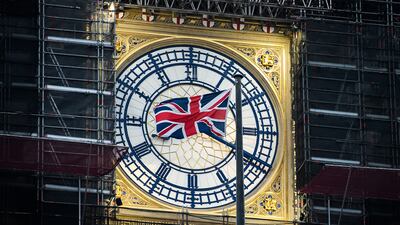
A union flag flies in front of the clock face of Big Ben just after the sun rises on January 1, 2021, the first day of the UK's future outside the European Union. Getty Images -
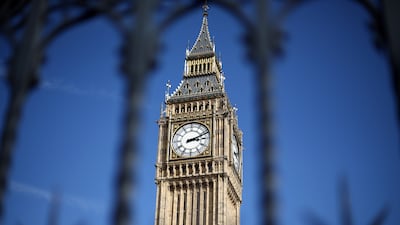
Big Ben pictured in 2015 before the current restoration works began. Getty Images -

Workers clean the east-facing clock face in 2014. Getty Images -

The flag of Great Britain is projected on to the Houses of Parliament and Big Ben during a light show to mark the start of the 2012 Olympic Games. Getty Images -
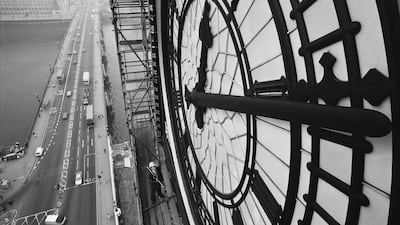
A close up view of the clock face of Big Ben, with Westminster Bridge over the River Thames to the left, in 1985. Getty Images -
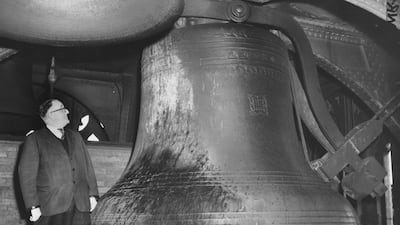
The 13.5 ton bell known as Big Ben is seen in 1959. The clock came into operation on May 31, 1859, but Big Ben itself did not ring out until July 11 of that year. Getty Images -

Charles King, the man then responsible for winding and maintaining the great clock of Big Ben, looking down the centre of the tower's staircase in 1957. Getty Images -
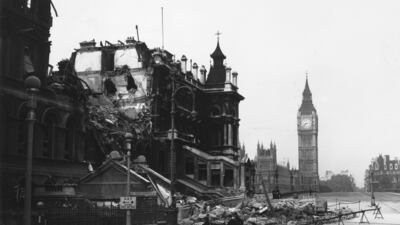
The debris of St Thomas's Hospital, London, the morning after receiving a direct hit during the Blitz, in front of the Houses of Parliament and Big Ben, in 1940. Getty Images -
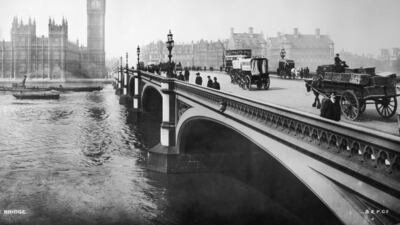
Big Ben stands above Westminster Bridge in 1890. Getty Images -
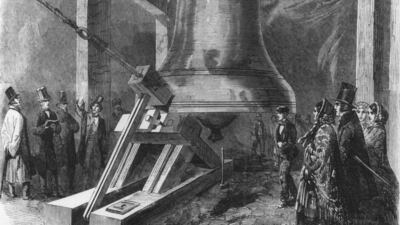
A sounding experiment on the first bell for St Stephen's Clock Tower, commonly known as Big Ben, in 1856. Getty Images


In the past the bells have boomed out to mark wartime commemorations including Armistice Day and Remembrance Sunday, plus New Year celebrations, although a year ago a scheme to celebrate Brexit had to be abandoned because the restoration work was not complete.
And so this year, the bonging of this powerful symbol finding its voice once again was a powerful, optimistic moment. But the story of the restored Big Ben, the bell and its problems, the failure to act earlier, compounding the damage rather than fixing it, is part of a pattern for other British institutions in trouble. There is an attitude of complacency that ageing British institutions are perpetually glorious, when the evidence can suggest that they do not work well any more and need urgent attention.
These institutions include (but are not limited to) the BBC, the British parliament, the military, the National Health Service, the justice system and the monarchy. All, in various ways, are part of our public life and historically have made Britain seem great. All in 2022 are under pressure to change, to modernise and to improve. And yet all may, again like Big Ben, only receive real attention when their problems become critical.
The BBC, for example, is under siege. The Conservative government has forced the corporation to fund free TV licences for the elderly with the cost to the BBC put at around £250 million a year. Given the divisive politics of post-Brexit Britain there are also fears that the BBC’s editorial independence is being undermined by a hostile government determined to limit the scope of publicly funded broadcasting or even to privatise it.
Many British newspapers are also extremely hostile to the BBC, since it competes with – and is far more trusted than – their own commercial operations. BBC insiders fear a long slow death of underfunding. In cash terms the corporation already finds it increasingly difficult to compete with new players like Netflix.

Then there is the monarchy. The sonorous bonging from Big Ben in the Elizabeth Tower comes as Britain is about to celebrate the Queen’s 70 years on the throne. But that inevitably raises questions about how the monarchy will reinvent itself for a new generation when Prince Charles becomes King. It also comes as his brother Prince Andrew has to deal with an American court case involving highly salacious and potentially very damaging allegations about his friendship with convicted paedophiles Jeffrey Epstein and Ghislaine Maxwell.
Affection for the Queen may not easily transfer to the next generation without urgent restoration work to the institution itself. Then there is the British armed forces.
These remain one of the world’s most truly professional military services on land, sea and air. But following the shambolic exit from Afghanistan and a reordering of defence priorities it is not clear how far British military forces can in any sense “punch above heir weight” as politicians used to claim. Their “weight” is much diminished.
Or how about the justice system? The Law Society and other organisations representing lawyers openly speak of the English court system as another Big Ben in the making – neglected for years, inefficient, running out of time and therefore potentially unjust.
Meanwhile the National Health Service is also facing unprecedented pressures. Coronavirus, of course, has taken NHS services and personnel to the limit of endurance. There are serious shortages of key workers and funding for hospital beds.

Then there is parliament itself, housed in the building underneath Big Ben. Poll after poll shows British people have become increasingly disillusioned both by the work of parliament and the kind of people who end up there.
Taken together, trust in British public institutions is at a very low ebb, and – as Big Ben has shown – public investment and coherent programmes of modernisation are urgently required but are lacking. Public institutions require more than mere good wishes and a superficial lick of paint to spruce them up for the 2020s. The Big Ben bells are ringing in Westminster but time is running out for other institutions too. Tick tock.

