


Although the whole world now appears to be talking about "energy transitions", the phrase is hardly news. It was first coined in 1977 when US President Jimmy Carter declared that the world needed “permanent renewable energy sources”. Yet, more than 40 years later, and despite investments of $300 billion or so every year over the last decade into renewables, we are concluding critical Cop26 meetings and entering the Abu Dhabi International Petroleum Exhibition and Conference (Adipec) as global greenhouse gas emissions reach an all-time high (at the first Cop in 1995 emissions were 40 per cent lower than today).
The first problem is that in all this time, policymakers have not fully recognised what the phrase truly means. A transition suggests that things are in motion, where we move from one state to another. Yet most policy today seems to be concerned with the starting point and the end goal; to replace the old with the new and to switch from a fossil-fuel world to net-zero one. When we think about problems in this reductionist way, we fall victim to what is known as our "gap instincts", a tendency to think about issues as two distinct or even conflicting groups. To think about "us" and "them", the "West" and the "Rest", we create an imaginary gap that seems to make our problems impossible to overcome. When policymakers consider renewables and fossil fuels as warring factions, rather than part of our combined energy arsenal, this creates an impossible choice for emerging nations who often feel bullied into choosing between climate goals or growth.
As a result, such gap instincts have moved the world further away from previously set climate goals.
Secondly, by focusing solely on energy markets, mainstream discourse has applied the concept of transitions much too narrowly. Instead, the term relates to the much broader changes in technology and processes that can improve society. In the industrial age, the rise of coal-burning was not an "energy transition" but a much more comprehensive societal shift where we moved from sailboat to steamship, horse to automobile, rural fieldworker to urban consumer.
-
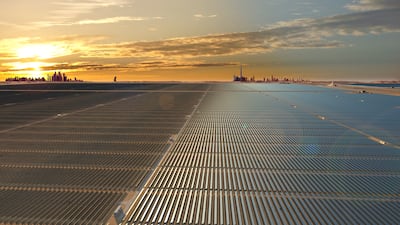
The third phase of the Mohammed bin Rashid Al Maktoum Solar Park in Dubai. Photo: Masdar -
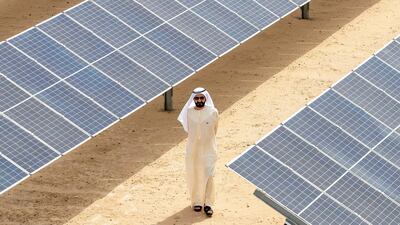
Sheikh Mohammed bin Rashid Al Maktoum, Vice President and Ruler of Dubai, inaugurates Dubai Electricity and Water Authority’s Innovation Centre and the 800MW third phase of the Mohammed bin Rashid Al Maktoum Solar Park, the largest single-site solar park in the world. Wam -
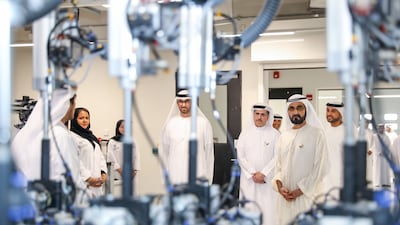
Sheikh Mohammed at the Mohammed bin Rashid Al Maktoum Solar Park. Wam -
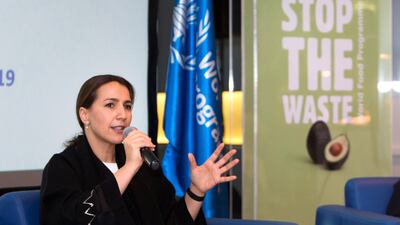
Mariam Al Mheiri, Minister for Food Security, speaks at the World Food Programme Stop the Waste campaign at Jumeirah Beach Hotel, Dubai. Leslie Pableo for The National -

Khaled bin Mohamed bin Zayed has launched a landmark clean energy partnership between Adnoc and EWEC that will see EWEC supply Adnoc’s grid power from nuclear and solar energy sources from January 2022. Photo: Abu Dhabi Government Media Office -

The UAE pavilion at the Cop26 summit in Scotland. Ashraf Helmi / The National -
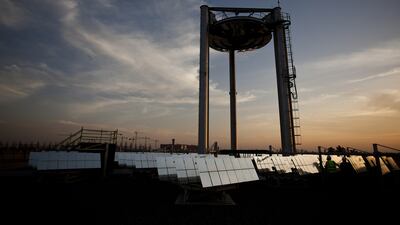
Masdar City in Abu Dhabi. Andrew Henderson / The National -

The Barakah Unit 2 grid connection delivers clean electricity. Photo: Emirates Nuclear Energy Corporation -

An aerial view of the Qurum Walkway in Jubail Mangrove Park. The UAE is doing everything it can to tackle climate change, from limiting greenhouse gas emissions to planting more mangroves. Wam -
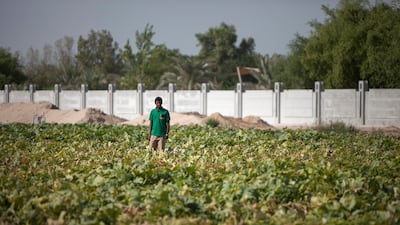
The Ministry of Climate Change and Environment is working to increase the amount of local produce grown by 5 to 10 per cent a year. Silvia Razgova / The National -
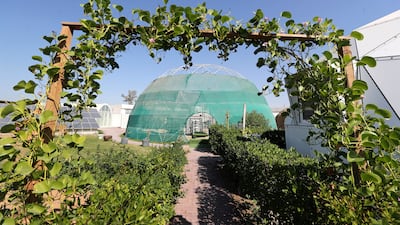
The eco-green technologies research site at Sharjah Research Technology and Innovation Park. Chris Whiteoak / The National -
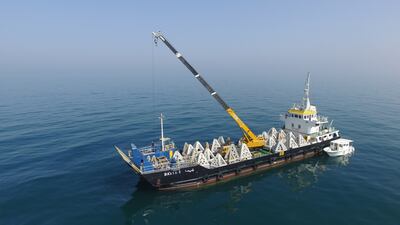
The Ministry of Climate Change and Environment has installed 300 artificial caves made of eco-friendly materials across 30 sites to enhance fish stocks in UAE waters. -

The future of cycling in Al Hudayriat Island, Abu Dhabi, is commemorated by a community ride around the track. Victor Besa / The National


So rather than being straight-jacketed by the term "energy transition", our discussions should instead focus on the evolution or continual improvement of our energy systems in tandem with the environment and society at large. In doing so, we can stop dividing problems into zero-sum camps and can consider solutions on their merits, for example those that are easiest to implement, such as coal to gas switching, or those that are highly effective such as methane reduction. Furthermore, an evolutionary mindset allows energy executives, policymakers and consumers to consider new technology as a crucial tool for inclusive development as well as to recognise the immense value of our natural ecosystems.
If the first Sustainable Development Goal (SDG) is to eradicate extreme poverty by 2030, we must look at both energy and society’s challenges through a single lens. By thinking about society and energy as two sides of the same coin, countries can fully evaluate smart energy policies as enablers of development, especially in the developing world where supporting a fair and just energy evolution must also facilitate unabated economic growth. On a related note, we mustn’t ignore the fact that well over 40 per cent of cumulative global emissions from the beginning of the industrial age were generated to fuel the economic prosperity of the United States and western Europe, even though both account for less than seven per cent of the global population today. A mere two per cent of emissions have come from the entire continent of Africa.
Stunting economic development, which is undeniably underpinned by affordable and accessible energy and which has seen global poverty rates fall by over 75 per cent since 1990, is simply not an option. Instead, national energy and climate policies can look towards pursuing a balanced and tailored greener energy evolution to achieve the best development outcomes given the prevailing circumstances. Fit-for-purpose renewables, R&D that lowers generation and transmission costs and large-scale storage solutions across the world should be strongly supported. However, this does not mean being close-minded in this quest, and demands pragmatism in its mass implementation.
As the world is becoming increasingly urban, cities now account for nearly 60 per cent of our population but less than three percent of our landmass. This matters, because when planned for and managed well, urbanisation contributes to economic growth and poverty alleviation, as well to sustainability and climate change mitigation, by helping curb emissions. For example, dense living can reduce per capita energy consumption, as it’s more energy efficient to cool and heat homes and increases the likelihood of mobility using public transport or walking – all reducing greenhouse gas emissions.
Consumption habits, including with food, are also influenced by city living. For example, over 90 per cent of vegans in high-income countries live in urban areas. Enabling such choices matters in a world that consumes 50 billion animals and 150 million tonnes of seafood each year that are responsible for 15 per cent of global greenhouse gas emissions. Therefore, while technology has an important role to play, policies that incentivise growth, development, education and urbanisation should be promoted especially when they achieve the same climate objectives. In this context, rising incomes and protecting the planet are no longer mutually exclusive policy goals.

Lastly, and perhaps most importantly, focusing on these broader societal, economic and supply chain issues creates a narrative that allows us all to recognise the power of our natural ecosystems to help slow, mitigate and potentially reverse some of the effects of climate change. Trees and grasslands can be especially valuable in this regard, due to their ability to prevent catastrophic flooding and protect the natural habitats of countless species of wildlife. In the UAE for example, mangroves are renowned for their supercharged ability to absorb carbon from the atmosphere at a higher rate than most other plants and trees.
Unfortunately, mangrove habitats throughout Asia and Africa are being decimated at an alarming rate by communities that simply do not have access to other sources of energy and are therefore burning these natural carbon capturers as simple fuel. The number of people without access to electricity rose last year to nearly 800m people. Around 2.5bn people still cook using wood, charcoal, or dung. These are just some examples, but they serve as powerful reminders that global energy and climate policies need to embrace an energy evolution that also incentivises the adoption of less destructive methods everywhere. Similarly, we always need to be honest with ourselves about the total environmental costs of seemingly attractive solutions such as biofuels, the production of which can lead to the clearing of large swathes of land and forests and the inherently massive carbon release of such actions. As an illustration, it is estimated that the release of just 0.1 per cent of the carbon currently stored in European soils would equal the annual emissions from as much as 100m cars. Today, very sadly, we are losing forests around the world over three times the size of the UAE every single year. The Cop26 pledge to reverse deforestation committed to by over 100 world leaders is a step in the right direction.
Making the wrong energy policy decisions, even with good intentions, can do irreversible damage to fragile ecosystems and societies around the world. We should therefore move away from a narrow interpretation of the so-called energy transition. Instead, the focus must be on how broader energy frameworks can help billions of people around the world live happier and more prosperous lives, while respecting and protecting the climate and environment that their communities depend on.

