


What does it tell us about a country when foreign ambassadors advising their host state on a judicial matter and refugees playfully teasing their host citizens on social media receive the same response from the government? That Turkey’s in the mood for some “me-time”.
About a decade ago, as Turkish President Recep Tayyip Erdogan sought to position himself as a Muslim leader and champion of the persecuted, his country may have been more open to outsiders than any country on Earth. In the years after the outbreak of the Syrian civil war in 2011, as many as five million refugees flowed into the country.
About a million continued on their way to Europe, sparking the 2015-16 refugee crisis, while nearly four million stayed and set about building new lives. They were far from alone in their choice of sanctuary. Nearly 200,000 Afghans also fled their war-torn homeland and found refuge in Turkey, which also welcomed thousands of exiled Muslim Brotherhood members from the region, as well as Uighurs, the Turkic Muslim minority from China's Xinjiang province.
Living in Istanbul in the mid-2010s, I wrote for a number of US outlets about the wave of foreign journalists, activists and refugees that had made Turkey a beacon of hope with a golden opportunity to integrate the new arrivals and emerge as an assured, immigrant-friendly state.
Despite the ground shifting, this reputation has stuck.
Last year, The Guardian argued that Istanbul had won back its crown as the heart of the Muslim world, while just a few months ago France’s Monde Diplo described the former Ottoman capital as the home of Arabs.
In reality, the tide began to turn in early 2019, when the main opposition CHP rode to landmark victories in several mayoral votes on the argument that less government spending on refugees would have curbed unemployment. By 2020, CHP leader Kemal Kilicdaroglu was vowing that, once in office, his party would send all Syrians back home. Mr Erdogan, meanwhile, was laying out plans to safely return two million Syrians to their homeland.

Xenophobia has since taken root. In August, rumours that Syrians had killed a Turkish youth spurred an angry mob of locals to assault dozens of Syrian homes and businesses in Ankara. Several hundred thousand Syrians have been resettled in their homeland in the past two years, with hundreds reportedly forcibly returned. The Turkish government has nearly finished a massive wall along its border with Iran, following widespread anger in response to the steady stream of Afghan arrivals this summer.
There are countless smaller examples of this shift, from Afghan interpreters for Turkish forces waiting for evacuation from Afghanistan to Uighur and Turkmen activists who fear deportation.
But two key incidents have dominated headlines of late. The first was Mr Erdogan’s threat to expel 10 western ambassadors for urging Ankara to release jailed philanthropist Osman Kavala. After a 48-hour standoff, the row was resolved diplomatically.
Days later, however, a viral video emerged detailing a street scene in which a Turkish man denounces a Syrian woman for having an easier life than he and his compatriots. “I can't eat bananas,” he said as a crowd gathered, “while you buy them by the kilogram.”
Bemused Syrians turned to social media in response, posting dozens of videos on TikTok and other platforms. In one, a ninja breaks into a home filled with luxury items but steals only a bowl of bananas. In another, Syrians working at a barbershop act as if it’s perfectly normal to go about their day munching on bananas.
Again, the Turkish government responded with outrage, vowing, with a straight face, that seven Syrians would be deported for provocative banana eating. Pro-government columnists denounced Syrians as having “abandoned their fatherland” only to launch a campaign mocking Turks’ economic hardship.
Turkey is still home to the world’s largest refugee population, at around five million people, and has of late been facing high inflation, few jobs and a steep decline in the lira. Turkey’s currency is worth so little that scrap dealers have reportedly begun melting down coins because the bits of copper and nickel have more value: minting a half-lira coin is now said to cost two-thirds of a lira.
During such times, it’s understandable if Turks – like the party host turning to his fellow revellers with weary eyes as dawn breaks – have had enough of all these guests. But the reality is that Syrians face just as much hardship.
It’s true that many working-class Turks have faced fewer employment opportunities due to the presence of so many Syrians. Yet, because so few Syrians have work permits, the vast majority are forced to work in the informal economy where they face potential exploitation, working long hours with no insurance for minuscule pay. More importantly, they have lost their homes and the world in which they were raised.
-
Turkish soldiers on patrol in the Syrian village of Ram Hamdan, north of the city of Idlib. All photos: AFP -
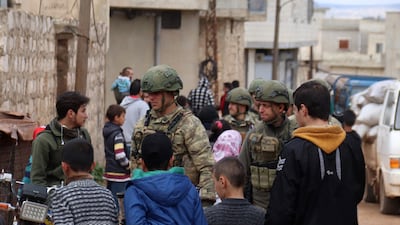
Displaced Syrian children watch Turkish soldiers near the town of Batabu on the road linking Idlib to the Syrian Bab al-Hawa border crossing with Turkey. -

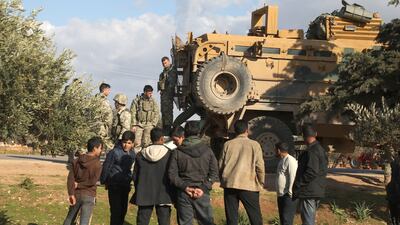
Turkish soldiers keep watch as vehicles from a joint Russian-Turkish patrol pass through the outskirts of the rebel-held town of Ariha in Syria's north-west Idlib province. -
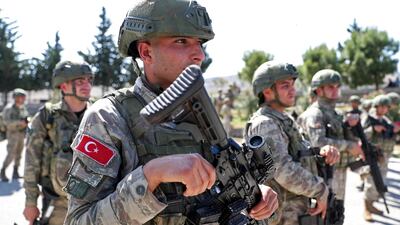
Turkish soldiers secure a section of the M4 motorway near Ariha in Idlib province. -
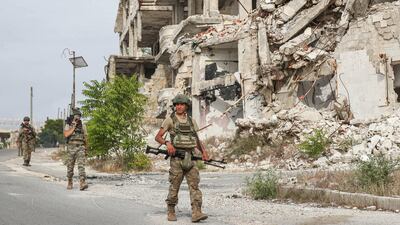
Turkish soldiers patrol on Arbaeen hill overlooking Ariha in the southern countryside of Idlib province, Syria. -
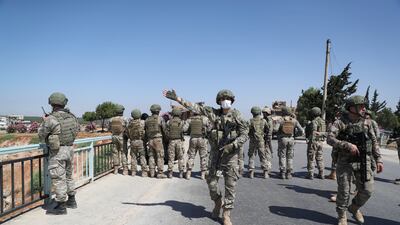
Turkish soldiers on guard on a bridge overlooking a section of the M4 motorway. -
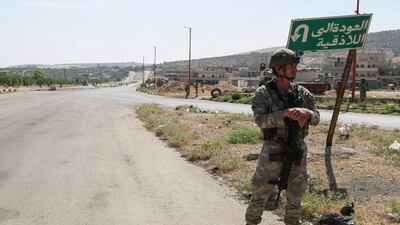
Turkish soldiers secure a section of the M4 to allow joint Russian-Turkish patrol to pass.


And despite reports to the contrary, their homeland remains an unwelcoming place. Last year, Turkey dispatched thousands of troops to Syria’s north-western Idlib province to avoid the prospect of as many as two million more Syrian refugees. If Syria is safe, why would so many Syrians be rushing for the exit? Now Ankara is said to be planning its fourth Syrian incursion, underscoring again the extent to which its neighbour remains unsafe for return.
If they had been expelled, those 10 western ambassadors would have been just fine (though Turkey-West relations would surely have suffered). Syrians would not be so lucky. As detailed last week by Human Rights Watch, returnees to Bashar Al Assad’s Syria regularly face arbitrary detention, torture, kidnapping and forced disappearance.
Everybody tires of hosting duties. But if Turkey and its weary citizens are unable to muster a bit more empathy – to take a minute to envision their country eviscerated by war, their loved ones dead and their lives reliant on the warmth of others – darker days surely loom.

