

It’s been a decade since Syria tumbled into the abyss of the most devastating conflict since the Second World War, a bloody struggle that has left at least half a million people dead and 12 million displaced, a region destabilised, a generation lost and a Stalinesque despot still in power.
Initially, no country responded more generously than Turkey. “We will always keep our doors open to our Syrian brothers and sisters,” President Recep Tayyip Erdogan, then prime minister, vowed in spring 2011.
Within a few years Turkey had welcomed a million Syrian refugees and spent some $3 billion accommodating them in camps The New York Times famously described as perfect. By early 2016, Turkey had taken in some 3.5 million refugees even as wave after wave of asylum-seekers, from Syria, Iran, Afghanistan and Somalia, squeezed into dinghies to attempt perilous crossings of the Aegean and eastern Mediterranean.

Horrifying images of three-year-old Alan Kurdi lying face down on a Turkish beach shook the world as hundreds of migrants died on the high seas. All those arriving refugees, who were mainly Muslim, inflamed anti-immigrant sentiment across the EU as far-right parties depicted them as criminals and terrorists.
The crisis finally ended when the EU agreed to grant Turkish nationals visa-free travel, amend the EU-Turkey customs union and pay Turkey €6bn (roughly $7bn) for refugee hosting duties. Turkish authorities in turn agreed to curb illegal crossings, after which the EU would begin transferring Syrians from Turkey to EU states in exchange for those who had arrived in the EU illegally. The number of refugee crossings, and deaths at sea, fell sharply as Turkey stepped up security along its borders and cracked down on smugglers.
But then Turkey's generosity ran out. Two years ago, anti-Syrian sentiment played a key role in opposition mayoral candidates defeating their ruling Justice and Development Party (AKP) foes in Turkey's two largest cities, Istanbul and Ankara.
Mr Erdogan went back on his vow to keep the doors open and at that year's UN General Assembly detailed a plan to carve out safe zones in northern Syria and build vast tracts of housing there, in an effort to have millions of refugees to return. At the same time, he repeatedly threatened to inundate the EU with migrants by "opening the gates" and allowing refugees to freely cross into Greece.
Ankara has also abetted the violence in Syria, first by allowing thousands of extremist fighters to cross the border and reportedly sending arms to Islamist rebels against President Bashar Al Assad. Turkey has been widely blamed for turning a blind eye to the rise of ISIS in the war’s early years.
-
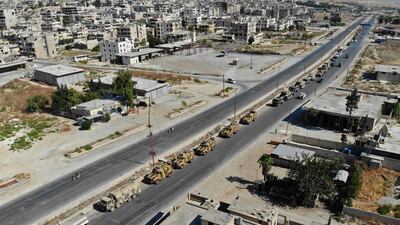
An aerial view of a convoy of Turkish military vehicles passing through Maaret Al Numan in Syria's northern province of Idlib, reportedly heading toward the town of Khan Sheikhun in the southern countryside of the province. AFP -

A truck carrying a tank. AFP -
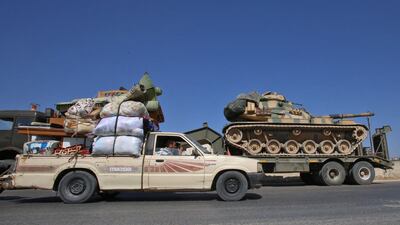
A convoy of Turkish enters as inhabitants flee the battles and shelling toward safer areas. AFP -
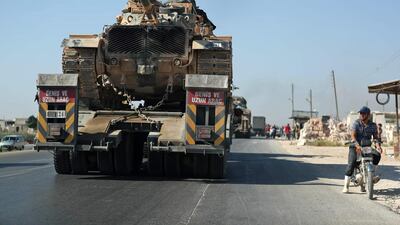
The convoy passes through the town of Saraqeb in the northwestern province of Idlib. AFP -

The Syrian Foreign Ministry told Sana that the “aggressive” move would not affect “the determination of the Syrian Arab Army to keep hunting the remnants of terrorists”. AFP -
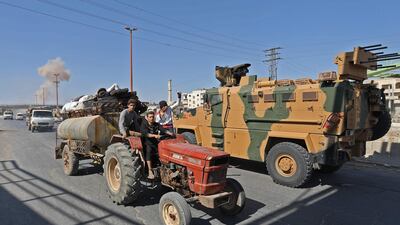
The Syrian Foreign Ministry said the convoy was carrying munitions. AFP -

Inhabitants of Maaret Al Numan in Syria's northern province of Idlib watch a convoy of Turkish military vehicles reportedly headed to assist rebels against regime forces. AFP -
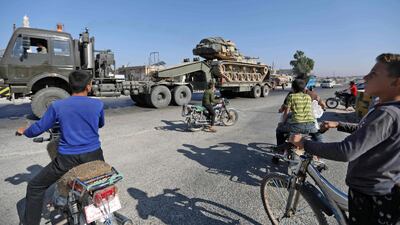
Inhabitants of Maaret Al Numan in Syria's northern province of Idlib watch a convoy of Turkish military vehicles reportedly headed to assist rebels against regime forces. AFP -

Inhabitants of Maaret Al Numan in Syria's northern province of Idlib watch a convoy of Turkish military vehicles reportedly headed to assist rebels against regime forces. AFP -
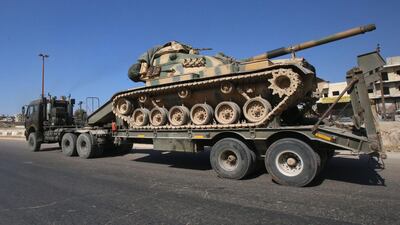
Inhabitants of Maaret Al Numan in Syria's northern province of Idlib watch a convoy of Turkish military vehicles reportedly headed to assist rebels against regime forces. AFP


More recently, Turkey has launched three incursions into northern Syria. Military operations in Afrin and north-eastern Syria, where Turkey now controls chunks of territory, sparked allegations of war crimes and ethnic cleansing against the mainly Kurdish population by Turkey-backed rebels.
A year ago, the Russia-backed forces of Mr Al Assad threatened to retake the last rebel stronghold, in Idlib province. Some two to three million displaced Syrians had fled there from other parts of the country and would probably have been forced into Turkey by an Assad regime offensive.
To drive the situation home to Europe, Turkey followed through on Mr Erdogan’s refugee threat, bussing tens of thousands asylum-seekers to the Greek border, leading to clashes and at least one dead. In Idlib, however, the Turkish military intervened and temporarily staved off a catastrophe, agreeing to a ceasefire with Russia that still holds today.

The pandemic has dominated the headlines of late, but the millions of refugees in Turkey, along with the displaced in Idlib, still represent a ticking time bomb. Last week, as the Turkey-EU deal marked five years, Turkish Foreign Minister Mevlut Cavusoglu said the EU had failed to fulfill its promises on a customs union update and visa-free travel. The deal is set to expire when the EU fulfils its financial commitment, likely sometime in the next year. Turkish officials have said it should be renewed, but not before a thorough revisit.
In an op-ed for Bloomberg last week, Mr Erdogan re-issued his refugee threat, demanding western powers invest in Turkey’s plan to return Syrians to areas it controls in the country’s north. “Failure to share Turkey’s burden may result in fresh waves of migration towards Europe,” he warned.
Last week, the EU decided to hold off on sanctioning Turkey for its drilling operations in the eastern Mediterranean, signalling a warming in relations as European leaders head to a summit in Brussels later this week. But the EU seems lukewarm about a new refugee deal.
EU foreign policy chief Josep Borrell last week said the current deal had produced results and remained in effect. As attempted crossings have fallen sharply during the pandemic, so too have fears of mass migration, along with the outlook for far-right parties such as Alternative for Germany. And Europe appears to have gotten over the moral hurdle of using force and other legally questionable means to push back migrants. A year ago, the head of the European Commission, Ursula von der Leyen, applauded the aggressive tactics used by Greek security forces against migrants on land and at sea, describing Greece as “Europe’s shield”.
Of course, this could all change in a flash. As vaccine-driven immunity takes hold and the weather warms, the refugee waves could return, in part because Syrians in Turkey remain torn between putting down roots and making plans to move on.
More than 100,000 have become Turkish citizens and some 500,000 children have been born to Syrians in Turkey. Yet as of late 2019, nearly two-thirds of Syrians outside the camps lived close to or below the poverty line, according to the Brookings Institution. The pandemic has made matters worse: 87 per cent of refugees surveyed last year by Relief International reported that someone in their household had lost their job because of Covid-19.
-
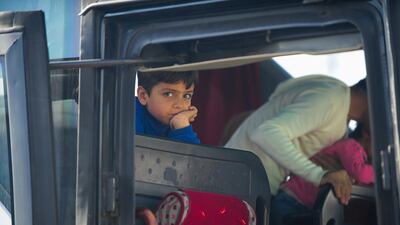
Syrian refugees board buses to take them back to their country in the Esenyurt district of Istanbul on November 6, 2019. Emrah Gurel for The National -
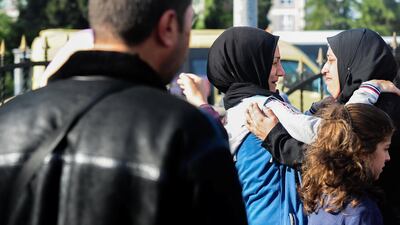
A total of 143 Syrian refugees were sent back to their homelands in Jarablus, Damascus, Aleppo, Azaz, Al Bab and Afrin in Syria. Emrah Gurel for The National -

A Syrian refugees holds his child as they board one of the buses at Esenyurt Municipality garden in Istanbul, Turkey. Emrah Gurel for The National -
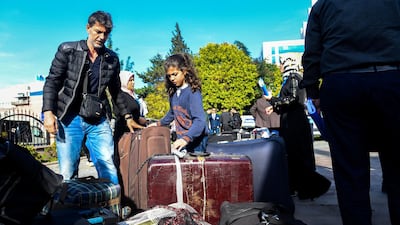
Syrian families load their belongings on to buses at the Esenyurt Municipality garden in Istanbul before being driven to Syria. Emrah Gurel for The National -
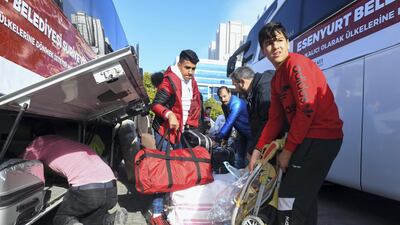
Syrian families load their belongings on to buses at the Esenyurt Municipality garden in Istanbul before being driven to Syria. Emrah Gurel for The National -
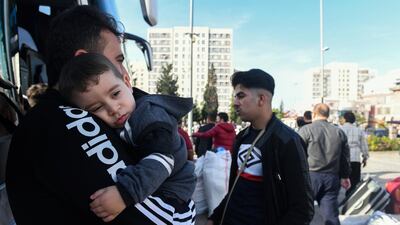
Syrians to prepare to return to their homeland aboard buses departing from the Esenyurt Municipality garden in Istanbul, Turkey. Emrah Gurel for The National -
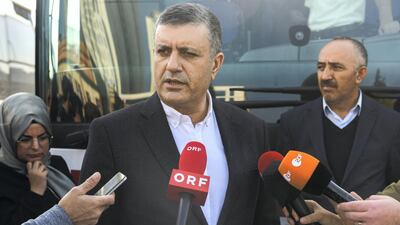
The mayor of Esenyurt, Kemal Deniz Bozkurt holds a press briefing about the departure of the Syrian refugees. Emrah Gurel for The National -
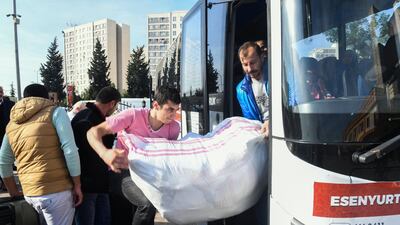
Syrian families load their belongings on to buses at the Esenyurt Municipality garden in Istanbul before being driven to Syria. Emrah Gurel for The National -
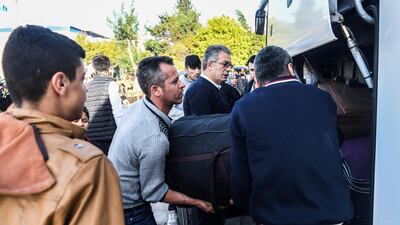
Syrian families load their belongings on to buses at the Esenyurt Municipality garden in Istanbul before being driven to Syria. Emrah Gurel for The National -
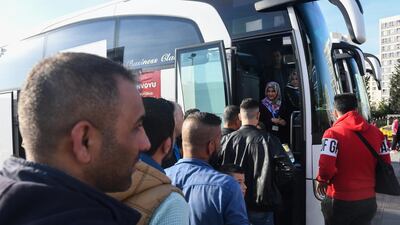
Syrian refugees board buses taking them back to Syria from Turkey at the Esenyurt Municipality garden in Istanbul on November 6, 2019. Emrah Gurel for The National -
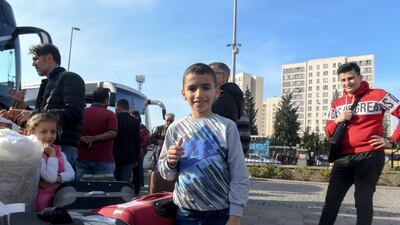
A Syrian boy gestures as he waits to leave for Syria with his family at the Esenyurt Municipality garden in Istanbul, Turkey. Emrah Gurel for The National


At the same time, Syrians appear to have worn out their welcome. “Turks change their attitudes toward us from one day to the next,” a Syrian journalist who has learned Turkish and gained her citizenship since arriving in Istanbul in 2012 told Synaps, a research and analysis site. “They don’t know if they should like us because we share a common history, or dislike us because we’re filthy Arabs and agents of destruction.”
After all these years, it is understandable that Turks might have tired of being good hosts. They have done their part. But the reality is that the vast majority of the six to seven million Syrians in Turkey and Idlib province will not soon be returning home, where many are likely to face detention or forced disappearance.
These people have lost more than most of us could imagine. For a decade they have struggled and suffered. Surely they have earned the dignity of not being treated like political pawns, or cattle to be herded from one place to the next. It's time for Europe, the US and the international community to work with Turkey to devise a Syrian resettlement plan that includes housing and employment opportunities, and offers a real chance to build new lives.
David Lepeska is a Turkish and Eastern Mediterranean affairs columnist for The National

