


Albert Einstein once defined insanity as "doing the same thing over and over again and expecting different results". I have been thinking about this quote in relation to the recent bizarre behaviour of the parties involved in the Palestinian-Israeli conflict – Israel, the US government and the major Palestinian actors, Hamas and the Palestinian Authority (PA). Each of them appears determined to repeat the same mistakes, over and over, without ever learning the lessons from their past disasters.
Let me start with Israel and Hamas. I will never understand what Israel feels it gains by massively bombing Gaza, destroying buildings, hospitals and desalination and power plants. This has been going on for decades, first in response to Hamas-directed suicide terror bombings in Israel and now following rocket attacks originating from Gaza.
While Israel terms their bombings "self-defence", respected international jurists and human rights organisations have called them war crimes, both because of the overwhelmingly disproportionate death and destruction they have caused and because these attacks have deliberately targeted the civilian infrastructure. The "self-defence" argument is further called into question given Israel's Iron Dome network that has shown itself capable of neutralising Hamas's attacks.
-

Rockets fired towards Israel from Beit Lahia in northern Gaza on Friday. Anas Baba / AFP -

Smoke and flames rise after an Israeli air strike in northern Gaza early on Friday. Gaza’s Health Ministry said 109 Palestinians, including 28 children and 15 women, had been killed by air strikes. EPA -
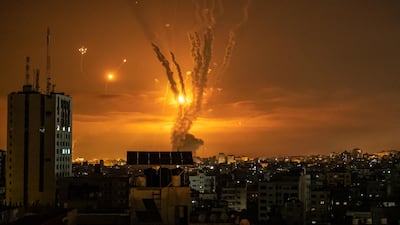
Rockets launched towards Israel from northern Gaza Strip are countered by Israel's Iron Dome missile defence system overnight on Thursday. Seven people in Israel have been killed in the cross-border rocket exchanges. Fatima Shbair / Getty Images -
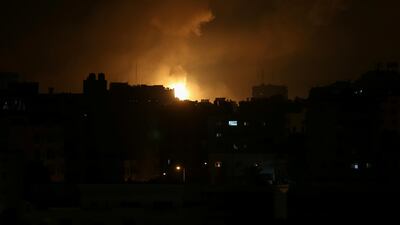
Smoke and flames caused by an Israeli air strike on Gaza city early on Friday. Reuters / Ibraheem Abu Mustafa -

A policeman stops traffic to allow police cars to make their way towards reported rioting in Haifa, Israel, on Thursday. Jews and Arabs have been involved in mob violence. Daniel Rolider / Getty Images -

A fire blazes in the middle of a street in Haifa's Hadar neighbourhood on Thursday night, as rioting continued in several Israeli cities. Daniel Rolider / Getty Images -
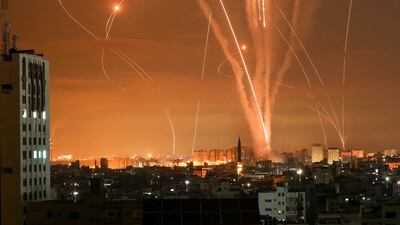
Rockets fired towards Israel from Beit Lahia in northern Gaza on Friday. Israel massed troops on the border as barrages were fired by both sides. AFP / Mohammed Abed -
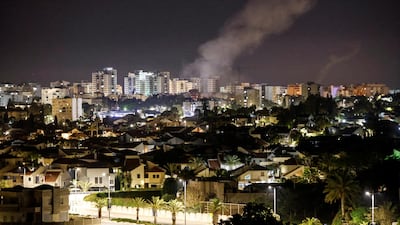
Smoke rises over houses in Ashkelon, in southern Israel, after a rocket attack launched from Gaza. Reuters / Amir Cohen -
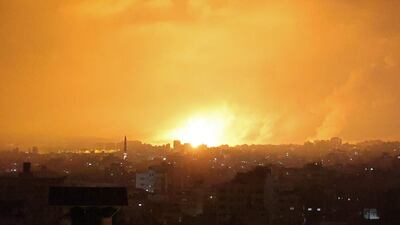
An explosion during an Israeli air strike on Beit Lahia in northern Gaza on Friday. AFP / Mohammed Abed -
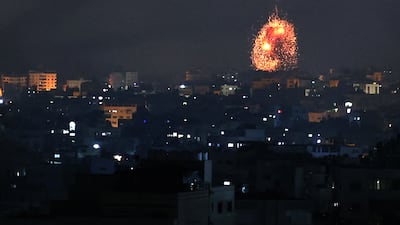
An explosion lights up the sky during an Israeli air strike on Beit Lahia in northern Gaza on Friday. AFP / Mohammed Abed -
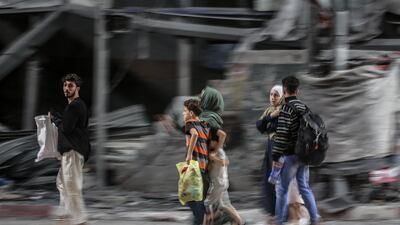
A Palestinian family flee from their home in the east of Gaza city during Israeli air strikes early on Friday. EPA / Mohammed Saber -
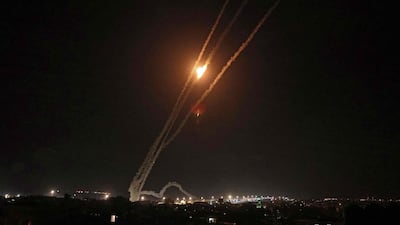
Rockets are fired towards Israel from Rafah in southern Gaza on Friday. AFP / Said Khatib -
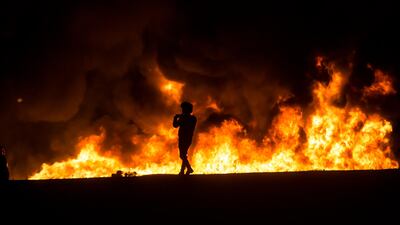
A field blazes after an explosion in Ramla, Israel, caused by a rocket launched from Gaza on Thursday night. Amir Levy/Getty Images -
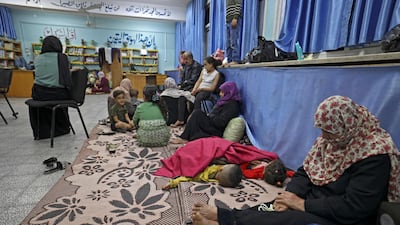
Palestinian families take shelter in a UN school in Gaza city on Thursday, after fleeing their homes in the town of Beit Lahia. Israel pounded Gaza and sent extra troops to the border as Palestinians fired barrages of rockets back. AFP / Mahmud Hams -

A Palestinian family takes shelter in a UN school in Gaza city on Thursday, after after fleeing their home Beit Lahia. AFP / Mahmud Hams


Since Israel has been using such violence for decades, even before Hamas' use of rockets, the more likely reason Israel acts as it does is its belief that by demonstrating uncontested power, it can force Palestinians into submission. Sometimes it has cruelly referred to its assaults as "mowing the grass" – by which it means causing enough damage to buy a few years of peace. The problem, of course, is that it never works quite that way. Instead, its actions only create more suffering and hatred, seeding the ground for more violence.
In 2005, Israel left Gaza ignoring the appeal from then US secretary of state Condoleezza Rice that it does so in an orderly fashion, turning the area over to the PA. Instead, it chose to depart unilaterally, leaving the territory ripe for a Hamas takeover. After Hamas seized control, Israel imposed a suffocating economic closure, believing that this would force Palestinians into submission. Since then, Hamas has only gained strength in the territory.
During the past decade, Israel has behaved in a contradictory manner toward Hamas. At times it mercilessly punishes the Palestinian civilian population for Hamas' actions, while at other times allowing funds from external parties to go to Hamas and even engaging in indirect negotiations with the group over prisoner exchanges – something it has refused to do with the PA.
It appears Israel is pleased to have fostered a deep division in the Palestinian polity – weakening and discrediting the PA, while strengthening Hamas, which it sees as a convenient whipping boy.
For its part, Hamas appears more than happy to play the spoiler. In the aftermath of the Oslo Accords, it suborned young Palestinians to participate in suicide attacks that killed scores of Israelis in a successful campaign to sabotage the failing peace process. Each time, the result was the same – a massive Israeli response that killed many more innocent Palestinians. It was only after the blockade and closure of Gaza that Hamas turned to firing primitive rockets – with the same tragically fatal results. In all of this, the victims are the people of Gaza. Too many are homeless, jobless, suffering from PTSD, and left without hope.
After the last round of violence, it has been both unnerving and infuriating to see Hamas' leaders visiting some Arab capitals on a "victory tour". Someone recently chided me for calling into question Hamas' actions and for daring to criticise the group that "brought Israel to its knees". My response was: "On what planet do you live? What victory? Hundreds of Palestinians are dead, and Gaza is in ruins, again. And Israel is proceeding apace with demolitions in Silwan, seizures of homes in Sheikh Jarrah, and settlement expansion in the West Bank."
It is as though for Hamas' supporters, like Israel, lessons are never learned. Just as overwhelming bombardments and massive oppression will not end the resistance to the injustices of the occupation, neither will rockets or suicide bombings end the occupation.
From all available evidence, neither Israel nor Hamas appears to have learned anything. Israel has stepped up its efforts to seize homes in Jerusalem and expand settlements and intensify repression in the West Bank, while continuing to strangle Palestinians in Gaza. For its part, Hamas, riding high on its hollow boasts of victory, demonstrates no understanding of the devastation wrought by its insistence on provoking confrontations it cannot win.
Let me be clear: while both Israel and Hamas stand guilty of repeating their mistaken approaches, Israel bears the greater responsibility. It is the oppressive occupying power that has created the nightmare of Palestinian existence. It could change this reality, but it is unwilling to do so. That said, Hamas bears responsibility for not altering its course. This is not blaming the victim; it is asking Hamas to be smarter, and not continuing to play into Israel's hands.
In my next column, I will look at how both the US and the PA are also guilty of repeatedly making wrongheaded moves that have only served to make a bad situation even worse. I will also point to hopeful developments that suggest a way forward out of this morass.
Dr James Zogby is the president of the Arab American Institute and a columnist for The National

