

The UN’s early leaders were keen to remind the world that the body was “not created to take mankind to heaven, but to save humanity from hell”. But with US President Donald Trump sending a message to the Nobel Committee through Norwegian Prime Minister Jonas Gahr Store that he was no longer obliged to think of the world purely in terms of peace, it can now be argued that we’ve come full circle.
The UN’s current leadership is the first to acknowledge that it stands shredded of influence in the face of the pressure meted out by Washington. When Secretary General Antonio Guterres addressed a celebration of the institution’s 80th birthday at the weekend, he reflected that its members first met above a bomb shelter.
He also reminded that many of its earliest staff carried the scars and permanent disabilities of war – such as the British mandarin Brian Urquhart, who bestrode post-Second World War diplomacy with a limp resulting from a parachute that failed to open.

Mr Guterres further reflected that 2025 left the global body with nowhere to hide following a profoundly challenging year, which saw the start of the second Trump term. “Aid was slashed,” he said. “Inequalities widened. Climate chaos accelerated. International law was trampled. Crackdowns on civil society intensified. Journalists were killed with impunity.”
Speaking to the BBC on Monday, the Secretary General added that the US had pressed override on the international system. “When one sees the present policy of the United States, there is a clear conviction that multilateral solutions are not relevant and that what matters is the exercise of the power and the influence of the United States and sometimes in this respect by the norms of international law.”
Yet England and Wales Attorney General Richard Hermer pointed out that in providing the world’s apex court, the International Court of Justice, the UN remained the place where the challenges are defined. But, as the barb against the UK foreign office goes, time spent admiring the problem is not the same as fixing it.
-
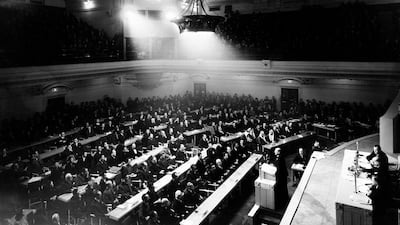
The first session of the UN General Assembly opens on 10 January, 1946 at Central Hall in London. Photo: UN -
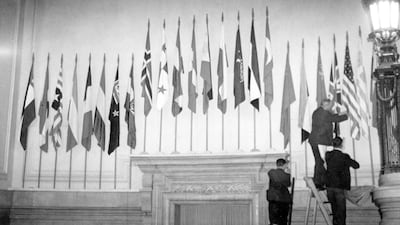
The flags of UN members being put up over the main entrance hall in Central Hall in 1946. Getty Images -
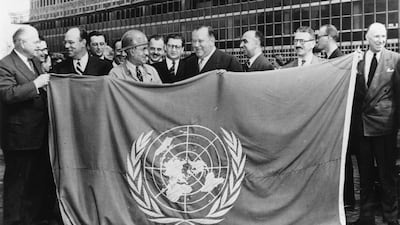
UN Secretary General Trygve Lie, centre, displaying the UN flag in front of the incomplete UN headquarters building in New York, in 1949. Getty Images -
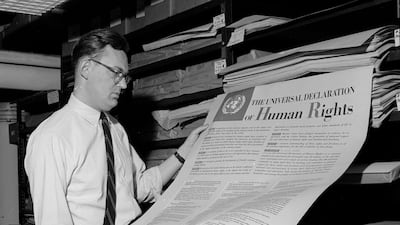
One of the first documents published by the UN, The Universal Declaration of Human Rights, which was ratified in 1948, is seen in New York. Getty Images -

The General Assembly of the UN in 1960. Getty Images -
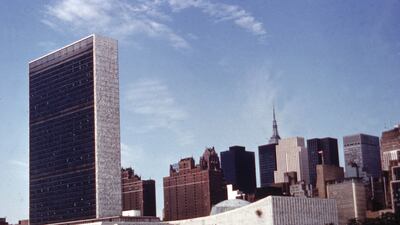
The UN headquarters in New York in the 1960s. Getty Images -
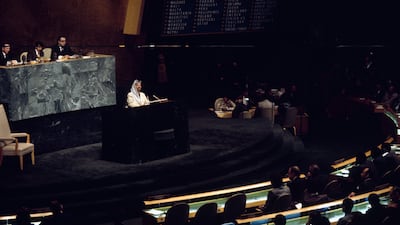
Palestine Liberation Organisation chairman Yasser Arafat speaking at a plenary session of the General Assembly of the UN in 1974. Getty Images -

A UN patrol vehicle in Daru, Sierra Leone in 2001. Getty Images -
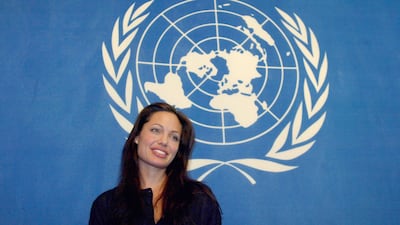
Actress and United Nations High Commissioner for Refugees goodwill Ambassador Angelina Jolie gives a press conference in Moscow, Russia, in 2003. Getty Images -
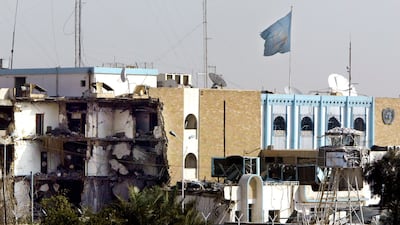
Damaged UN headquarters after a car-bomb attack in Baghdad, in 2003. Getty Images -
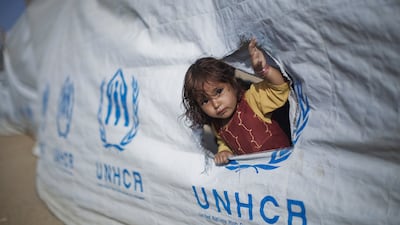
A displaced Pakistani girl looks out from a hole in a fence before departing Yar Hussain UNHCR camp in Chota Lahore. Getty Images -
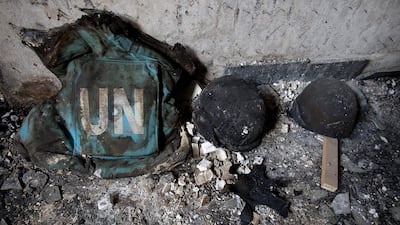
A UN flak jacket and helmets lie on the floor inside a destroyed guesthouse in Kabul, Afghanistan in 2009. Getty Images -
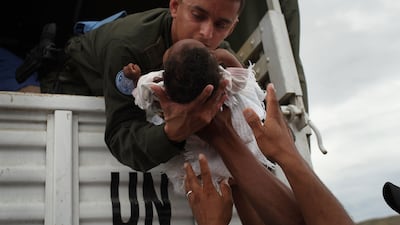
UN peacekeepers evacuating more than 1,000 of the most vulnerable residents of the Corail-Cesselesse relocation camp before Tropical Storm Tomas makes landfall in Port au Prince, Haiti in 2010. Getty Images -
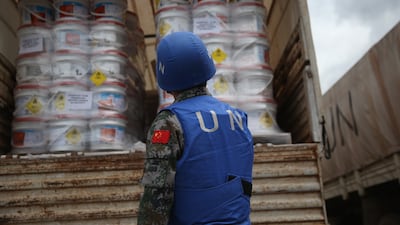
A Chinese UN soldier prepares a lorryload of Ebola relief aid, in Harbel, Liberia in 2014. Getty Images -
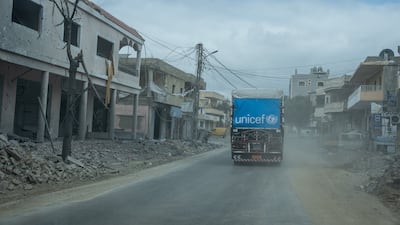
A Unicef aid lorry passes buildings damaged and destroyed by Israeli air strikes, in Kafra, Lebanon in 2024. Getty Images -
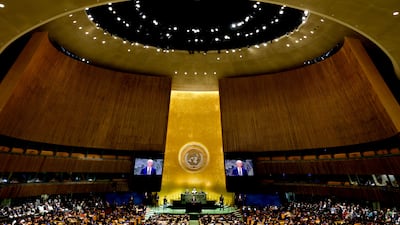
US President Joe Biden speaks at the UN General Assembly in New York in 2024. Getty Images


Mr Trump could, if he was inclined, quote a number of precedents for shaping the world of hemispheric interests that currently dominate his mindset.
For an explanation of the US President’s motivations, it does not require much more than to look at a map. The vast access point that Greenland represents to the Arctic region is something that the US leader sees as significant. This is not least to his Golden Dome project to acquire Israel-like defences against continental threats.
There are many points floating around to counter Mr Trump’s logic. For example, the southern point of Greenland is almost 2,500km from the northern tip of Maine. Or that the US foreign policy tilt has left its Nato allies scrambling for a new strategic direction. Mark Carney, for instance, travelled to China last week, making the first visit by a Canadian prime minister to the country in almost a decade.
None of this matters to Mr Trump.
It may be more pertinent to mention that China’s adoption of the status “near-Arctic state” in 2018 was a development during the first Trump term. In embracing this policy, it argued that its climate vulnerability and economic interests made a polar silk road inevitable. Meanwhile, the prevalence of Russian naval ships and submarines transiting around the UK past Iceland and Greenland may not be much of a practical issue these days, but for the Trump White House it is a potential encroachment on the US sphere of interest.
The sense of an Atlantic relationship in which both sides are talking a different language could not be more real. When the Nato countries decided to send small detachments of troops to Greenland last week to scope out a more active presence, the Europeans saw this as a good-faith response to Mr Trump’s security concerns.
The US President was contemptuous, seeing it as an affront to his country’s power and stepping up his encroachment plans for Greenland. Despite sealing a trade deal on tariffs with Europe just months ago, he announced a new 10 per cent hit.
There is a directional shift that can’t be reversed, and the penny is dropping. US Treasury Secretary Scott Bessent played down tensions with Europe at the weekend, but used the same White House tone that the US knows better what’s good for Europeans than their own leadership. “Europe is being overrun with Chinese goods,” he told a TV interviewer. “There is now an emergency is Europe.”
In other words, he meant to say: “Get with the Trump programme, Europe.”
True believers in the UN will never accept that the international system can be ground to dust. There were many prominent and distinguished people in the hour-long queue on Saturday afternoon in central London for access to the 80th anniversary jamboree. This included parliamentarians, ambassadors and academics.
The frontline of the storm that Mr Trump is bringing to the world is the UN, which is hunkering down to survive. In this, the organisation has one great asset: it can preserve the ethos that was first laid out in the post-Second World War era. As Mr Hermer told the meeting, the UN’s task now is to remain “true to the timeless values that inspired its foundation”.

