
Last month’s recognition of Somaliland by Israel generated strong protest from Somalia, which claims sovereignty over the territory that broke away about three decades ago. But Somalia refuses to accept Israel’s 80-year sovereign existence while Israel condemns the recognition of a Palestinian state by 157 countries.
Meanwhile, Russia and Ukraine battle over Donbas, Cambodia and Thailand dispute their borders, Rwanda and the Democratic Republic of the Congo skirmish in Kivu, India and Pakistan spar over Kashmir, and China flexes its military muscle over Taiwan.
Common here is competition for territory by nations claiming history on their side. Or they assert that the unfair hand that history dealt them justifies wars of correction, such as after the Great Powers imposed post-war boundaries on small European nations or departing colonialists delineated independent nations across the Global South. Not forgetting the Soviet Union’s initial territorial acquisitions and subsequent break-up.

But how far should they look back to justify dying to defend or grab land? Strong affinity to ancestral territories associated with cultural traditions and myths is the foundation of many national identities. They get embellished with repeated reiterations down generations to attain the sacred status evident in national anthems and symbols. Thus, it is difficult for governments to surrender even an inch of sovereignty to others.
The land quest also provides ample fuel for nationalists who may instrumentalise the ethnicities shared across frontiers through historical migrations. That is what Adolf Hitler did with his earliest conquests to consolidate the Aryan Germanic people.
When old history can’t be stretched to justify aggression, new history is created through modern arguments such as national security and access to critical resources. US President Donald Trump’s craving for Greenland is concerning in that context.
The reality is that nations have always formed and fallen, expanded and shrunk through conquest and defeat. A sobering thought for many states that did not even exist a century ago. Illustration is provided by the US itself: born through revolution out of the world’s greatest territory-holder, the British Empire. It seems that Greenland has also been up for grabs: originally colonised by a 17th-century Nordic kingdom, it became Danish in 1814 only after splitting from Norway.
So when did history’s shifting territorial legacies get cast as sacrosanct principles of sovereignty, territorial integrity, and inviolability of borders? In 1945, with the UN Charter’s radical provisions that prohibit force to alter borders or acquire territory and obliges states to seek peaceful dispute resolution.
How well has this rules-based order worked to settle territorial disputes?
Post-Second World War, 50-odd territorial disputes have been settled, many without confrontation or fuss. Successes include the Soviet Union and China negotiating their frontier and the Vatican mediating the Argentina-Chile border settlement. Australia and Timor-Leste settled their maritime boundaries through conciliation while Croatia and Slovenia resolved their border problem through external arbitration.
Such agreements are laudable and in keeping with the UN Charter’s spirit of co-operation and harmony, but they rely on mutual good faith in abiding by agreed processes – either bilateral negotiations or third-party intermediation.
For the less saintly minded, the UN Charter offers the International Court of Justice. Mutual goodwill is still essential as the ICJ cannot enforce its rulings, and only 74 of 193 UN member states recognise ICJ jurisdiction for settling territorial disputes. Notably, that includes only one Security Council member, the UK, which complied with an ICJ judgement to return sovereignty over the Chagos Islands to Mauritius.
ICJ referral has resolved several disputes such as between Burkina Faso and Mali over their post-colonial boundary, Libya and Chad over land, status of an island between Qatar and Bahrain, and the sovereignty of Caribbean islands between Nicaragua and Colombia.
“There is no peace without justice,” goes a maxim and the ICJ appears to have prevented or stopped several territorial conflicts. But the court’s further value is through developing crucial jurisprudence. Building on customary international law and norms, its advisory protocols reduce the toxicity of countless frictions that are routine in international relations.
Noteworthy here is the principle of newly sovereign states retaining their contentious colonial boundaries, thereby preventing potential wars between neighbours. The ICJ has also innovated by incorporating traditional values of fairness by not insisting on winners and losers in complex disputes without clear legal answers.
For example, it has urged equitable resolutions through shared sovereignty such as the joint Swiss, German and Austrian “co-dominium” over Lake Constance. Or joint development zones to share rights and benefits as between Malaysia and Thailand in the Gulf of Thailand. Although they are supposedly temporary solutions, they last indefinitely and create new history.
But are the golden days over? The first challenge is from non-state actors asserting territorial control without being party to sovereign agreements. That has required settlement through force as by Azerbaijan in Nagorno-Karabakh, or in countering ISIS in several countries, or in relation to the Houthis in Yemen, and Kurds in Turkey, Syria and Iraq.
Second, climate change’s environmental changes are altering physical reference points. One third of the total length of international boundaries follow unstable riverbanks leading to territorial losses and gains or creating ungoverned criminalised spaces such as between Thailand and Myanmar. Similarly, free-for-all high seas provide grey zones for conflict as with US attacks on alleged narcotics traffickers in the Caribbean.
-
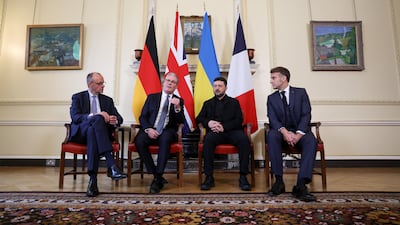
From left: Friedrich Merz, Keir Starmer, Volodymyr Zelenskyy and Emmanuel Macron at 10 Downing Street. Getty Images -
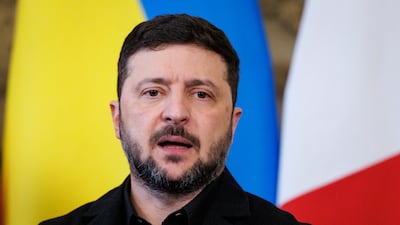
Mr Zelenskyy speaks during the talks, which are aimed at ending Russia’s war in Ukraine. EPA -

Mr Starmer with the leaders outside 10 Downing Street. Reuters -

Mr Starmer welcomes Mr Zelenskyy. Getty Images -

Mr Macron arrives at Downing Street. AFP -

Mr Starmer greets Mr Merz on his arrival at Number 10. AFP


Melting Alpine glaciers have already required amicable modifications of the Swiss-Italian border. Will that happen peacefully in the Himalayas where India and Nepal intersect with China and Pakistan?
Rising sea levels that inundate coastlines and submerge islands may cause states such as Kiribati and Maldives to disappear, or affect sovereignty over valuable maritime resources. Conversely, the construction of artificial structures to extend marine boundaries has considerable tension-provoking potential, as in the South China Sea.
Current international law is not robust with new challenges. This is not helped by institutional fragmentation with tribunals under the UN Law of the Sea and Human Rights Courts following different legal principles and nibbling away at the ICJ’s jurisdiction.
But most of all, the credibility of international territorial law is threatened by power rivalries that delay, derail and discourage peaceful remedies. The legality of US intervention in Venezuela is questioned but follows in the wake of Russia’s refusal to accept rulings on Crimea, China’s non-compliance with the South China Sea arbitration award and Israel’s rejection of ICJ opinions around Palestine.
Unsurprisingly, conflicts have increased within and between nations. The 200,000 “conflict events” that caused 240,000 deaths last year have diverse parameters. But they often crystallise around physical geography and instrumentalise associated sentiments and interests to aggravate violence. Can international law help?
Less and less. Our 80-year-old international law norms have served well relatively weaker states with minor disputes. But inconsistent application and selective manipulation by powerful states feed perceptions of their irrelevance for tackling more serious or fundamental contentions, or in regulating fair relations between countries of different strength.
That is the new reality as we transition from the rules-based order to the new “might makes right” order. What will be its legal norms? Disturbingly, the adage that “possession is nine tenths of the law” comes to mind which, incidentally, was how the conquest of the American West was justified.
New norms and laws for a new order are what nations should consider. Not simply lamenting or condemning the overthrowing of the old dispensation. It is a debate more urgent by the day.

