


It's funny how things work out – one minute, you're minding your own business at a high-profile event, trying to see if there are any hors d'oeuvres left; the next, you're on stage presenting a major presidential declaration.
In April 2023, I was assigned to attend an event hosted by Arab America, a prominent national organisation focused on representing Arab-American interests. I was unfamiliar with the event and didn't think there would be any news made there, but I knew that there would be members of Congress in attendance and I thought it might be an opportunity to network with the Arab-American community in Washington.
Being the first to arrive, I picked a chair in the far corner where I could get a full view of the event. I stayed put as people trickled in and was nearly jarred from my seat minutes later by a very loud, rhythmic banging. I turned to see a huge dabke (a Levantine style of dance) troupe coming up the stairs, followed by dozens of attendees.
I looked around, scanning the room for familiar faces, and followed the procession next door for a better view of the proceedings.
Later in the evening, as I stood by the door, longing for my abandoned chair, I looked to my right and saw a prominent member of Congress, one whom I had been hoping to meet all night. I said hello, we shook hands and I was about to introduce myself, when the politician abruptly handed me a large picture frame, asking me if I could “present this and say a few words”.
I didn’t know what “this” was and, before I had a chance to examine it, the politician was gone, leaving the frame in my hand and her friend laughing next to me.
The frame I was to present held President Joe Biden’s signature on a document declaring April as Arab-American Heritage Month. I can't remember who I gave the declaration to or what I said after being called up on stage, but I do remember being enthusiastic about it, if a bit confused.


While the tale of how I bungled my way through that major event has been met with general amazement and hilarity from my friends and colleagues, in recent days, it's made me think about how things have changed so drastically for the Arab community over the past year.
Reflecting on the significance of Arab-American Heritage Month and how it could possibly affect our community, I've come to realise that – just like Black History Month in February, Hispanic Heritage Month from September 15 to October 15, and Asian-American and Pacific Islander Heritage Month in May – the declaration is ingratiating and symbolic, while also helping to bring unaddressed issues to the attention of politicians and people outside of the community.
And this is probably more important than ever before.
Now a year has passed, and Arab Americans have a very different view of Mr Biden. Feelings of betrayal are ripe in almost every conversation within Arab circles. Once held in esteem as the sane, safe alternative to his predecessor, much of the community now holds Mr Biden and his administration accountable as facilitators – and even perpetrators – of the ongoing assault against the people of Gaza.
In fact, a poll conducted by the Arab-American Institute during the early months of the war on Gaza showed Mr Biden’s support from the Arab community had plummeted from 59 per cent to a mere 17 per cent.
This is an election year, and such numbers can swing results in favour of Mr Biden’s putative rival, former president Donald Trump. Mr Biden has struggled in the polls since before the war in Gaza. According to 538, at six months out from the election, his disapproval rating is at 55 per cent.
The current administration’s campaign tactics, focused primarily on reproductive rights, forgiving student loans and the survival of American democracy, have done little to persuade the Arab community that their concerns are a priority.
Mr Biden has invited prominent Arab Americans to the White House for a Ramadan Iftar, but the event was scaled down since most of the invitees refused to attend and left in protest. During the event, the President was given a letter from an eight-year-old girl in Gaza who lost her entire family by Dr Thaer Ahmed, who then left the event.
-
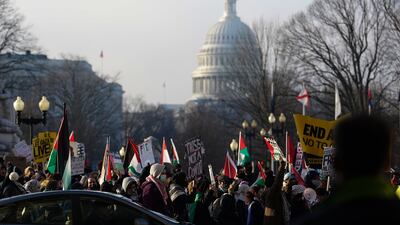
Pro-Palestinian demonstrators take part in a protest against the continuing war in Gaza outside Union Station in Washington on February 1. EPA -
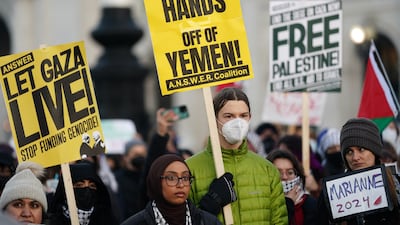
Tens of thousands of Palestinians have been killed since the militant group Hamas launched an unprecedented attack on Israel from the Gaza Strip on October 7. EPA -
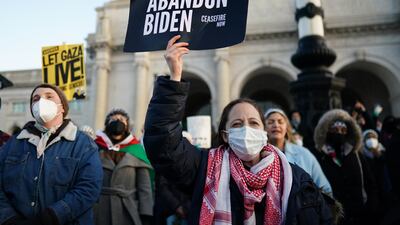
Israeli has responded with a military onslaught in the Palestinian enclave. EPA -
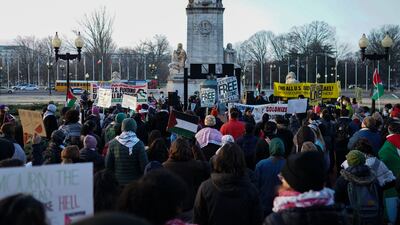
The rally in the US capital drew protesters from far and wide. EPA -
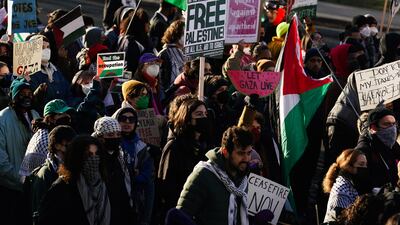
Meanwhile, US Defence Secretary Lloyd Austin has said Joe Biden's administration must do more to address the issue of the besieged Palestinian people. EPA -
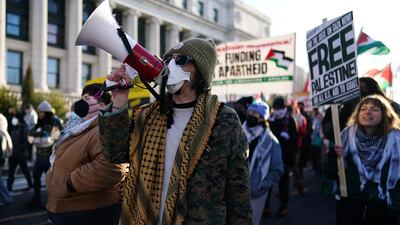
Mr Austin said in regular talks with Israel he has stressed the need to protect civilian lives and provide humanitarian aid to the Palestinians. EPA -
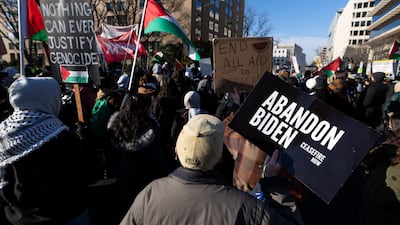
Demonstrators block a junction near the US Capitol as President Joe Biden attends the National Prayer Breakfast. Getty Images -

Protesters in Washington call for a ceasefire in Gaza. Reuters -

Pro-Palestine demonstrators shut down interstate ramps on the street on Capitol Hill, Washington. Reuters -

Gaza protests in Washington. The National -
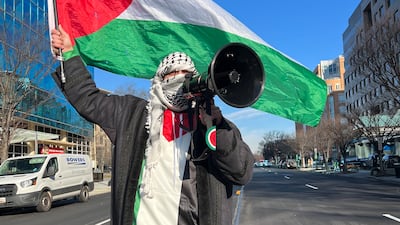
A person participates in the protest in Washington. The National -
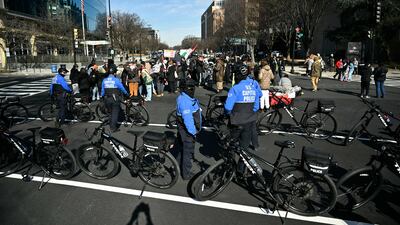
Metropolitan Police Department officers as members of the anti-Zionist Jews group Neturei Karta join pro-Palestinians people blocking a street close to the US Capitol in Washington DC. AFP -
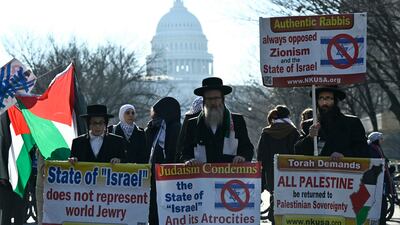
Members of the anti-Zionist Jews group Neturei Karta join pro-Palestinians people blocking a street close to the US Capitol in Washington. AFP


Gaza has brought different parts of the Arab, Muslim and even Jewish communities together in a way that was not imaginable before the war. It has opened channels and conversations between students and teachers, neighbours and strangers, imams and rabbis, all of whom are sharing their vision of a just future.
Such conversations might not have an impact on the Oval Office or in the halls of the State Department, but they have become powerful tools in shifting public opinion about the Palestine-Israel conflict. Members of Mr Biden's own Democratic Party are now openly pushing for a ceasefire and an increase in aid to Palestinians, and a March Gallup poll suggests that a majority (55 per cent) of Americans disapprove of Israel’s actions in Gaza. Approval of Israeli military actions dropped from 50 per cent in November 2023 to 36 per cent in March.
Arab Americans face a hard decision come November, since most agree that Mr Trump would certainly not hold their interests any higher than Mr Biden. US foreign policy is, however, a massive vessel that will not dramatically change course based on the inhabitant of the White House.
That being said, focus on Arab Americans has reached new levels, especially from centrist Democrats fearing the absence of their votes would significantly alter the outcome of the election and signal a sea change in American minority politics.
As fraught has the past year has been, and as dissatisfied as I have become with the American political landscape, I do believe some celebration is in order.
Having the Arab American vote pushed to the forefront of US politics during a presidential election and seeing Arab American voices and opinions legitimised on national media outlets are welcome – albeit possibly temporary – changes to those who have long felt excluded or unheard. And, despite the ongoing atrocities and horrors presented by the war in Gaza, we finally have something we have been waiting for: an America and a world that is paying attention.

