
A coalition of 80 countries on Thursday called for the full restoration of maritime navigation in the Arabian Gulf, warning that restrictions imposed by Iran and renewed attacks by Houthi rebels were threatening international trade and regional security.
“We call for the full restoration of navigational rights and principles without delay,” Bahrain’s Foreign Minister Abdullatif Al Zayani said, reading a joint statement to reporters on the sidelines of the UN General Assembly.
The countries called for the urgent reopening of the Strait of Hormuz and for vessels to be allowed to transit safely without tolls, conditions or what they described as illegal charges.
“Iran’s actions in the Strait of Hormuz continue to threaten international security and navigational rights and freedoms,” the statement said.
The coalition, which includes Gulf Arab states and major western powers, also condemned Iran’s attacks against countries in the region and its disruption of international trade and energy supplies.
“Five months after our last press takeout on this very issue, the threat we face remains very real and continues to grow,” Mr Al Zayani said.
He spoke of an attack on a commercial vessel off the coast of Oman on Wednesday that killed an Indian crew member, as well as six ballistic missiles launched by Houthi rebels towards Saudi Arabia on Thursday. Saudi authorities said the missiles were intercepted.
The coalition called for the “urgent and full reopening” of the Strait of Hormuz and the safe and secure passage of vessels “without the imposition of tolls, conditions, or illegal charges", in accordance with international law.
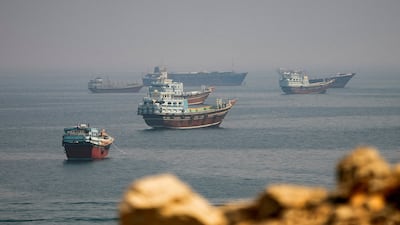
Restrictions on shipping through the strategic waterway have disrupted maritime traffic since the start of US-Israeli attacks on Iran in February. The Strait of Hormuz, connecting the Arabian Gulf with the Arabian Sea, is one of the world’s most important energy corridors.
The statement also condemned the Houthis' decision to resume fighting in Yemen, their strikes on Saudi Arabia and attacks in the Red Sea.
Mr Al Zayani warned that advances by Houthi rebels towards the Bab Al Mandeb strait, another critical shipping chokepoint linking the Red Sea and the Gulf of Aden, could cause further disruption to global maritime trade.
“Commercial shipping and seafarers must never be used as leverage,” he said.
Saudi Arabia and the Houthis
Riyadh said on Thursday it had intercepted six ballistic missiles aimed at the Red Sea port of Yanbu and the south-western city of Taif, blaming the attacks on Iran-backed Houthi rebels in neighbouring Yemen.
The Houthis did not immediately claim responsibility. The group has been blamed for several attempted attacks on the kingdom in recent days, including strikes aimed at the Saudi capital.
Saudi Arabia’s Foreign Minister said Yemen’s internationally recognised government was capable of defending its territory against the advancing Houthi forces, while stressing that preserving the country’s unity remained Riyadh’s priority.
Asked by The National on the sidelines of the UN General Assembly whether Saudi authorities were in direct contact with the Houthis and whether the group could advance on the southern city of Aden, Prince Faisal bin Farhan said the Saudi-led coalition would continue supporting the Yemeni government.
“I think the government of Yemen is very capable of defending the territory that it controls,” he said.
The coalition would continue working with the government to help it “impose its control over all of Yemen”, he added.
“The priority must be for the unity of Yemen.”
Fighting has intensified in recent weeks as the Iran-aligned Houthis have made gains along Yemen’s western coast and around the Bab Al Mandeb.
Prince Faisal said Saudi Arabia was responding to Houthi attacks against the kingdom but was also co-ordinating with international partners.
“This is not just about Saudi Arabia,” he said. “The responsibility to dealing with this threat is not just on Saudi Arabia. It is also on the whole international community.”

