


Live updates: Follow the latest news on the Iran war
Hezbollah is operating as an arm of Iran, not Lebanon, France’s ambassador to the United Nations has warned, as intensifying clashes with Israel drag Beirut into a regional war that has killed hundreds of people and displaced more than a million.
In an interview with The National, Jerome Bonnafont said the militant group’s recent actions underscored its allegiance to Tehran over Beirut.

“What Hezbollah has done after the death of the supreme leader demonstrates that Hezbollah is not fighting for Lebanon. Hezbollah is not fighting for a national cause. It is a proxy of Iran. It is acting under the orders of the Iranian regime,” Mr Bonnafont said. “It is attacking Israel, indifferent to the consequences in Lebanon.”
The renewed conflict, which started on March 2 after Hezbollah fired missiles into northern Israel in response to the US-Israeli war on Iran, has caused widespread destruction and paralysed the economy. This has fuelled a deepening a crisis that has gripped Lebanon since its financial collapse in late 2019. The country was already struggling to recover from the previous Israel-Hezbollah war in 2024.
More than 1.2 million people have been displaced in recent weeks, and at least 1,345 people killed, according to Lebanon’s Ministry of Public Health.
The escalating violence has also hit UN peacekeeping forces in southern Lebanon, killing three Indonesian blue helmets.
Mr Bonnafont said there was “something extremely tragic” about Hezbollah dragging Lebanon into another war when the country “was starting to rebuild a political consensus, to rebuild a capacity to reform, to rebuild a national pact”.
“Lebanon should not be a victim of this situation, and Lebanon has to be helped to go out of this spiralling effect,” he added.
-
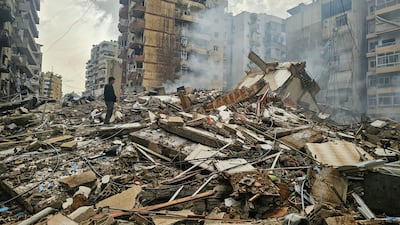
A man stands in the rubble of a building destroyed in an overnight Israeli air strike on Haret Hreik, in Beirut's southern suburbs. AFP -
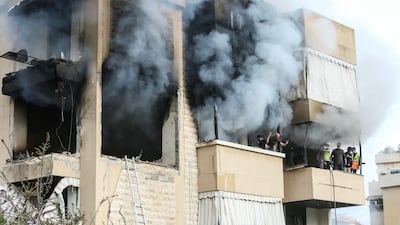
Emergency workers at the site of an Israeli air strike on an apartment building in Haret Saida, on the outskirts of Sidon. AFP -
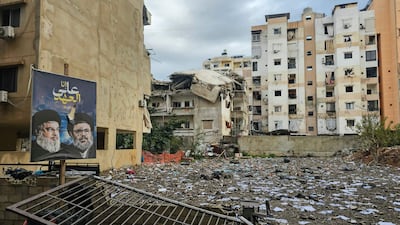
A banner bearing portraits of slain Hezbollah leaders Hassan Nasrallah, left, and Hashem Safieddine at the site of a strike on Burj Al Barajneh, in Beirut's southern suburbs. AFP -
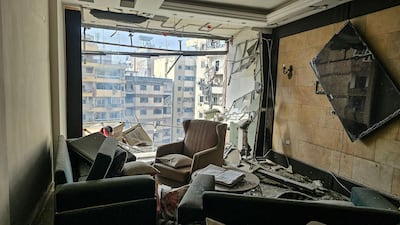
Damage from an Israeli air strike in Haret Hreik. AFP -
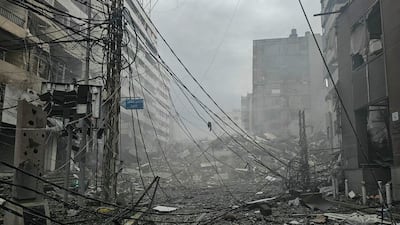
Downed power lines and destroyed buildings in Beirut’s southern suburbs. AFP -
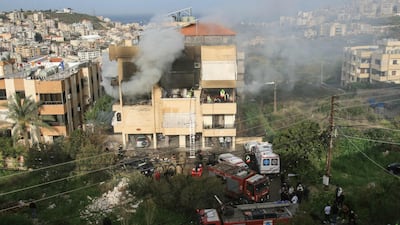
Emergency personnel tackle a fire after an apartment building in Haret Saida was hit. AFP -
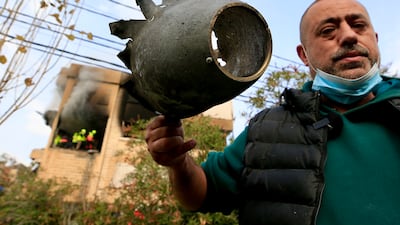
A man holds missile debris in Haret Saida. EPA -

Plumes of smoke rise following Israeli strikes on Beirut's southern suburbs, seen from Baabda. Reuters -
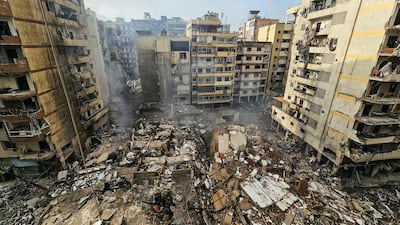
The aftermath of an Israeli air strike in Haret Hreik. AFP -
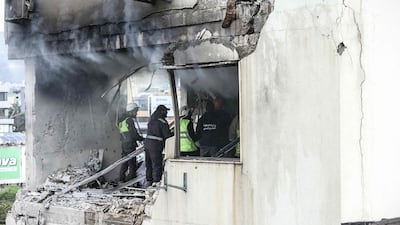
Emergency workers respond after an apartment was hit in Beirut's Burj Hammoud suburb. AFP -
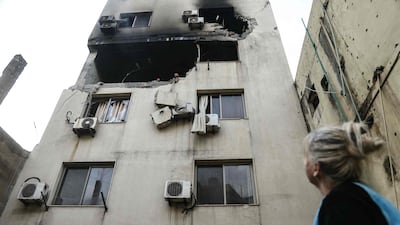
A damaged building in Burj Hammoud. AFP


Mr Bonnafont said that reversing Lebanon’s downwards spiral would require a renewed focus on strengthening state institutions, particularly the Lebanese Armed Forces, which he described as central to restoring sovereignty and stability.
“Hezbollah is a militia. A militia has to be disarmed by the Lebanese state itself,” he said. “We have to help the Lebanese government, the Lebanese Armed Forces be able to disarm, like they have said they want to do, and to neutralise the military capacity of Hezbollah, so that Hezbollah is no longer in a position to be a military ally of Iran against Israel.”
France has long positioned itself as a key diplomatic actor in Lebanon, with which it has deep historical ties.
But Mr Bonnafont acknowledged that international efforts to support Lebanon have fallen short, even as new initiatives are being prepared.
“One cannot simply say that nothing was done,” he said. “A lot more had to be done. A lot more was being prepared, and a lot more will have to be done whenever the situation allows.”
Still, he argued that the current military escalation offers no viable path forward.
Hezbollah’s tactics, he said, place civilians at disproportionate risk while accelerating the country’s destruction.
“It is clear for us that the present military escalation is not the solution,” he said. “Hezbollah is conducting asymmetric hostilities in which civilians are the first to pay the price, and Hezbollah doesn’t care about the price that civilians pay, or the destruction that the country is suffering.”
Lebanon’s government, he noted, has taken steps that could mark a turning point in the country’s modern history.
Officials have formally called for Hezbollah’s disarmament and moved to classify its military activities as illegal, a decision Mr Bonnafont described as “historic”.
“This means the Lebanese government wants the country to be freed from militias,” he said. “And this is a basic of the sovereignty of a state.”

He also pointed to signals from Lebanon’s leadership suggesting a potential diplomatic shift. President Joseph Aoun, he said, has expressed openness to direct talks with Israel, a prospect that would have been unthinkable just a few years ago.
“There is a decision expressed by President Aoun himself that he wants direct discussions with Israel,” Mr Bonnafont said. “And you know, as well as me, this is also a shift of historic importance.”
Such talks, he suggested, could lay the groundwork for a more stable arrangement between the two countries, centred on mutual recognition of sovereignty and territorial integrity.
“This is the key for us,” he said.
At the same time, Mr Bonnafont pushed back against Israeli rhetoric suggesting the possibility of territorial changes in southern Lebanon, stressing that the country’s borders must remain inviolable.
“Lebanon is a state with a territory,” he said. “This territory must be integrally guaranteed, and peace between Israel and Lebanon will come with full respect of the territorial integrity of Lebanon.”
Whether it can do so, Mr Bonnafont suggested, will depend not only on internal political will but also on sustained international backing and a de-escalation of the conflict that has once again placed the country at the centre of a volatile regional struggle.

