

A trade war between the US and Colombia seems to have been averted, after Washington said Bogota had agreed to accept military aircraft carrying deported migrants.
Earlier, Colombia had turned away US military aircraft returning migrants, leading US President Donald Trump to threaten tariffs of up to 50 per cent on Colombian imports. In response, Colombia's President Gustavo Petro pledged to match any US tariffs.
But late on Sunday, the White House said Colombia had agreed to accept the migrants after all, and Washington would not impose its threatened penalties.
“The government of Colombia has agreed to all of President Trump’s terms, including the unrestricted acceptance of all illegal aliens from Colombia returned from the US, including on US military aircraft, without limitation or delay,” it said.
Washington said draft orders imposing tariffs and sanctions on Colombia would be “held in reserve”.
Colombian Foreign Minister Luis Gilberto Murillo said: “We have overcome the impasse with the US government. The government of Colombia … has the presidential plane ready to facilitate the return of Colombians who were going to arrive in the country this morning on deportation flights.”
Colombia and the US had on Sunday traded threats of tariffs after Bogota refused to allow flights carrying deported migrants to land in its territory.
The tit-for-tat tariff threats came after Mr Petro said that his government would not accept flights carrying migrants deported from the US until the Trump administration creates a protocol that treats them with “dignity”.
“A migrant is not a criminal and must be treated with the dignity that a human being deserves,” Mr Petro said on X, explaining why his country would not allow two military planes carrying Colombian migrants to land.
He added that his country would receive its citizens in “civilian planes” and “without treatment like criminals”, saying in a later post that he would not allow flights carrying “handcuffed” Colombians. “I am a man of freedom, not of chains,” he said in another post.
Mr Trump responded on his Truth Social platform by saying he would impose retaliatory measures on Colombia including tariffs, sanctions and travel bans, and that Mr Petro's actions jeopardised US national security.
“These measures are just the beginning. We will not allow the Colombian Government to violate its legal obligations with regard to the acceptance and return of the Criminals they forced into the United States,” he wrote.
Mr Petro issued his own threat of tariffs.
“I have been told that you have placed a 50 per cent tariff on the fruits of our human labour entering the US − I will do the same,” he said in a post on social media site X. “You will never dominate us.”
The US President enacted a series of executive orders in the days after he came into office that have included the sealing of the southern US border and deployment of troops to the area, and a nationwide crackdown on illegal immigration. Mr Trump has insisted that those people who are currently being targeted for detention and expedited deportation are “murderers” and those that “have been as bad as you get”.
-
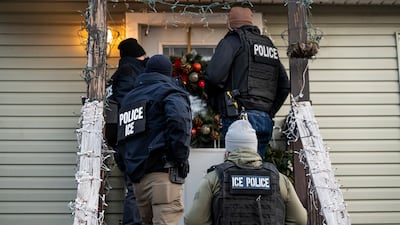
US Immigration and Customs Enforcement agents knock on the door of a residence in Chicago, Illinois. Bloomberg -
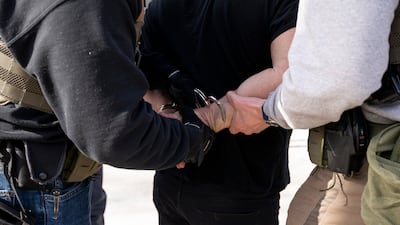
ICE agents detain a suspect Lyons, Illinois, during the immigration crackdown. Bloomberg -
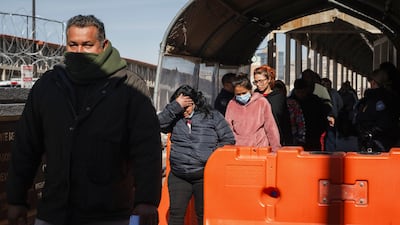
Migrants cross the US-Mexico border after being deported from El Paso, Texas, to Ciudad Juarez, Chihuahua state, in northern Mexico. Bloomberg -
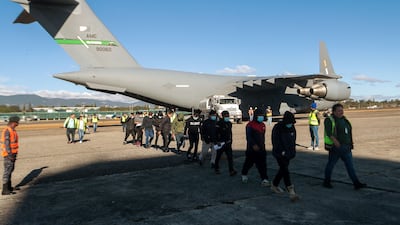
Migrants descend from a US military plane at the Guatemalan Air Force base in Guatemala City, after being deported from America. AFP -

A giant tent in Ciudad Juarez, where Mexican authorities are building temporary shelter for migrants deported from the US. Reuters -
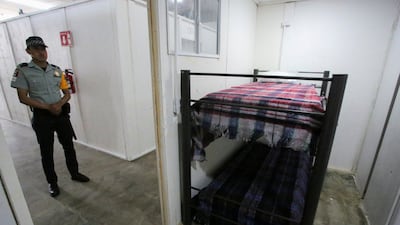
A room at the Flamingos social club, which will be used to house migrants deported from the US, in Tijuana, north-west Mexico. Reuters -
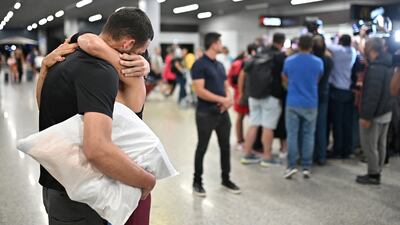
A Brazilian migrant deported from the US is welcomed at Confins International Airport, in Belo Horizonte, eastern Brazil. Reuters -
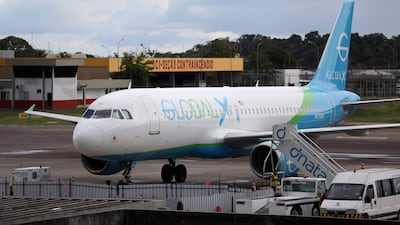
An aircraft that brought Brazilians deported from the US pictured at Eduardo Gomes International Airport in Manaus, Amazonas state, north-west Brazil. AFP -
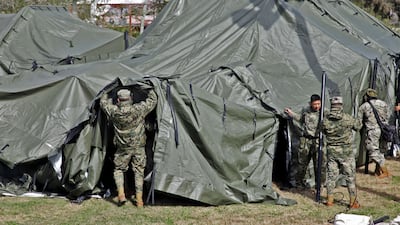
Mexican Navy personnel erect temporary shelter for deported migrants at Matamoros, Tamaulipas state, in north-east Mexico. AFP


Two US Air Force C-17 troop and cargo planes carrying migrants removed from the US touched down early Friday in Guatemala. That same day, Honduras received two deportation flights carrying a total of 193 people.
Mexico has also refused a request from the Trump administration to allow a US military aircraft deporting migrants to land in the country, Reuters reported, quoting American and Mexican officials.
The Mexican official did not give a reason for the denial of permission to land.
In a statement late on Friday, the Mexican Foreign Ministry said the country had a “very great relationship” with the US and co-operated on issues such as immigration.
“When it comes to repatriations, we will always accept the arrival of Mexicans to our territory with open arms,” the ministry said.
As part of the immigration crackdown, the Trump administration announced it was relaunching the programme known as “Remain in Mexico”, which forced non-Mexican asylum seekers to wait in the country until their cases in the US were resolved.
Mexican President Claudia Sheinbaum said on Wednesday such a move would require the country receiving the asylum seekers to agree, and that Mexico had not done so. Ms Sheinbaum has said she does not agree with mass deportations and that Mexican immigrants are vital to the US economy.

