


Latest updates: Follow our full coverage on the US election
As early Arizona election results trickled in on Tuesday evening, there was optimism among the people who spent the day knocking on voters' doors to rally support for Kamala Harris and down-ballot immigration issues.
Arizona is the only swing state on the US border with Mexico, and with nearly a million immigrants living here, the stakes in the race between Ms Harris and Donald Trump were high.
A coalition of immigration advocates, including those from other border states such as Texas and California, huddled into Phoenix's expansive Corona Ranch and Rodeo venue for a night of food, drinks, live music and dancing.
Parents played and danced with their young children, running around waving blue balloons and chanting “Si se puede” or “Yes, you can”. Cowboy hats and campaign T-shirts were worn throughout the room.
“I think that there's a lot of reasons to be a little scrambled and afraid, but I'm feeling really good. I feel really grounded,” Greisa Martinez Rosas, an undocumented activist with the US advocacy group United We Dream, told The National.
“We've been preparing for this moment for the last three years. We know what it feels like to win, and we know what it takes to win.”
But Arizona Proposition 314 passed with a significant majority among voters – almost 63 per cent support. The measure makes it a crime for non-citizens to enter the state at any location other than a port of entry, allows state and local police to arrest non-citizens who cross the border illegally, and permits state judges to order deportations.
The rise in migrant crossings has been felt strongly in Arizona, and Republican backers of the measure claim it will help to better secure the US border and block a national surge in drug trafficking.
Immigration advocates, up early on election day in their final push to talk to Maricopa County voters, said the fate of this bill would have implications across the whole US.
“The reason that we are trying to actively fight against this resolution is because I think what we're going to see … more of a turn towards state and local enforcement of anti-immigrant laws … and then we're going to see copycats around the country,” Michelle Ming, United We Dream's policy director, told The National on Tuesday.
The bill's passing, paired with a sweeping Republican mandate including control of the White House, Senate and probably the House of Representatives, will result in reliving the “trauma” experienced by immigrant and undocumented workers under the previous Trump administration.
As the reality settled in throughout the night on Tuesday, those remaining in a fast-dwindling crowd chose to look at small victories.
“What the night is looking like for me – enjoying it with my peers, my team leads, everybody that has helped us reach 600,000 doors [knocked on in this election],” watch party guest Alex told The National.
“The last few days we've done the best that we can … and whether we lose or win [tonight], we are still going to fight until we win.”
Fear and resolve also crept in. “My sister is a Daca [Deferred Action for Childhood Arrivals] recipient, so this morning, she asked me, like, 'What's going to happen to me?'” Bruna Sollod told The National in the early hours on Wednesday.
-

A mural outside the Sacred Heart Church in El Paso, Texas, where dozens of migrants are seeking shelter. All photos: Jihan Abdalla / The National -
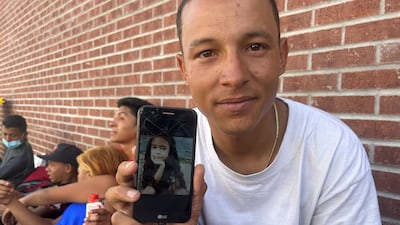
Dhean, 29, shows a picture of his daughter who is still in Venezuela -
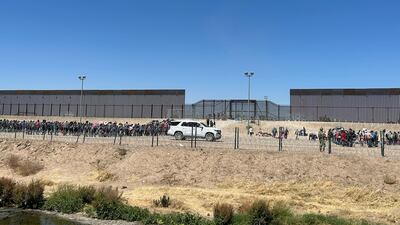
Hundreds of migrants queue at a gate along the US-Mexico border, hoping to claim asylum -

Venezuelan migrant Jose, 27, is hoping to go to Chicago to join his girlfriend -

Paolo, 21, on the right, sits with other migrants outside the Sacred Heart Church in El Paso -
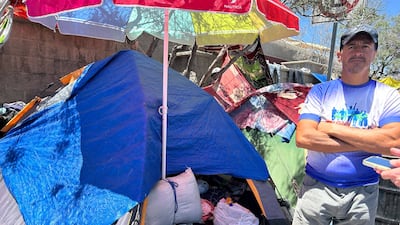
Juan Angel Pabon, 52, stands beside a tent in Cuidad Juarez, Mexico, that he shares with his two daughters -
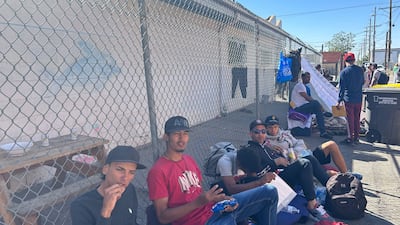
Victor Manuel, 22, left, with other migrants a day after arriving in El Paso -
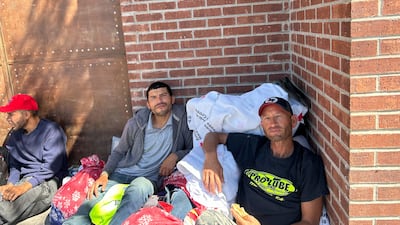
Venezuelan migrants sit outside the Sacred Heart Church


“And I said to her, 'Nothing, because I'm part of a movement that will fight for you and protect you, and so nothing's going to happen to you'.”
She added, however, that “we need to prepare for mass deportation”.
Mr Trump's victory came with a significant gains among Latino voters, particularly men.
“I could talk about the white vote because I'm definitely frustrated by a lot of white women who continue to do this to us,” Ms Sollod said. “But I think there's a lot of work to be done with voters in our own communities and having tough conversations with them, and I think those are lessons to try something new.”
Arizona helped to seal a swift victory for Mr Trump, who has promised mass deportations when he re-enters the White House in January. An estimated 11 million undocumented migrants live in the US, although conservatives say the true figure may be two or three times that number.
Mr Trump said he would call on Congress to provide funding for another 10,000 border patrol agents, and has even quoted a founding-era law – the 1789 Alien Enemies Act – as a means of deporting immigrants with criminal records.
That has particular implications for Arizona. About 13 per cent of the state's residents were born in another country, and 16 per cent of residents are native-born Americans with at least one immigrant parent. One in six Arizona workers is an immigrant, according to the American Immigration Council.
“Our communities have been here for generations, they have built their whole lives here, and the impact of this election in particular will directly effect a lot of people here in Arizona,” Victor Guillen Febres, an organiser who migrated to the US from Venezuela, told The National.
“I came here looking for opportunity, for a better life. It really was a pivotal moment for me in 2016 when I started seeing a lot of anti-immigrant rhetoric and hate.”
Mr Guillen Febres is a former Temporary Protected Status holder, a programme Mr Trump slashed in his first term and could threaten in a second.
Recent data from the Department of Homeland Security, first published by Forbes, shows that up to 2.7 million people could be deported within the next two years if Mr Trump again ends TPS and other immigration protection.
“Arizona has been here before,” said Alejandra Gomez, executive director of Arizona immigration group Lucha.
Discussing the stakes of the US election in Arizona, the phrase “SB-1070” – known as the “show me your papers” law – is mentioned frequently among these mainly Latin and Hispanic-American activists.
Under that state measure, local police were allowed to demand papers and investigate the immigration status of a person suspected to be undocumented, and make arrests without warrants if they believe they are deportable immigrants.
The fear it inspired for many families in Arizona is remembered well as they prepare for another Trump term.
“Time and time again at the doors we heard the stories of the families that were separated, and once again we're living that reality again. No matter what, we know we're still going to be here, this is our home,” Ms Gomez said.
Ms Sollod said that the work begins now. “Our mandate for the next few weeks and months is to show immigrants that they are not alone, they are not going back into the shadows … we're going to fight like hell to make sure people are able to stay with their loved ones.”

