

Live updates: Follow the latest news on Israel-Gaza
UN humanitarian aid operations in Gaza were forced to halt on Monday following new evacuation orders from Israel, issued late on Sunday for Deir Al Balah in the central Gaza Strip, a senior official said.
“What transpired over the weekend brings us to a point where we just cannot continue to operate, and it's not under our control … practically we cannot operate,” the UN official, speaking on condition of anonymity, told reporters.
“This morning, I had a chat with my security adviser on the ground, and I asked, 'are there any operations this morning?' He said ‘no, impossible'.”
The official said the UN had relocated its main command operations for the Gaza Strip and most personnel to Deir Al Balah after Israel ordered the evacuation of Rafah in the south of Gaza.
The Israeli military said on Monday it was going after “terror operatives” in Deir Al Balah and working to dismantle the “remaining terrorist infrastructure” of Hamas, whose attack on southern Israel on October 7 triggered the war in the Gaza Strip.
People in Deir Al Balah were told by the Israeli military on Sunday to “evacuate immediately”.
Despite the operational challenges, the UN official emphasised that the world body has no plans to withdraw from Gaza.
“We need to find solutions,” the official said. “And if it means that we need to anchor down for 24-48 hours and reset, we do that. But we're not leaving. Right now, the challenge is to find a place where we can reset and effectively operate.”
When questioned about whether Israel is viewed as a partner or adversary in the UN's efforts in Gaza, the official said: “Israel is a partner and I think for us … to bring Israel to trust us, to trust the UN.”
Speaking from Gaza, Louise Wateridge, senior communications officer for UNRWA, the UN agency for Palestinian refugees, said about 15 displacement orders have been issued in the past month.
“Every time there is an evacuation order issued, our facilities are very often in those areas and we have had to stop what we're doing and rethink everything,” she said.
-

An injured father comforts his daughter. AFP -

The school playground, in a screengrab from video. AP -
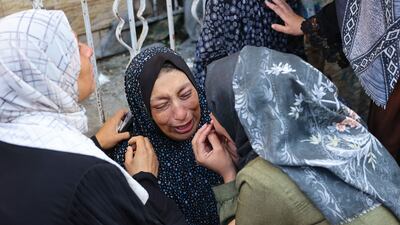
A woman identifies a family member among the dead. AFP -
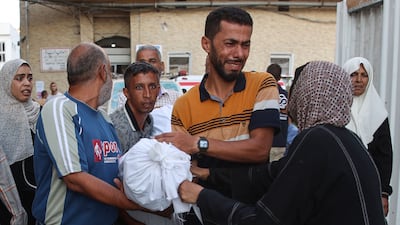
People at a Gaza city hospital carry the body of a family member killed in a strike on a school housing displaced Palestinians. AFP -
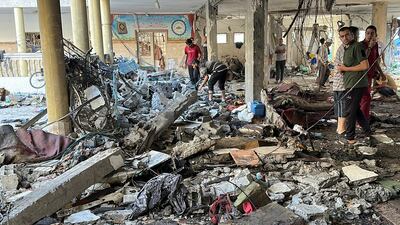
The destroyed school. Reuters -
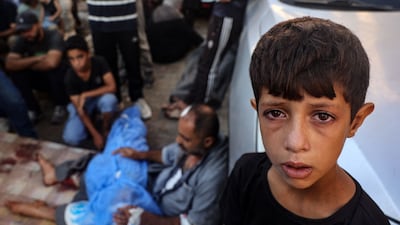
A child at Al Aqsa Martyrs hospital in Deir Al Balah on August 10, in front of a man cradling the body one a family member, killed in an Israeli strike on their home in Nuseirat, Gaza. AFP -
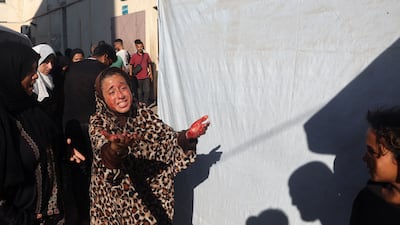
An injured girl at Al Aqsa Martyrs hospital. AFP


Ms Wateridge said there was “no humanity left” in Gaza.
“People are using the sand and building walls with the sand to stop the seawater coming into their makeshift shelters … there are scorpions, there are mosquitoes, rats, mice, snakes among the population who are living in these conditions,” she explained.
“We're seeing an increase in spread of disease … there is very limited hope … It's very degrading for the population. But really, when you talk to people, they tell you now that they are really waiting for death.”
Echoing Ms Wateridge's concerns, Sam Rose, UNRWA's senior deputy field director, said: “We are being squeezed into ever smaller areas of Gaza. The humanitarian zone declared by Israel has shrunk.
“It's now about 11 per cent of the entire Gaza Strip. And this isn't 11 per cent of land that is fit for habitation, fit for services, fit for life, really. These are sand dunes.”
Since the Gaza war began, more than 40,400 Palestinians have been killed, according to Gaza's health authority. More than twice that number have been injured and most of the enclave's 2.3 million residents displaced, some several times.

