

The State Department on Tuesday announced the US has reached a framework agreement with Saudi Arabia on space co-operation.
The two countries said they will develop a strategic relationship to tackle scientific studies, increase commercial investment and establish a legal framework for their joint projects, the SPA news outlet reported.
The agreement, which is focused on co-operation in aeronautics and the exploration of space for peaceful purposes, was signed on Monday.
Nasa administrator Bill Nelson was the signatory for the US while Saudi Space Agency chief executive Mohammed Al Tamimi signed the agreement on behalf of the kingdom.
“Building on my visit to Saudi Arabia earlier this year, I look forward to strengthening our co-operation for the future of exploration,” Mr Nelson said.
“We are living in the golden era of exploration – one that is rooted in partnership. This new agreement outlines how we will work together and explore together for the benefit of humanity.”
The US has long had a presence in space through Nasa and space flights and exploration are being expanded through the private sector.
Saudi Arabia has increased its space-focused projects in recent years and has been in talks about next-generation space stations with other nations.
Riyadh has collaborated with US-based company SpaceX to purchase astronaut spots from Axiom, which resulted last year in the first Arab woman to complete a space mission.
Abdullah Alswaha, chairman of the Saudi Space Agency, said the deal with the US "represents a turning point in the kingdom’s journey towards building a strong and prosperous space sector”, SPA reported.
James Webb space images - in pictures
-
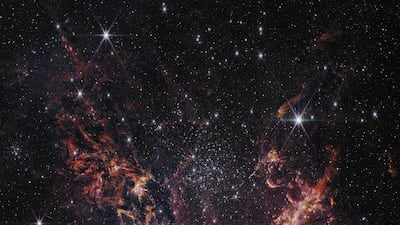
A cluster of stars in the Small Magellanic Cloud in an image taken by the James Webb Space Telescope. PA -
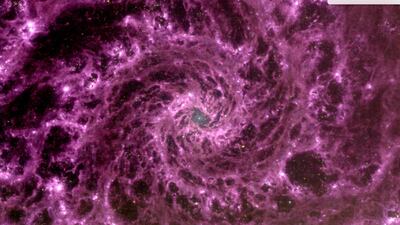
A colour composite image of the Messier 74 galaxy. Photo: Gabriel Brammer (Cosmic Dawn Center, Niels Bohr Institute, University of Copenhagen) / James Webb Space Telescope -
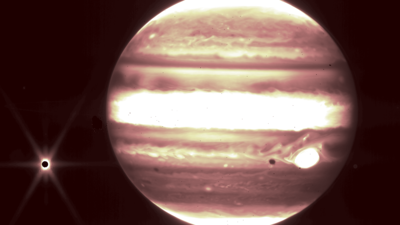
Jupiter and its moon Europa, left, are seen through the James Webb Space Telescope. Photo: Nasa -
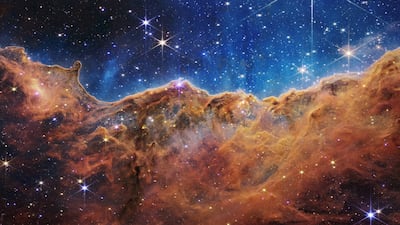
Captured in infrared light by Nasa's new James Webb Space Telescope, this image reveals areas of star birth in Carina Nebula. All photos: James Webb Space Telescope -
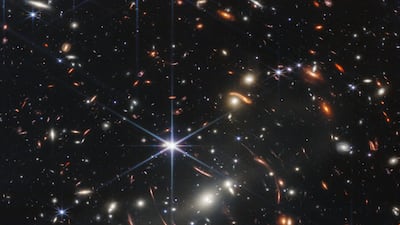
Known as Webb's First Deep Field, the picture showcases a galaxy cluster called SMACS 0723 as it appeared 4.6 billion years ago. The image was revealed by US President Joe Biden on July 11 during an event at the White House. -
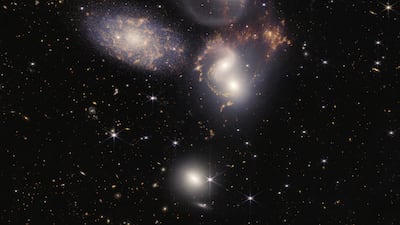
An image of Stephan's Quintet, an area in space with a group of five galaxies. -
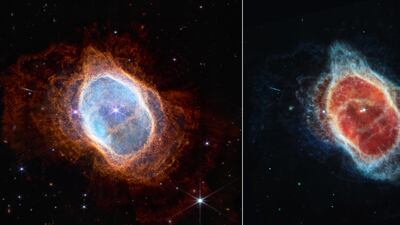
Side-by-side comparison shows observations of the Southern Ring Nebula in near-infrared light (left) and mid-infrared light. -
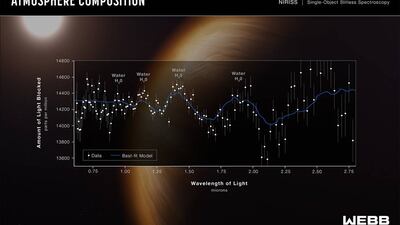
The telescope has captured the distinct signature of water, along with evidence for clouds and haze, in the atmosphere surrounding a hot, puffy gas giant planet orbiting a distant Sun-like star, called WASP-96 b. Photo: James Webb Space Telescope



