

Bolivian President Luis Arce on Wednesday confirmed the country was facing an “attempted coup” after the “irregular mobilisation” of some army units in La Paz.
Heavily armed soldiers and armoured vehicles gathered in the capital's Plaza Murillo, according to videos shared on social media.
Live television feed also showed a military vehicle ramming into the front doors of the Bolivian Government Palace.
“Our country is facing an attempted coup,” Mr Arce, surrounded by his ministers, said in a video posted on Facebook.
“Once again, our country is facing interests that aim to topple democracy in Bolivia.”
He called on Bolivians to organise against the coup “in favour of democracy”.
“Long live the Bolivian people. Long live democracy,” he said, with the call repeated by those around him.
Mr Arce earlier appeared on live TV confronting the general commander of the army, Juan Jose Zuniga, in a hallway, saying: “I am your captain and I order you to withdraw your soldiers.”
Gen Zuniga was later heard demanding political prisoners, including members of the military, be released, and that democracy be re-established in Bolivia.
Troops eventually withdrew from the plaza, with local media reporting that Gen Zuniga had been arrested.
Bolivians flocked to petrol stations to fill up on fuel while others joined long queues to take money out of ATMs.
Mr Arce had previously denounced on X “irregular mobilisations of some units of the Bolivian Army”, adding that “democracy must be respected”.
AFP reported that the military has withdrawn from the plaza.
Leaders in South America, Europe and in the Organisation of American States have condemned the reported coup attempt.
Bolivian TV outlets showed soldiers and two tanks in the square, which is right outside major government buildings in La Paz.
“The three chiefs of the armed forces have come to express our dismay,” Gen Zuniga told a local TV station.
“There will be a new cabinet of ministers. Surely things will change but our country cannot continue like this any longer.”
Gen Zuniga later said he would recognise Mr Arce's authority “for the moment”.
Mr Arce has sworn in new leaders of the army, navy and air force, according to local media.
Former president Evo Morales, who has publicly split with Mr Arce even though both belong to the same socialist movement, called for a national mobilisation of his supporters to back democracy.
He also announced a general stopwork and called for roads to be blocked.
“I ask the people with a democratic vocation defend the homeland from some military groups that act against democracy and the people,” he said on X.
-
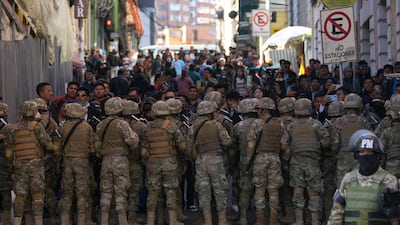
Military police block entry to Plaza Murillo in La Paz, Bolivia. AP -

People wave Bolivia's national flag during a coup attempt against the government of Bolivian President Luis Arce by military units led by Gen Juan Jose Zuniga, in La Paz. Reuters -
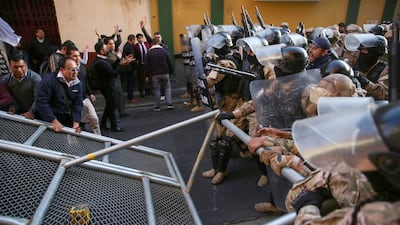
Followers of Mr Arce protest against military personnel trying to enter the government headquarters. EPA -

People help a man stunned by a flash grenade thrown by military police. Reuters -

Military police walk amid tear gas outside the presidential palace at Plaza Murillo. Getty Images -

Soldiers stand guard with an armoured truck outside the government palace at Plaza Murillo. Getty Images -

Bolivian Army Gen Zuniga inside a vehicle during the attempted coup in La Paz. EPA -
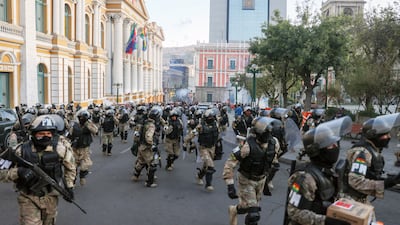
Military personnel withdraw after attempting to enter the government headquarters. EPA -

Mr Arce, left, and Vice President David Choquehuanca greet followers gathered at Plaza Murillo. EPA -

Bolivian police hold the detained Gen Zuniga. AP



