


A senior UN official on Friday said restrictions on women's rights are hindering Afghanistan's reintegration into the international community, adding that the Taliban's participation in upcoming talks in Doha is not “legitimisation” of the isolated government.
Since seizing power in August 2021, the Afghan Taliban have banned schooling for girls older than 12 and have curtailed many basic freedoms for women, including widespread restrictions on employment.
“By being deeply unpopular [the restrictions] undermine the de facto authorities' claims to legitimacy,” Roza Otunbayeva, head of the UN mission in the country, Unama, told the Security Council.
“And they continue to block diplomatic solutions that would lead to Afghanistan's reintegration into the international community.”
No country has yet given full diplomatic recognition to the Taliban.
Last year marked the start of several rounds of UN-hosted talks on Afghanistan to consider strengthening international commitment to the country.
The Taliban were not included in the first set of talks in May 2023 and then refused an invitation to the second in February 2024 because they wanted direct talks with UN Secretary General Antonio Guterres and the exclusion of other representatives.
The third UN-convened meeting of special envoys and representatives on Afghanistan is set for June 30 and July 1 in Doha, which the de facto authorities have agreed to attend.
The Taliban accepted an invitation from Mr Guterres to participate in talks, extended by under secretary general for political and peacebuilding affairs Rosemary DiCarlo during her mid-May visit to Afghanistan.
“For this process to truly begin, it is essential that the de facto authorities participate at Doha,” Ms Otunbayeva said, warning however that high expectations “cannot realistically be met in a single meeting.”
Ms Otunbayeva said it “cannot be repeated enough that this sort of engagement is not legitimisation or normalisation.”
The UN agenda reportedly contains no discussion of women’s rights, and no Afghan women have been invited to participate in the meeting.
Tirana Hassan, executive director of Human Rights Watch, criticised the exclusion of women from discussions. UN Security Council Resolution 1325 mandates full participation of women in international peace and security talks.
“Excluding women risks legitimising the Taliban’s abuses and triggering irreparable harm to the UN’s credibility as an advocate for women’s rights and women’s meaningful participation,” she said.
Since 2021, more than 50 edicts, orders and restrictions have been placed on women and girls, from travel restrictions and dress codes to the banning of secondary education, NGO work and beauty salons.
Afghanistan is ranked last on the Women, Peace and Security Index, with its women as well as UN officials having referred to the situation as “gender apartheid”.
Afghan women living under Taliban rule – in pictures
-
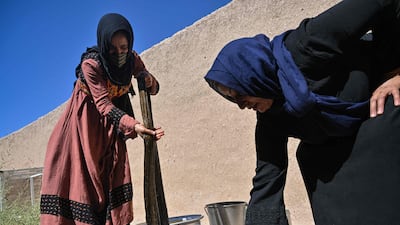
Women wash freshly dyed silk in a factory in Herat province. Whether Afghan girls receive an education under the Taliban is turning into an issue of wealth, young women living under the regime say. AFP -
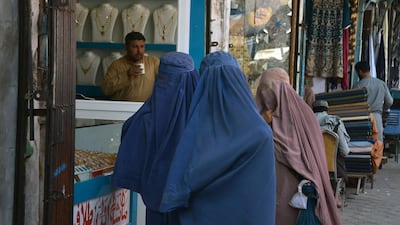
Afghan women walk in a Kandahar market. Even if Afghan girls can receive an education, the likelihood they will be able to put it to any use is low. AFP -
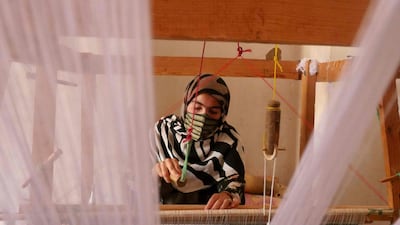
An Afghan women weaves silk to make scarfs and other products inside a workshop in the Zandajan district of Herat province. Many Afghan girls fear the longer they stay away from school, the more pressure will build to conform to patriarchal standards and marry. AFP -
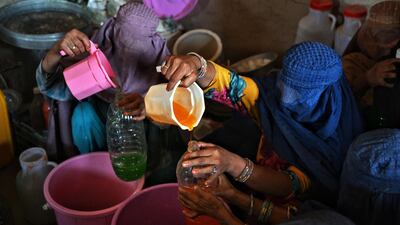
Burqa-clad women work in a shampoo factory in Kandahar. AFP -
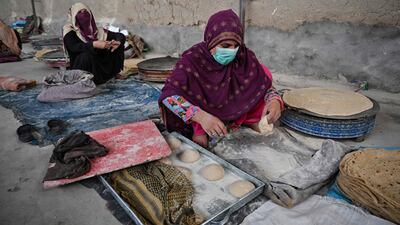
Women make flatbread in a factory in Kandahar. AFP -
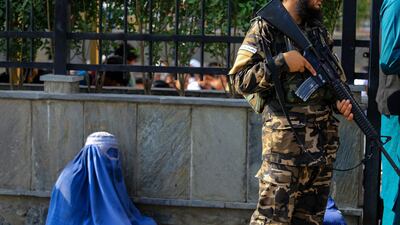
An Afghan woman begs as Taliban fighters stand guard in Kabul. Amnesty International says the Taliban have breached women's and girls' rights to education, work and free movement since they took control of the government. EPA -
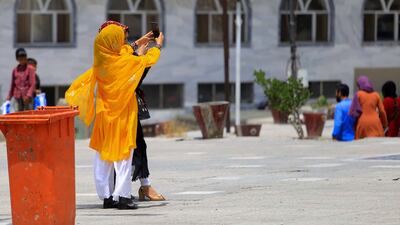
Afghan women take a selfie at a park in Kabul. The rates of child, early and forced marriage in Afghanistan are increasing under Taliban rule, Amnesty International has said. EPA -
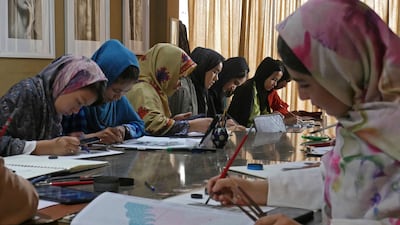
Afghan girls paint at a workshop class in Herat. The World Bank estimates that for each year of secondary education, the likelihood of marrying before the age of 18 decreases by five percentage points or more. AFP -
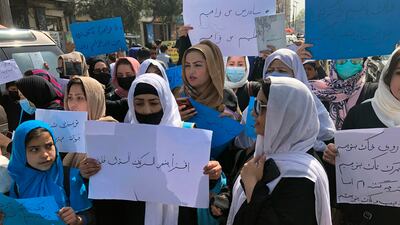
Afghan women protest in Kabul. The lives of Afghan women and girls are being destroyed by the Taliban’s crackdown on their human rights, Amnesty has said. AP -
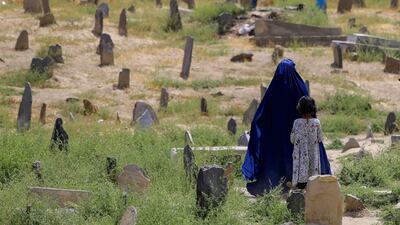
An Afghan woman walks in a graveyard in Kabul. EPA -

Shgofe, an Afghan newscaster, presents a programme on private channel 1TV in Kabul. Female TV presenters and reporters in Afghanistan continue to appear with their faces covered to comply with a mandate issued by the Taliban. EPA -
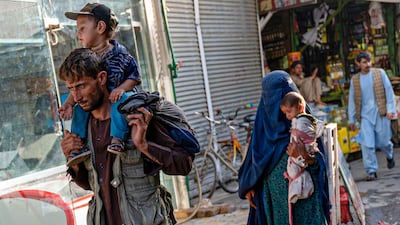
An Afghan family walk past a market near the Pul-e Khishti Mosque in Kabul. AFP -
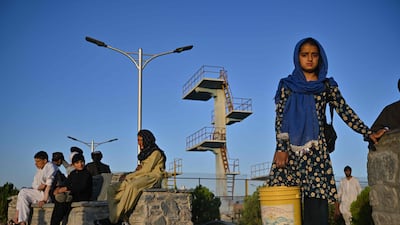
People at Wazir Akbar Khan Hill in Kabul. Whether Afghan girls receive an education under the Taliban is turning into an issue of wealth, young women living under the regime say. AFP -
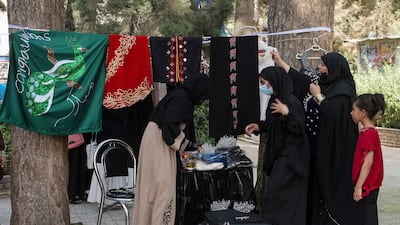
Women browse through garments and fabrics for sale in a stall at a women's handicraft market in Herat. AFP -
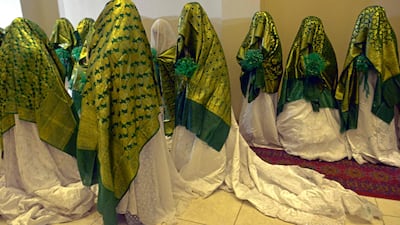
Brides wait for the start of a mass wedding in Kabul. Dozens of Afghan women, concealed in thick green shawls, were married off in an austere ceremony attended by hundreds of guests and gun-toting Taliban fighters. AFP



