


Live updates: Follow the latest on Israel-Gaza
In a marked shift in tone, US President Joe Biden said this week that he would block the delivery of weapons to Israel that could be used in Rafah, the densely populated southern city in Gaza where more than a million Palestinians have taken shelter.
The comments, made during an interview late on Wednesday, were the first time that Mr Biden has publicly said he would use US arms to try to influence how Israel wages its seven-month war in Gaza.
“If they go into Rafah, I’m not supplying the weapons that have been used historically,” he told CNN.
“It’s just wrong. We’re not going to supply the weapons and artillery shells.”
Until now, Mr Biden, a long-time supporter of Israel, had resisted calls to put conditions on military aid to the country, even as the death toll in Gaza – at more than 34,900 according to local authorities – continues to rise and a humanitarian crisis worsens.
His remarks highlighted the growing rift between him and Israeli Prime Minister Benjamin Netanyahu. They also underscored the high stakes for Mr Biden, who is running for re-election and facing intense domestic and international pressure to do more to end the bloodshed.
“He’s drawn a pretty clear red line in the sand,” Jim Manley, a Democratic strategist, told The National. “Based on his past history, I am frankly shocked that he made these comments.
“This goes against everything he said for years, which leads me to suggest he's very troubled by what he's seeing.”
The Biden administration has for weeks been calling on Israel to refrain from launching a major ground offensive in Rafah, arguing it would pose a significant risk to the roughly 1.5 million displaced Palestinian civilians, many of whom are living in tents.
An invasion of Rafah, the White House said, also threatens already fraught international efforts to bring about a six-week ceasefire.
“Any kind of major Rafah ground operation would actually strengthen Hamas's hands at the negotiating table, not Israel's. That's our view,” National Security Council spokesman John Kirby told journalists on Thursday.
Israel launched a major military offensive in Gaza on October 7, after Hamas gunmen attacked southern Israel, killing 1,200 people and taking scores hostage, according to local authorities.
-

Activists and students take part in an encampment protest at George Washington University, in Washington. AFP -
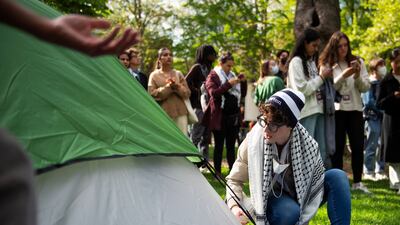
Students and faculty of Drexel University and University of Pennsylvania erect an encapment to protest against the war in Gaza, at the University of Pennsylvania campus, in Philadelphia. AFP -
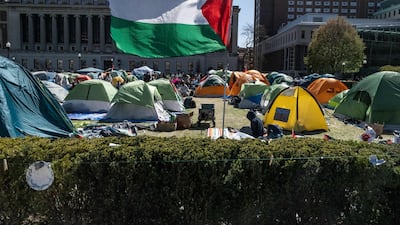
Columbia University students continue their demonstration on campus afterlast week's arrest of more than 100 protesters, in New York City. Getty Images -
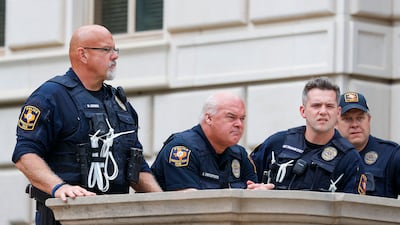
Police watch as students and faculty show support at a Protect Palestine Rally at the University of Texas, in Austin. EPA -
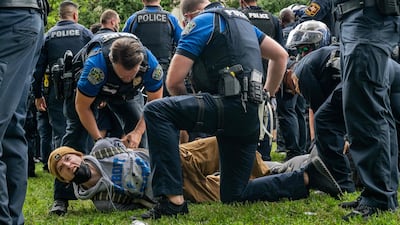
A student is arrested during a pro-Palestine demonstration at the University of Texas at Austin. Getty Images -
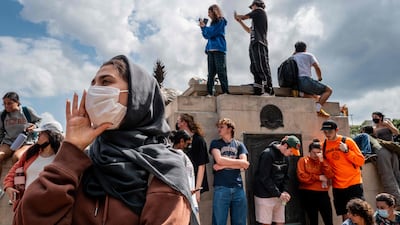
Students rally at the University of Texas at Austin, where police arrested scores of protesters. Getty images -
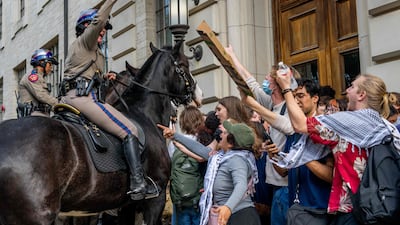
Mounted police confront students protesting against the war in Gaza, at the University of Texas at Austin. Getty Images -
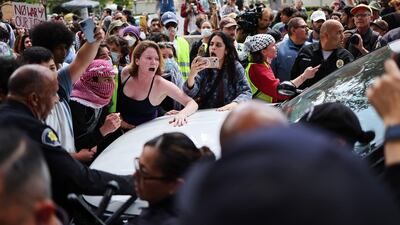
Pro-Palestine demonstrators argue with University of Southern California officials, who attempted to take down an encampment set up in support of Gaza, at the institution in Los Angeles. Getty images -
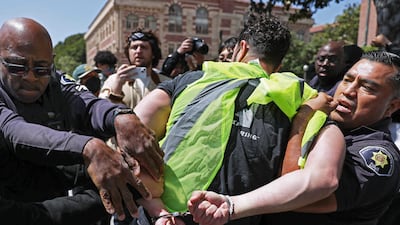
University of Southern California police officers detain a pro-Palestine demonstrator. Getty Images -
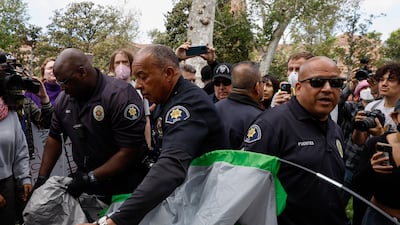
University of Southern California officers dismantle protesters' tents. EPA -
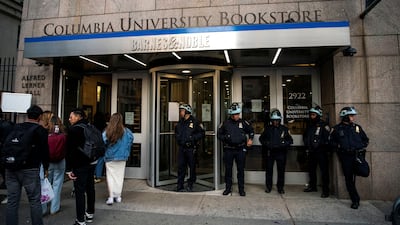
Police stand guard at an entrance to Columbia University, in New York City, where students continue to protest in support of Palestinians, amid the war in Gaza. Reuters -
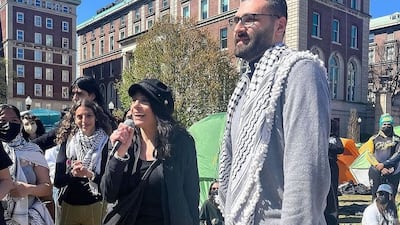
Najla Said, daughter of Palestinian-American academic and literary critic Edward Said, and Motaz Azaiza, a Palestinian photojournalist from Gaza, join the Gaza solidarity encampment at Columbia University. Photo: Columbia Students for Justice in Palestine -
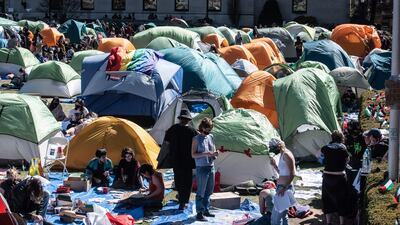
As the campus protests continue, Columbia has moved its classes online. AFP -
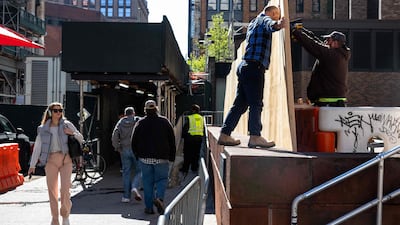
Workers erect a wooden barrier at New York University Stern School of Business after an encampment set up by students was cleared out on Monday night. Getty Images -
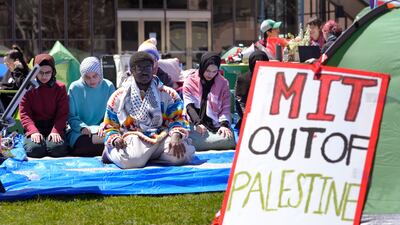
Massachusetts Institute of Technology student Isa Liggans, front left, takes part in Muslim prayer with others, at an encampment of tents at the college, in Cambridge, Massachusetts. AP -
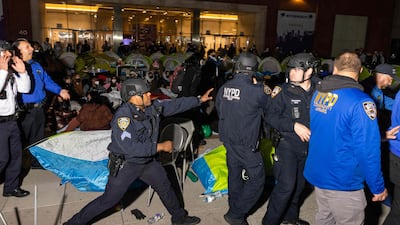
Police officers disperse pro-Palestinian students and protesters who set up an encampment on the campus of New York University. AFP -
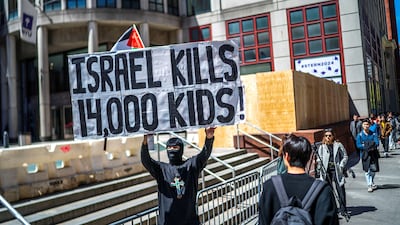
A protester outside New York University. Reuters -
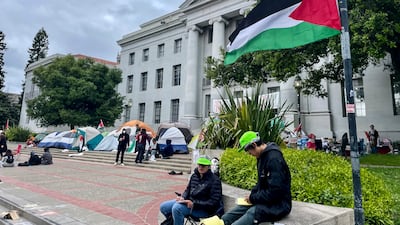
Pro-Palestinian protesters gather in front of Sproul Hall on the campus of the University of California, Berkeley. AP -
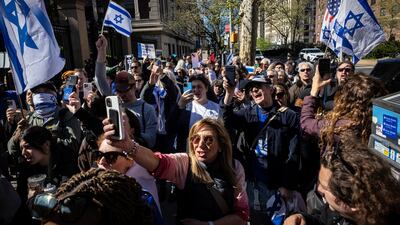
Pro-Israeli demonstrators chant 'shame' after Columbia University assistant professor Shai Davidai was denied access to the main campus. AP -
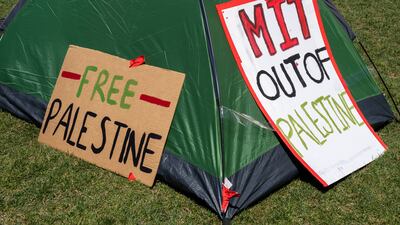
A tent used by pro-Palestinian demonstrators at MIT. Bloomberg -
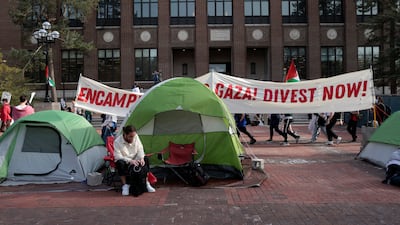
A coalition of University of Michigan students rally to pressure the university to divest its endowment from companies that support Israel. Reuters -
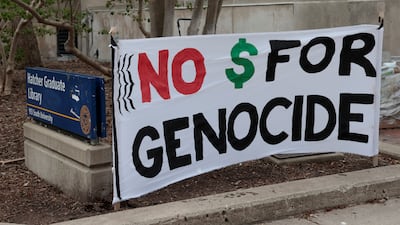
A sign at the University of Michigan. Reuters -
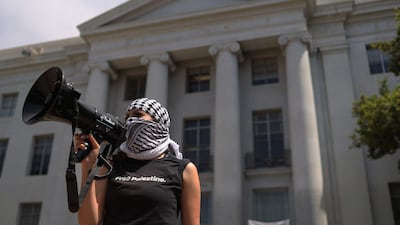
A pro-Palestinian protester in front of Sproul Hall in Berkeley, California. Getty Images / AP -
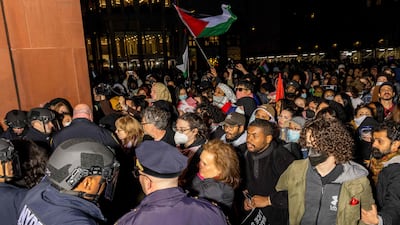
Police officers detain pro-Palestinian students and protesters at New York University. AFP -
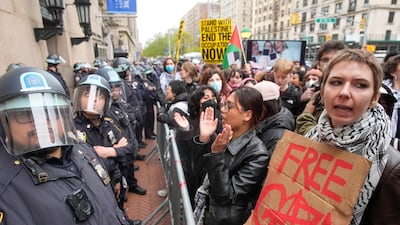
Police in Riot gear stand guard as demonstrators chant slogans outside the Columbia University campus. AP -
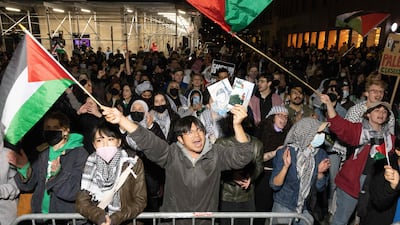
Pro-Palestinian students and activists protest against the Israel-Gaza war on the campus of New York University. AFP


The US is by far the biggest supplier of weapons to Israel, sending more than $3.3 billion in military funding annually, with more on the way.
The 1,000kg bombs that Israel has been dropping in Gaza came from the US, with Mr Biden acknowledging that they had been used to kill civilians.
Still, Mr Biden has shrugged off domestic pressures to push for a permanent ceasefire in Gaza, even as dozens of protest camps have sprung up on university campuses across the US, with student chants and signs calling the President “Genocide Joe”.
“The people here in the United States, who are frustrated at the President over his failure to do this, are asking the same question: Why did it take so long?” Yousef Munayyer, head of the Palestine-Israel programme at the Arab Centre in Washington, told The National.
“Obviously, those who are vehemently pro-Israel are going to be upset about this, so politically, it didn't make sense to wait this long to do it either.
“And, of course, we don't really know if he's going to follow through.”
In the interview, Mr Biden pledged to continue to provide Israel with the weapons it needs to defend itself.
Still, the move has already drawn intense criticism from Israel's far-right government and conservatives in Washington, who said it could be grounds for impeachment.
Meanwhile, a defiant Mr Netanyahu has said he would go ahead with invading Rafah, with or without US support.

