


Live updates: Follow the latest on Israel-Gaza
More than 50 tenured journalism professors and scholars from leading US universities have called for a comprehensive external review of The New York Times' investigative front-page story on sexual violence perpetrated during the October 7 Hamas attacks on Israel.
The professors, hailing from institutions including New York University, the University of Pennsylvania, Northwestern and the University of Texas, urged the newspaper to commission a group of journalism experts to conduct a thorough and full independent review of the reporting, editorial procedures and overall publication process for the story, and to release a report of findings.
The lengthy investigative story "‘Screams Without Words’: Sexual Violence on Oct 7”, which was published in December under the byline of international correspondent Jeffrey Gettleman and two freelancers, detailed how Hamas used sexual assault during the attacks.
Shortly after the story was published, questions arose about its accuracy.
Family members of one of the women killed in the attack, who was prominently featured in the report, challenged the claim that she had been raped.
Discrepancies in the testimony provided by a witness cited in the article drew further scrutiny.
The decision to send the letter came after persistent criticism from external observers and growing dissatisfaction within the Times' own ranks about the credibility of the story.
The letter, obtained by The National, was sent on Monday to Times publisher AG Sulzberger, executive editor Joe Kahn and international editor Philip Pan.
Two hundred days of Israel Gaza war – in pictures
-
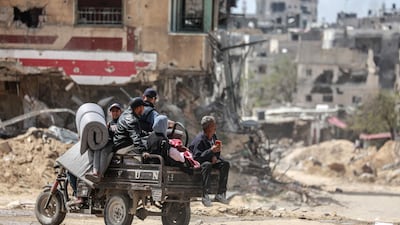
Palestinians move with their belongings on a road lined with destroyed buildings, in Khan Younis, in the south of the Gaza Strip, on April 22. AFP -
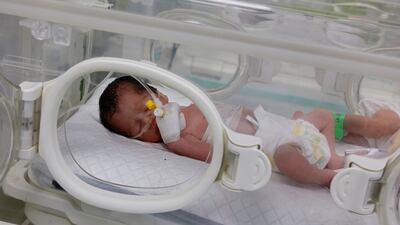
An infant saved from the womb of her mother Sabreen Al Sheikh, who was killed in an Israeli strike along with her husband Shokri and her daughter Malak, lies in an incubator at Al Emirati hospital in Rafah, on April 21. Reuters -

A man rides a bicycle, on April 2, past a damaged vehicle where employees from the World Central Kitchen non-profit, including foreigners, were killed in an Israeli air strike. Reuters -

A woman at the damaged Al Shifa Hospital, on April 1, after Israeli forces withdrew from the medical complex following a two-week siege. Reuters -
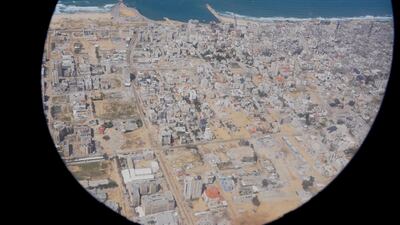
The view from a Jordanian flight dropping vital aid by parachute into Gaza, in March. Matthew Kynaston / The National -

Nozha Awad flees Al Shifa hospital with her triplet children, after an Israeli raid siege began at the medical complex, in March. Reuters -

Palestinians gather to receive aid outside a UNRWA warehouse, in March. Reuters -

A family end their fast amid the rubble of their destroyed home, during Ramadan in Rafah, in March. Reuters -

Wafaa Tabasi with her twin malnourished daughters, at Al Awda health centre in Rafah, in March. Reuters -

Palestinians carry bags of flour taken from an aid lorry near an Israeli checkpoint in Gaza City, in February. Reuters -

Fernando Simon Marman and Louis Hare, two Israeli hostages who, according to the Israeli military, were freed in a special forces operation in Rafah, reunite with loved ones at Sheba Medical Centre, in Ramat Gan, Israel, in February. Reuters -
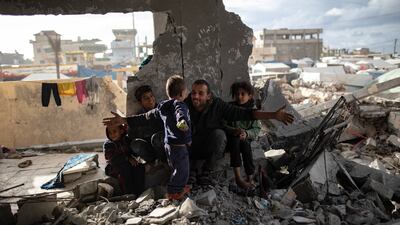
Palestinian Muhammad Al Durra with his children in the ruins of a house in Rafah where they sheltered on January 11, 2024. EPA -
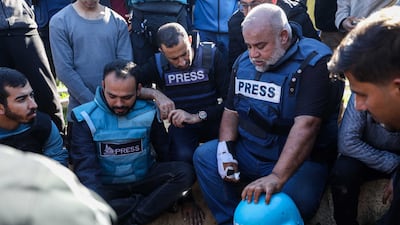
Family and friends at the funerals of journalists Hamza Al Dahdouh and Mustafa Thuraya on January 7, 2024 in Rafah, Gaza. Getty Images -
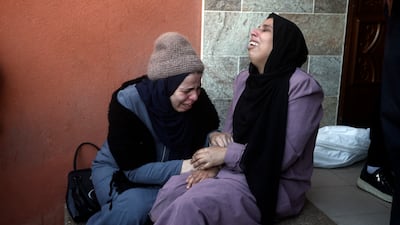
Palestinians mourn relatives killed by Israeli bombardment of the Gaza Strip outside a mortuary in Khan Younis January 4, 2024. AP Photo -
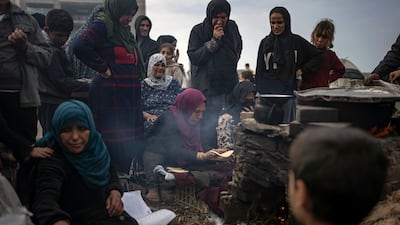
Displaced Palestinians queue to bake bread at a camp in the Muwasi area of Rafah, Gaza Strip, on December 23, 2023. AP Photo -
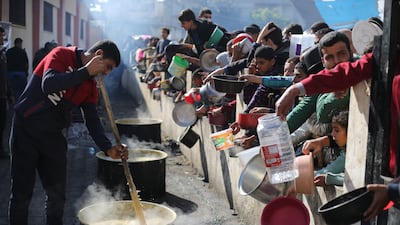
Palestinians queue for food in Rafah, the Gaza Strip, on December 20, 2023. AP Photo -

The ruins of Rafah on December 14, 2023. AFP -
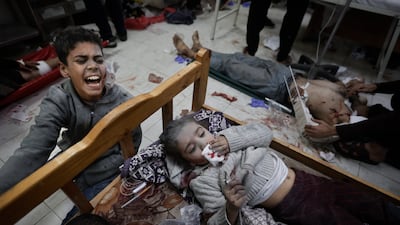
Palestinians wounded in the Israeli bombardment of the Gaza Strip arrive at a hospital in Khan Younis on December 8, 2023. AP Photo -
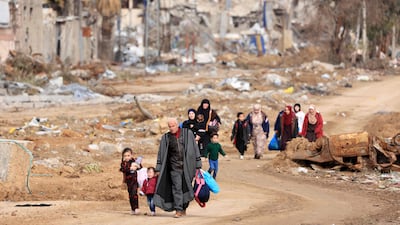
Palestinians flee Israeli bombing along the Salaheddine Road in the Zeitoun district of Gaza city on November 28, 2023. AFP -

A Red Cross vehicle takes Israeli hostages from the Gaza Strip into Egypt in Rafah on November 25, 2023. AP -
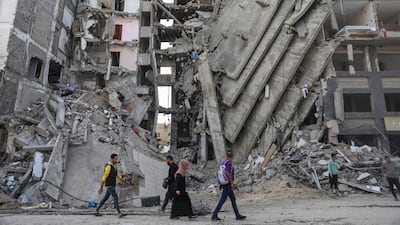
The ruins of buildings in Gaza city on November 24, 2023, as a temporary truce between Israel and Hamas took effect. AP Photo -
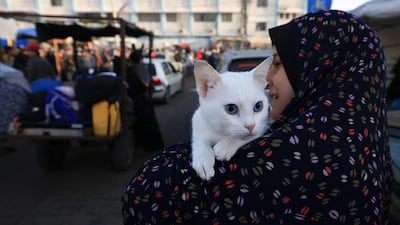
A woman and her cat return home to eastern Khan Younis in the southern Gaza Strip during the first hours of a four-day truce between Israel and Hamas forces on November 24, 2023. AFP -
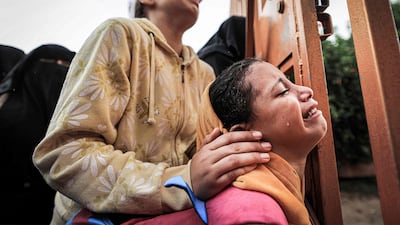
Mourning the dead of Israeli bombardment outside the mortuary at Nasser Hospital in Khan Younis on November 14, 2023. AFP -
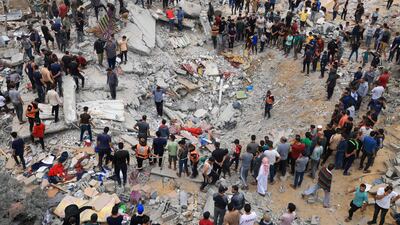
Civilians and rescuers look for survivors in the rubble of a building after Israeli bombing of Khan Younis in the southern Gaza Strip on November 12, 2023. AFP -

November 7, 2023, a month to the day after Hamas attacked Israel, a victim of an Israeli bombardment in Rafah is moved from the rubble. AFP -
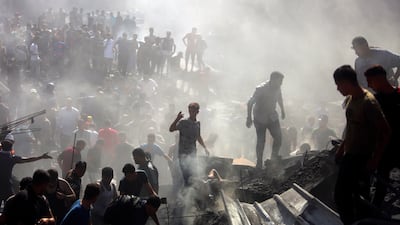
Searching the rubble after Israeli air strikes on the town of Khan Younis, southern Gaza Strip, on October 26, 2023. AP Photo -
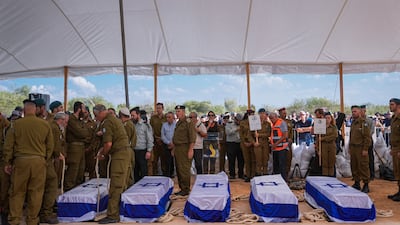
Mourning the Kotz family at their funeral in Gan Yavne, Israel, on October 17, 2023. AP Photo -
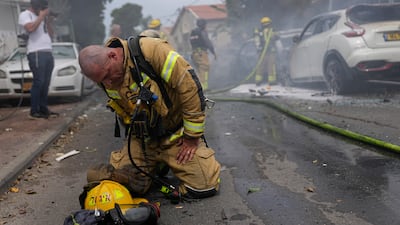
An Israeli firefighter composes himself after he and his colleagues extinguished cars set on fire by a rocket fired from the Gaza Strip in Ashkelon, Israel, on October 9, 2023. AP Photo -
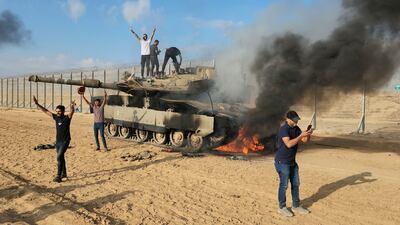
Palestinians with the wreckage of an Israeli tank at the Gaza Strip fence east of the city of Khan Younis on October 7, 2023, the day Hamas forces swept unopposed into Israel. AP Photo -
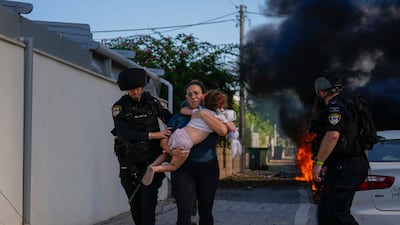
Israeli police officers evacuate a woman and a child from a site hit by a rocket fired from the Gaza Strip, in Ashkelon, southern Israel, on October 7, 2023. AP Photo


Signatories include Mohamad Bazzi from New York University, Andrew Butters from University of Texas at Austin, AJ Christian from Northwestern University, Larry Gross from University of Southern California and Sarah J Jackson from the University of Pennsylvania, among others.
Shahan Mufti, a professor at the University of Richmond, told The National that the intent behind the letter was to prompt the publication to “eventually concede that there are problems with the story and retract it or at least correct it”.
“But for some reason the Times is digging its heels deeper and deeper even as the story continues to disintegrate,” he said.
“The stakes are just so high with this particular story because of what it was about and the time at which it was published.
“As we point out in the letter, when the International Court of Justice is talking about plausible genocide and UN agencies are warning of man-made famine, then it’s all the more important that any errors with previous reporting are recognised and corrected quickly.”
The letter conceded that it is an “impossible task” to produce “perfectly accurate drafts of history in real time”.
The letter stated that if an independent review clears the publication of serious wrongdoing, it will benefit not only the Times but journalism as a whole.
It added that, if the investigation uncovers significant errors or negligence, the publication would not be able to “reverse the damage done to Palestine and to Palestinians, but ... could still reverse some of the damage it has done to itself with its silence”.
Either way, the letter concluded, an immediate review “is the only responsible and credible thing to do”.
“Whether we like it or not, for better or worse, the Times often sets the bar for journalistic standards in America,” Mr Mufti said.
“If the Times starts lowering ethical standards, you can be sure that others will, too.”

