


Congressional leaders are pressing US President Joe Biden's administration to designate Russian dissident Vladimir Kara-Murza as wrongfully detained, amid warnings that internal repression by Moscow is fuelling its war in Ukraine.
The designation would give the US government more capabilities to address the Kremlin critic's case with Russian officials under the Levinson Act, a bipartisan measure named after former FBI agent Robert Levinson, who was unlawfully detained by Iran.
“I have called upon Secretary of State [Antony] Blinken to designate Vladimir as a wrongfully detained status under the Levinson Act,” Senate Foreign Relations Committee chairman Ben Cardin told Mr Kara-Murza's wife and children on Tuesday.
“We think that will put a more direct attention on this and make it a priority for the United States in our conversations with the Russian Federation.”
The bipartisan solidarity for Mr Kara-Murza's case comes as far-right Republicans in Congress continue to thwart efforts to fund Ukraine's battle against Russia's invasion.
Ukrainian President Volodymyr Zelenskyy warned this week that Kyiv would lose if Congress does not pass a $60 billion spending package for the war effort.
Sonata Coulter, State Department deputy assistant secretary, did not address calls for the Levinson designation while speaking before the committee.
“Russia's internal repression enables its external aggression. These are inextricably linked and we cannot address one without the other,” she said.
House of Representatives Speaker Mike Johnson was supposed to take up the legislation for a vote when the chamber returned from spring break this week, but indicated he would again push back the vote amid continued backlash from conservative hardliners.

A representative from the Free Russia Foundation said that a Levinson designation would “send a very strong signal to the Kremlin that the US is invested in [Mr Kara-Murza's] fate”.
In a stirring speech about her husband's advocacy for democracy in Russia, Evgenia Kara-Murza said the killing of fellow opposition leader Alexei Navalny has “demonstrated the urgency” of his case.
“Just like Navalny spent the last 15 years of his life trying to warn the international community of the danger that Putin's regime represents for the free world, I spent the last two years of mine trying to convince decision makers around the world that my husband's life was in danger,” Ms Kara-Murza said, alongside two of their three children.
The dual Russian-British citizen's charges centre on a March 2022 speech to the Arizona House of Representatives in which he was critical of Moscow's invasion of Ukraine.
Mr Kara-Murza, who has twice survived poisonings that he blamed on the Kremlin, has rejected the charges against him, describing it as punishment for standing up to President Vladimir Putin.
Congressional leaders joined the general public in a letter-writing station set up in the foreign relations committee hearing room, which was kept open for those in attendance to write notes of support that will be delivered to Mr Kara-Murza's penal colony.

The UK's deputy ambassador to the US, James Roscoe, joined the Capitol Hill event.
“We should be absolutely clear as we sit here today, that Vladimir Karma is a is a political prisoner in Russia … [The UK] will do all we can, we will make diplomatic interventions at the highest level, we will continue to consider further sanctions,” he said.
Tuesday's anniversary event took a uniquely personal tone, with many members of Congress speaking of their friendship with Mr Kara-Murza, whose lobbying played a critical role in Washington passing the Sergei Magnitsky Rule of Law Accountability Act in 2012.
The Republican ranking member of the Senate Armed Services Committee, Roger Wicker, was among those to show support for the Russian activist on the two-year anniversary of his imprisonment.
“I am honoured, deeply humbled to be a friend of Vladimir Kara-Murzo, and to be called upon to say a word or two,” Mr Wicker added, hinting that he will also be declaring his call for the Levinson designation on the Senate floor later on Tuesday.
Steve Cohen, a Democratic congressman, said the State Department had been to slow to consider the case.
“We have attempted to get State Department to use all available possibilities … We have written, and we have written and we have written, and I feel as if I'm writing to Vladimir Putin with the responses I'm getting from the State Department,” Mr Cohen said.
“There's no reason they shouldn't do this … you cannot be easy with Putin and expect any results.”
Thousands gather for funeral of Kremlin critic Alexei Navalny – in pictures
-
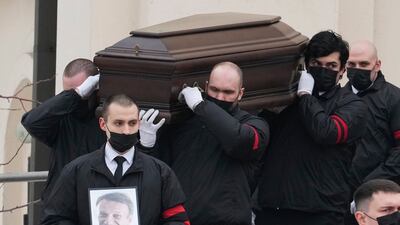
A portrait of Kremlin critic Alexei Navalny is carried before his coffin from the Church of the Icon of the Mother of God Soothe My Sorrows, in Moscow. AP -
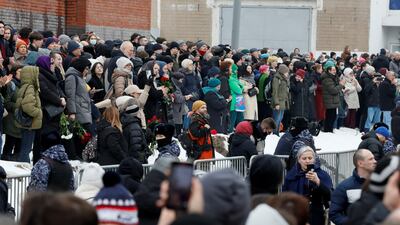
Crowds gather near the church in Moscow's Maryino district, where the opposition leader had once lived. Reuters -
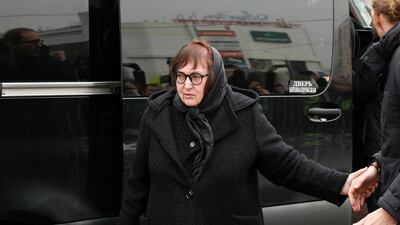
Lyudmila Navalnaya arrives for the funeral of her son. Mr Navalny died at an Arctic penal colony on February 16. Reuters -

The coffin is carried inside the church. Mr Navalny's family had struggled to find anywhere willing to hold his funeral. EPA -

France's ambassador to Russia Pierre Levy at the funeral. AFP -

Mourners gather in Moscow. The Kremlin warned against unauthorised protests around the funeral. AFP -
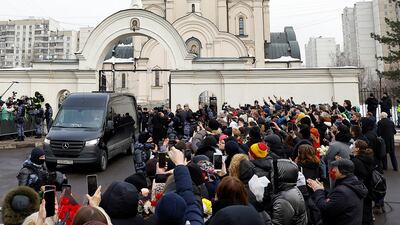
A hearse outside the church. The Russian authorities denied involvement in Mr Navalny's death. Reuters -

A wreath is brought through a metal detector security gate. AFP -
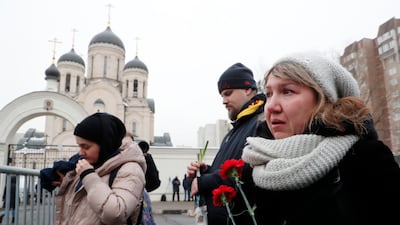
Mourners in Moscow. Mr Navalny shot to prominence exposing what he said was rampant corruption in Russia's government. EPA



