
British MPs have called on the government to speed up and expand its new sanctions regime against Israel to include those blocking the entry of aid into Gaza.
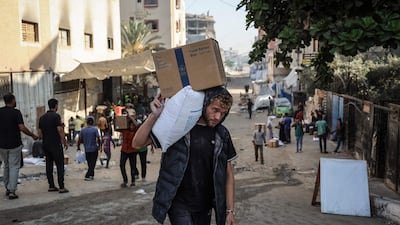
In a letter to Foreign Secretary Ed Miliband, 75 MPs and peers warned that more punitive measures were needed to address the worsening humanitarian crisis in Gaza, which is compounded by delays to the delivery of aid.
The UK announced a new sanctions regime in September to target companies trading in illegal Israeli settlement goods and services in the occupied West Bank, as well as violent settlers. The designations are expected to take six months to come into force.

But sanctions are also needed to target those blocking aid, including extremists groups, the letter drafted by Liberal Democrat MP Alistair Carmichael said. Labour MPs Rushanara Ali and Abtisam Mohamed, and Liberal Democrat Layla Moran are among the co-signatories.
“Make the first designations before winter sets in. Treat cases relating to aid obstruction in Gaza as a priority for assessment, and announce the first designations within weeks rather than months,” the letter said.
Israeli ministers and officials who “designed, promoted or enforced” measures that have restricted the entry of the UN's Palestinian agency (UNRWA) and other aid organisations into Gaza should also be sanctioned, the letter said.
The signatories also called on the government to mirror EU sanctions against extremist groups that are blocking aid, using a new mechanism that allows for immediate sanctions to be imposed where they exist in other allied governments such as the EU or US. This includes the group Tzav 9, which has been sanctioned by the EU since July 2024 for blocking aid lorries entering Gaza.
The politicians urged the government to announce additional aid funds for food, water and shelters for Gaza before winter, with efforts to “mobilise other donors”.
The government's new sanctions regime has divided the ruling Labour party. Critics of Mr Miliband's punitive measures warned that they could compromise the UK's security and intelligence-sharing agreement with Israel, or that it could embolden the far-right in Israel.
Others fear that the measures are not wide enough to prevent Israel's expansion of its illegal settlements in the West Bank.
Sanctions on settlements
Earleri this month, the UK introduced the Global Human Rights and International Humanitarian Law Sanctions Regulations 2026, an expansion of existing British sanctions regulation.
On Tuesday, Mr Miliband said that these new regulations would allow the government to act more swiftly in designating individuals and organisations on human rights grounds.
This includes companies bidding for Israel's controversial E1 settlement project for which applications close on November 19.
Mr Miliband said the government would “do all we can to prevent the settlement building in E1 from happening”
“We have brought the sanctions regime – not the sanctions regime that is coming in the next six months, but the extension of the GHR sanctions regime – precisely so that we can take swift action,” he said.
But he declined to comment on which Israeli ministers or officials could be designated for facilitating the expansion of West Bank settlements.
The letter asks the government to use the powers given by the new regulation to designate those involved in blocking aid into Gaza.
“The powers now exist. We urge you to use them now, beginning with those responsible for denying and obstructing life saving aid to Palestinians in Gaza,” the letter said.
International agencies have repeatedly warned about the lack of attention to the humanitarian crisis in Gaza. Last week, the World Food Programme announced that it had cut its aid deliveries to Gaza due to funding shortages.
The number of people helped by the UN agency will drop from 1.6 million to 1.1 million, with meals provided community kitchens to be rationed from 250,000 to 150,000 a day.
Unicef also warned that the Sheikh Radwan stormwater basin could be drained within two weeks, but that the Israeli authorities had not allowed the necessary equipment in to replenish it. This risks flooding areas with sewage contaminated water.
Aid shortfalls
Meanwhile, charities have warned that the UK will miss its aid spending target of 0.3 per cent of gross national income by 2027, after no adjustments to spending were made during the autumn budget announced on Wednesday.
The Office of Budget Responsibility forecast on Wednesday that gross national income in 2027 had improved on previous projections. Yet money allocated to the UK aid budget will remain fixed from 2025.
This would mean that a shortfall of £320 million below 0.3 per cent of gross national income, according to Bond, a network of British charities in the aid sector.
The Labour government made cuts to the UK aid budget in 2025, but committed to spending 0.3 per cent of gross national income by 2027. The previous Conservative government had already reduced the UK's commitments from 0.7 per cent to 0.5 per cent in 2021.
The policy changes made in 2025 mean that the original budget allocated then based on available projections would remain fixed even if the UK's economy grew in that time.
“The UK aid cuts have already cost lives and forced lifesaving humanitarian, health and climate programmes to close. But failing to meet even the paltry target of 0.3 per cent means the government is failing people facing the worst impacts of conflict, crisis and extreme poverty worldwide,” said Gideon Rabinowitz, director of policy and advocacy at Bond.
“The government must urgently fix this injustice, by meeting its 0.3 per cent commitment and setting out a road map for a gradual return to the 0.7 per cent target. The Treasury should also ensure savings made by other departments spending UK aid are returned to the [Foreign Office],” he said.

