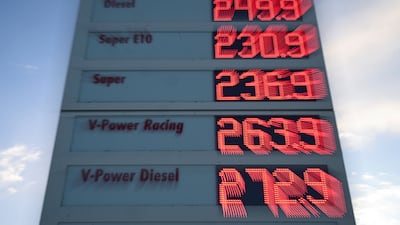

European leaders are launching subsidies and tax cuts to help cushion households from the soaring cost of energy due to the war in the Gulf, but critics say they fall short of a long-term strategy that could help make their own energy systems more secure.
The latest announcement came from France, which said it would extend its targeted fuel subsidies, at a cost of €450 million (£386.7 million / $512.7 million). It is aimed at low-paid workers, nurses, farmers and construction workers.
This would bring the total spent on fuel subsidies this year up to €1.4 billion, as the French government tries to ease the economic consequences of the war in the Middle East.

Roland Lescure, Economy and Finance Minister, said the package was in response to the “concerns of the French people, which sometimes take the form of anger.”
In Germany, taxes on petrol and diesel will be cut by €0.17 a litre, after Chancellor Friedrich Merz promised relief for consumers and businesses hit by soaring fuel prices. The move will come into effect from October 1 and run to the end of the year.
In addition, the German government said it would hold talks with the oil industry with the aim of introducing a cap on fuel prices, modelled on those in Luxembourg or Belgium, by January 1, 2027 at the latest.
“Anyone who relies on their car every day is reaching their breaking point,” Mr Merz said last week as he announced the change. “We are showing that we are resilient in the face of the crisis and are helping our citizens.”
Meanwhile, the UK has announced it would cut VAT on household electricity bills from their existing 5 per cent for six months from next week.
This has led to calls for more radical measures that could help bring down costs in the long term.
“While short-term subsidies can provide important relief, they ultimately treat the symptoms rather than the cause,” said Nigel Pocklington, chief executive of the British renewable energy company Good Energy.
“Lasting affordability comes from fixing the underlying market structures that continue to leave households vulnerable to events taking place thousands of miles away,” he told The National.

Security lessons
Europe dedicated the past few years to rebuilding its oil and gas security following the loss of Russian pipelines in 2022.
But the US-Iran war, which has involved the blockade of a crucial oil and gas shipping channel, and the Houthi attacks on a vital Saudi pipeline are testing the resilience of European energy systems.
And while the response led European legislators to seek better energy deals with the Gulf and fast-track the construction of new power infrastructure, the approach now appears more reactive, with temporary subsidies to help shield populations fed up with years of rising inflation.
European governments who responded to the Ukraine crisis by building more renewable energy infrastructure have “emerged in a stronger position”, Mr Pocklington said.
Spain's investment in solar panels in the past decade has insulated it from rising prices. “The countries that have emerged in a stronger position are the ones that paired short-term support with a rapid expansion of domestic energy generation and infrastructure,” he said.
Yet gas supplies continue to present a challenge. Germany’s gas reserves for winter are at their lowest in 15 years, despite the new floating and onshore liquefied natural gas (LNG) terminals it built at speed in response to the war in Ukraine.
These are also at a historic low across the European Union, as traders who bet that prices would drop after the Iran war held back from purchasing fuel reserves over the summer.
The UK faces the acute situation of having some of the highest and fastest rising energy prices in the world.
Critics say the VAT cut “inefficiently encourages households to consume more energy” and that more targeted measures in line with France are needed. The Institute for Fiscal Studies said that while discounted VAT rates have greater benefits for lower-income households, “in cash terms, most of the benefits accrue to higher-income households”.
The electricity prices for British households have risen by 147 per cent since 2010, in contrast to general prices which rose by 63 per cent in the same period, according to figures measured by the Consumer Prices Index.
While the cost of energy since 2017 has risen by 78 per cent, a 59 per cent rise in taxes and green levies are also contributing to the soaring costs, according to the IFS analysis.
The costs of upgrading the grid could rise from £7 billion a year in 2024-2025 to £12 billion by 2030, but if targets are met they could then drop after that, the IFS report said.
There is pressure on the government to approve new oil and gasfields in the North Sea to bring down energy prices and reduce the reliance on overseas oil and gas.
UK Prime Minister Andy Burnham reiterated his government's commitment to tackling climate change at the UN General Assembly, an indication he might resist calls for more drilling.
“The climate crisis is now a national security threat for countries around the world – as this summer of extreme heat, wildfires and floods has proved beyond doubt. Britain will continue to lead with others to fight this threat,” he said.
Dragged into war
The inability to contain soaring costs is also dragging risk-averse European governments into conflicts that they would prefer to avoid.
The UK said this week it would deploy military aircraft to assist Saudi Arabia in its fight against the Houthis, with Mr Burnham citing “cost-of-living pressures” as among the reasons to support Riyadh. This would involve air-to-air refuelling for a limited period of “weeks”, Mr Burnham said.
Saudi Arabia had announced earlier it would not be able to export diesel following Houthi attacks on its East West pipeline.
The need for more resilient energy systems is growing, as the targeting of energy facilities becomes a key part of warfare, according to energy economist Nick Butler.
“It is seen as an obvious, almost an initial target, in the war planning processes here and elsewhere. It would be an early target in any conflict or even in the pre-conflict phase,” he told The National.
“You try to take out communication systems or transport systems, and that would be seen as a way of weakening people before even a physical advance was made.”
US efforts at obtaining an energy ceasefire between Ukraine and Russia appeared to be making some headway this week.
Ukrainian President Zelenskyy called on US President Donald Trump to organise a trilateral meeting with Russian President Vladmir Putin, seeking an end to attacks on Moscow's attacks on Ukraine’s critical infrastructure.
But earlier attempts to mediate energy truces to protect the world from global shocks have been largely unsuccessful.
“There’s been quite a lot of diplomacy and it hasn’t worked. I’m afraid the attempts will continue but the physical reality will dominate what happens in the market,” Mr Butler told The National.

