

England received only 10 per cent of its expected rainfall last month, making it the driest July in 190 years of records.
Just 6.5 millimetres of rain was recorded, less than half the previous record of 13.4 millimetres in 1911. It was also the sunniest July, and second warmest.
July 2026 was also the third driest month ever for England, behind only February 1891 and June 1925, the provisional Met Office records show.

For the UK as a whole, it was the third driest July on record, with 28.9mm of rainfall, and the driest July nationally since 1868.
Southern England has been particularly dry, with only 1.9mm of rain falling – just 3 per cent of its long-term average for the month – making it the region’s driest month on record.
Nineteen counties recorded less than (or equal to) 1mm of rainfall across the entire month.
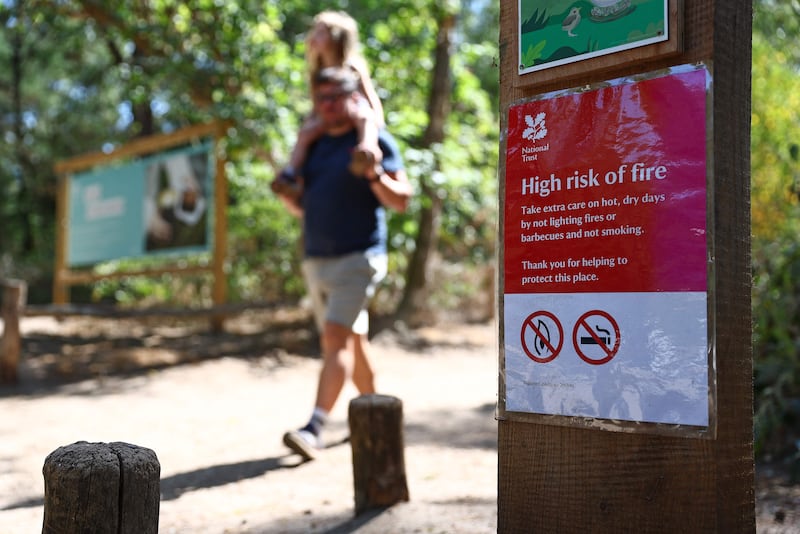
Last week, a swathe of England stretching from its western, Atlantic shore to the North Sea was declared officially in drought. Some parts of the drought area have exceeded 50 days without rain.
It has left homes overheating, gardens and farmland parched, and commuters sweltering on buses and trains as the country – much of it without air conditioning – is unused to such extreme heat. There have also been wildfires, notably a huge blaze last week in Suffolk alarmingly close to a nuclear power plant.
Met Office science manager Amy Doherty said: “July 2026 has been a truly remarkable month in the UK's climate record.
“The combination of record-breaking dryness, exceptional warmth and unprecedented sunshine has delivered one of the most notable summer months in our historical records.”
Helen Wakeham, chairwoman of the National Drought Group and director of water at the Environment Agency, said: “Dry weather depletes our water, while the hot conditions mean we use more of it. This is a difficult combination, and we are seeing the effects on our farmers, our wildlife and the amount available for public and business use.
“All sectors are taking action, and we are grateful to the public for following the restrictions, where in place, to make sure there is enough water for everyone this summer.
“We want everyone to stay safe and hydrated during the hot weather but every drop we can save is a drop more for nature and agriculture.”
-

The dried bed of Howden Reservoir, central England, which is at only 48 per cent of its storage capacity. EPA -

This aerial image shows the scorched grass surrounding the area at Stonehenge near Amesbury, Wiltshire in south-west England. AFP -

A drone view shows golfers playing on a parched fairway at Royal Mid-Surrey Golf Club. Reuters -

Escaping the hot sun in the dry grass of Green Park as temperatures rise in London. EPA -

Sun-scorched grassland around St Albans Cathedral. Reuters -

People make their way along a path through the parched grass of Primrose Hill in London. AFP -

The exposed riverbed of the Thames after it dried up in Ashton Keynes, about 10km from its source. Reuters -

Dry conditions in Bray, west of London. AFP -

Scorched grassland and smoke rising from the Tintwistle Moor wildfire, near Glossop. Reuters -

A person walks through parched parkland in Greenwich, London. EPA -

People walk through dry grass across Leyton Flats in east London. EPA -

Low water levels at Walthamstow Wetlands, London. EPA


The dry conditions have been accompanied by exceptional warmth across much of the UK, day and night.
The country is enduring its fourth heatwave of the summer, classed as three consecutive days with temperatures above 28°C. An amber heat health alert came into force on Monday afternoon with temperatures predicted to hit 33°C before cooling on Tuesday.
The UK has experienced its second warmest July for mean temperature on record at 17.4°C, which is 2°C above the long-term July average, the Met Office said.

