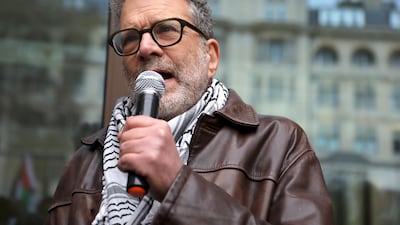

The Palestine Solidarity Campaign (PSC) in the UK has been one of the country's largest and fastest-growing campaign groups, but its inability to stop the Israeli occupation and military campaign in Gaza haunts its former organiser, Ben Jamal.
Looking back on the past three years of organising fortnightly marches in London, Mr Jamal is proud of its successes in bringing hundreds of thousands of people together. “The solidarity movement is stronger than ever. It has more people engaged, it has more active successes,” he told The National.
Israel, he said, is “more isolated than ever” and has “lost its battle for public opinion” – an achievement he attributes to the “collective power” of the Palestine solidarity movement. Images of people marching through London had also been an important "message" to those trapped in Gaza, he added.

But he is also conscious of a “horrible paradox” that while the movement grew, it did little to stop the unfolding catastrophe in Gaza and the West Bank. “Here's the paradox: the strength of the solidarity movement has not stopped a genocide,” he said.
This threatens the heart of the movement's existence, with some growing disillusioned with the marches. “At a moment where people are being obliterated, there will be times when people understandably feel powerless,” he said.
Mr Jamal, whose father’s family are from Jerusalem, stepped down from his role as director at the PSC after a decade at the helm this summer, as his wife lives with early-onset dementia. He is also appealing against a conviction for breaching the Public Order Act in January last year, when he and a group of organisers walked out of the delineated protest area in Whitehall and were arrested at Trafalgar Square.
His resignation comes at a time of deep challenges for the PSC, which faces growing public restrictions. Last month, MPs voted in favour of an amendment to the Crime and Policing Bill, which could see marches banned for their cumulative effect. Campaigners believe this is deliberately aimed at the pro-Palestine marches.
But his biggest concern is the stalling political progress on the Palestinian issue. This has led to waning support for the marches from some quarters. “People have come to me and said things like, our marches are just a waste of time, boycotts are a waste of time, why don't you encourage everyone to go and occupy the arms factories,” he said.
“I'm glad there are people occupying arms factories, but that hasn't stopped the genocide either,” he said.
“It needs a full range of tactics, mass marches, direct action and it particularly needs BDS, what Palestinian civil society is asking us to do,” he said. “I’m resistant to the idea that only one part of that is sufficient.”

Keep the Gaza cause alive
Chief in campaigners’ minds is the continuing humanitarian crisis and air strikes in Gaza, Israel’s occupation of southern Lebanon, and its escalation of settlement projects in the West Bank. A widely shared concern is how the US-Iran war serves to overshadow the immediate needs in Palestine and Lebanon.
The PSC is calling for a full UK arms embargo, a boycott of Israeli goods from illegal settlements and a commitment to the International Court of Justice's July 2024 ruling.
It is planning its next march on Saturday, in response to Andy Burnham’s promise to change Labour’s policy on the Israel-Palestine conflict and take stronger measures against Israel. Mr Burnham, who is expected to become the UK’s next Prime Minister next week, has already said he is “sorry” that the party “didn’t get it right” in the early weeks of Israel’s military campaign in Gaza.
“Andy Burnham has apologised and admitted that the government got it wrong. We know who got it right. Millions of people who’ve taken to the streets, who’ve got involved in campaigns for boycott, divestment and sanctions. Who’ve done so in the face of a sustained campaign to demonise them,” the PSC's deputy director Peter Leary said in an Instagram video.
“Unfortunately what he said remains totally inadequate,” Mr Leary added.
In a letter, Mr Leary also calls on Mr Burnham to “reverse the authoritarian use of public order and anti-terror legislation to suppress protest in support of Palestinian rights”.
Escalating tensions
There has been vocal opposition to the pro-Palestine marches since the outset of the war. They were first described as “hate marches” by Conservative cabinet ministers. Deputy Prime Minister David Lammy has rejected comparisons of the marches to the anti-apartheid movement, suggesting they were not the “peaceful protest of the kind Mandela would have advocated”.
The Metropolitan Police also appears to be escalating its approach against the marches, after repeatedly facing calls to restrict them and to make more arrests.
Commissioner Mark Rowley described the marches as “anti-Semitic” earlier this year. A Palestine march for Nakba Day, which takes place every year, was moved to a smaller route after the far-right convict and anti-Islam activist Tommy Robinson requested to march through Westminster on the same day.
Mr Jamal will appear at the Court of Appeal in December with Chris Nineham, vice-chair of the Stop the War Coalition, who was also convicted for his role in the January 2025 demonstration. A separate criminal trial for Sophie Bolt, general secretary of the Campaign for Nuclear Disarmament, and Alex Kenny, chair of STWC, is scheduled for February, on charges arising from the same demonstration.
The marches are blamed in some quarters for the rise of anti-Semitic crime on UK streets. The slogan “globalise the intifada” was banned following a mass shooting at a Hanukkah celebration in Australia last year, and a knife attack at a synagogue in Manchester weeks later. Last month, the Met Police released images of people suspected of using the banned slogan in chants or on placards at the Nakba Day march.
A recent wave of Iran-linked arson attacks on synagogues and Jewish businesses, and stabbings in London described as terror incidents by the police, has led to further calls to ban the marches. The movement also came in for criticism for not marching in support of the thousands of Iranians who were killed in anti-government protests in January. Some rights groups put the death toll at 40,000 civilians.
Mr Jamal rejects the accusations, pointing to the Jewish bloc of protesters who are part of the movement.
He accepts that people may feel intimidated by the marches, but believes this is due to how they’ve been framed in public debate. “If you tell people that there are thousands and thousands of people marching through the streets, many of them are anti-Semitic, they’re chanting slogans that express genocide against the Jewish people, you might be frightened,” he said.
“That’s part of the responsibility of those who have deliberately mischaracterised the marches for a political purpose, which is to shield Israel from scrutiny,” he said.
Mr Jamal spoke of the massive logistical effort involved in mass movement marches. In scale, his closest comparison is the anti-apartheid movement in South Africa – which the Palestinian movement is often compared to – while influences have been derived from the American civil rights movement and the Suffragettes.
A highlight for Mr Jamal was being told by a British Syrian woman that the marches had made her feel less isolated in the UK. “That's part of the goal. You give people the power to keep politically campaigning. The marches are a fundamental part of how you galvanise people to do something more,” he said.

Up to 300 volunteer stewards were present at each march to make sure people stayed within the protest’s route and did not get caught up with agitators who regularly come to try to derail the protests.
The relationship with the police remains “fraught”. Mr Jamal met representatives ahead of every march, even after his arrest in January 2025.
“I've always taken the view that you have to liaise. If you're operating on the scale that we are, then there are legitimate issues of public safety,” he said. “I don't want people marching into traffic. We have to liaise with the people who have the authority to close the roads.”
Mr Jamal believes that while the marches will not be banned outright, the police's ultimate goal is to reduce their size. This, he believes, would make the movement less effective. “The key dynamic only works if you’ve got masses of people turning up,” he said.

Influence in the UK
Another success of the movement, according to Mr Jamal, is the lasting effect it has had on British politics, as voters shift away from Labour and the Conservatives, the two traditional major parties.
Labour’s losses at the local elections in May were due in part to the rise of the left-wing Green Party, which is vocal about the Palestinian issue. Four independent MPs took Labour seats at the last general election by running on a pro-Palestinian platform.
“(Palestine) is not the be-all and end-all of why the Labour Party is now in the difficulty it is in, but it's a significant factor,” he said.
The PSC works closely with other anti-war groups such as Stop the War and the Campaign for Nuclear Disarmament. Former Labour leader Jeremy Corbyn, who has sought to establish his own left-wing political party, is linked to all three organisations, and is a patron for the PSC. The groups themselves say they are not politically affiliated to any party as they seek a broad support base for their cause.
The Labour government’s policy on Palestine has not satisfied campaigners’ demands. The UK recognised the Palestinian state in September last year, but continues to reject campaigners’ calls for a total arms embargo and sanctions on trade with illegal settlements.
It recently imposed new sanctions on violent settlers in the West Bank, and has warned in its business guidance that British companies should not engage in the construction of illegal settlements.
Splinter groups
But a new challenge for the PSC is the growing popularity of splinter groups, including the direct action group Palestine Action, which was designated a terrorist organisation last year. Mr Jamal views the designation as part of a police crackdown on the Palestinian movement, but its founder Huda Ammori has criticised the marches publicly.
Public debate about the decision to proscribe a direct action group has dominated headlines, often overshadowing the Palestinian issue itself. Over 3,400 people have actively sought arrest under UK terrorism laws for expressing support for Palestine Action after its proscription.
Mr Jamal says direct action is needed for the Palestinian movement, but that it should be part of a wider mobilisation. “Anyone who thinks all you need to do is march didn't learn the lessons of the Iraq war. Anyone who thinks that massive displays of solidarity like that are not a significant aspect of building a movement also hasn't studied history,” he said.
“There’s no silver bullet. If there were one tactic that we knew would generate enough power to stop something, then why would you not use that sole tactic? History says there isn’t,” he said.