The head of the UN's maritime agency, Arsenio Dominguez, today condemned Iran's attacks on two tankers in the Strait of Hormuz, warning that there had been "too many casualties" from the US-Iran war in Gulf waters.
One seafarer has been killed and eight injured after Iranian air strikes on two oil supertankers operated by the Abu Dhabi National Oil Company on Tuesday.
The renewed hostilities appear to have brought a fragile ceasefire between the US and Iran to an end, with the US reinstating its naval blockade of the Strait to protect ships.

"It's detrimental that the situation suddenly is moving in the opposite direction, Mr Dominguez, secretary general of the International Maritime Organisation, told The National. "All the progress that was made now has been tarnished by the attack on two vessels. We have at least two seafarers that are confirmed dead, and another 12 seafarers that have been injured.
The injured and surviving crew on board the ships needed immediate evacuation and support, he added. "This is a very traumatic situation."
About 6,000 seafarers remain stranded in the Arabian Gulf since the start of Iran's blockade of the corridor in early March, Mr Dominguez said on Tuesday. At least 15 have died.
"For me and for this organisation, the main priority is the safety and the security of the seafarers. There have already been too many casualties, too many seafarers still affected," he said.
Mr Dominguez said the agency would be willing to become involved in bringing both parties back to the negotiating table. "We're ready to lend any assistance that may be required in order to bring trade to the Strait of Hormuz in the way that it was taking place before this conflict started," he said.

Tolls illegal, but ...
Mr Dominguez rejected the possibility of a US or Iranian levy for crossing the Strait, after a US proposal to charge governments for naval protection this week.
But he said that although navigation tolls were illegal, this was different to the "voluntary" contributions recently proposed by Iran and Oman.
"When it comes to any tolls or any fees on a strait for international navigation, I have been very clear and will not change because this is what we have embedded in international law," he said.
"There's no legal basis where fees can be introduced on transit of vessels on straits for international navigation."

Oman and Iran have submitted proposals for "voluntary" contributions to be made by ships passing through the strait, saying safety of navigation and protection of the environment were concerns. This is modelled on similar payments made for passage through the Strait of Malacca.
Mr Dominguez said that these proposals would need to be reviewed by the IMO, and would only pass if they were consistent with international law but he declined to compare them to a levy or toll.
"Both Oman and Iran have the right to put forward proposals for additional traffic separation schemes in the region. It will go through the process at IMO if it's defined that it meets all the requirements and is good for the safety of navigation and protection of the environment. The organisation will take the right decision," he said.
New talks
Mr Dominguez said he had been speaking to Omani and Iranian officials about the proposals, which were at their "initial phases".
"This is an initial conversation in order to seek those areas where we can guarantee the safety and security of the Strait of Hormuz in the future," he said.
"There are mechanisms in place that have been used before. We can look into them as probably models for something that they can be developed in accordance to the needs and the requirements for the region surrounding the Strait of Hormuz."
-
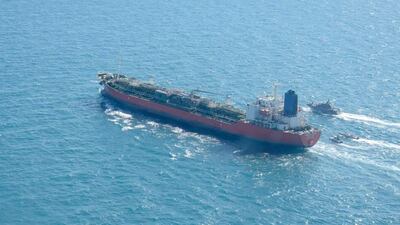
Iranian attack boats guide the Hankuk Chemi toward the Iranian port of Bandar Abbas on January 4, 2021, in aerial images published by Iranian authorities. AFP / Tasnim News -
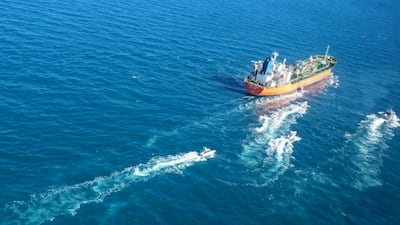
Iranian state television claim the South Korean-flagged vessel was responsible for 'environmental pollution' - but the seizure was widely seen as the latest harassment of a merchant vessel by Tehran's government. AFP / Tasnim News -

A US Marine watches an Iranian fast attack craft from the deck of the USS John P Murtha in the Strait of Hormuz in July, 2019. The US and its allies routinely patrol the narrow 30km strait as Tehran continues to harass maritime oil and gas tankers. US Navy via Reuters -
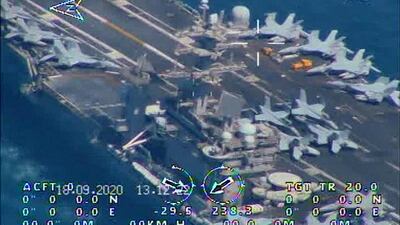
Iran has published a series of mock-up attacks and threats against US forces. This handout photo from Iran's Revolutionary Guard Corps (IRGC) shows it apparently targeting the USS Nimitz in September, 2020. AFP / Iran's Revolutionary Guard -
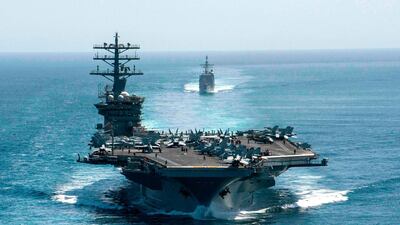
The USS Nimitz and the guided-missile cruiser USS Philippine Sea pass through the Strait of Hormuz on September 18, 2020. The aircraft carrier's deployment was extended on January 3, 2021 in the wake of threats from Iran on the first anniversary of the killing of Iranian military leader Qasem Soleimani. AP -
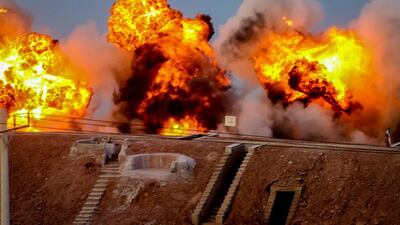
Iranian media shows a series of explosions during Iranian military exercises near the Strait of Hormuz in July, 2020. AFP -
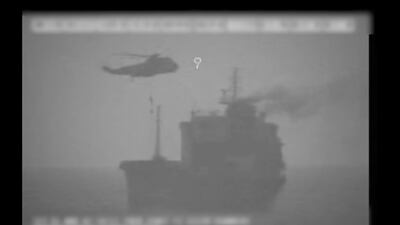
Iranian commandos fast-rope down from a helicopter onto the MV Wila in the Gulf of Oman on August 12, 2020. The Liberian-flagged oil tanker was held for five hours before being released in an operation designed to harass maritime vessels. US Military Central Command via AP -

The Royal Navy's HMS Montrose escorts two vessels through the Strait of Hormuz in July, 2019. AFP -
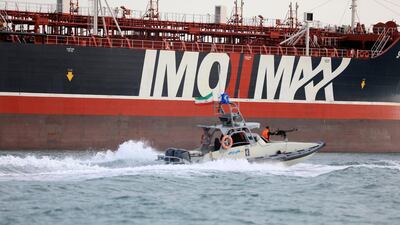
The Stena Impero tanker was seized by Iran in July 2019 and held for two months in the Iranian port of Bandar Abbas, before being released. AP -
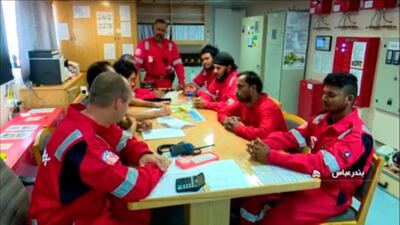
Iranian state media shows the crew of the Stena Impero while held captive in July, 2019. It was released in September, 2019. AFP -
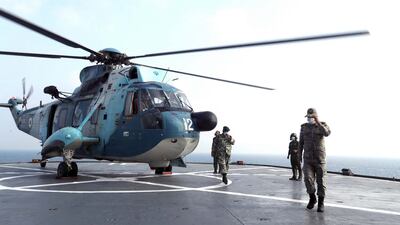
A handout photo made available by Iranian Army website shows an Iranian helicopter lands on a warship during a military exercise in the Arabian Gulf in September, 2020. EPA -
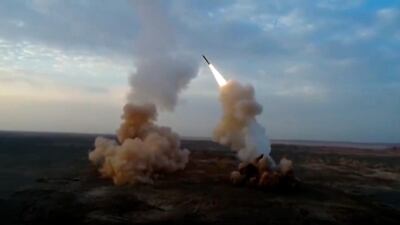
Underground ballistic missiles fired by the Iranian Revolutionary Guard during a military exercise involving a mock-up aircraft carrier in the Strait of Hormuz. AP


Evacuations suspended
An evacuation plan for ships on two routes along the coasts of Oman and Iran has been suspended as a result of the renewed hostilities. But its viability was questionable from the start as Iran's Islamic Revolutionary Guard Corps Navy said it would attack ships crossing on the route closest to Oman.
Mr Dominguez insisted that these developments did not mean the plan was obsolete. "We're ready to restart its operations. We are in a very good position when it comes to the restarting the route. The difficulty is that the safety guarantees are not there for as long as the conflict is ongoing," he said.
"What would be for me a security guarantee is that countries involved in the conflict will not target any vessels, any seafarers. I need to make sure that when we use these alternative routes that we're using right now, that the ships will not be targeted."
Mr Dominguez stressed that the route outlines for evacuation by Iran and Oman were "temporary routes" and that ships would go back to the internationally recognised traffic separation scheme when it has been demined.
"In the meantime, what we need is that ship is not used as collateral in all these geopolitical conflicts," he said.
Asked whether these developments were a sign that the international community had lost control of how straits are navigated, Mr Dominguez said: "I wouldn't say that there's a loss of control. The reality is, in the last few years, the world has gone through several conflicts that are shifting the way that normally international law has been operating.
"But one thing that that continues to be demonstrated, particularly here at IMO as an example, is that multilateralism is still alive; that countries actually look to uphold the rights of of international law.
"You see coalition of countries that are coming in order to see how they can assist and advise in order to de-escalate, and even to be prepared to provide support as required after a conflict comes to an end."