

As turmoil yet again grips British politics, can a far-right insurgent who has only been an MP for a year emerge as the next prime minister?
That is the challenge facing Nigel Farage after his party Reform UK stormed to the top of the opinion polls this summer, despite only having a handful of MPs.
Seizing power in the next general election would prove that Mr Farage's ability to take a signature issue and change the course of British politics was not a one-off in 2016 when he secured the Brexit referendum win.
The UK's political instability was underlined on Friday when Prime Minister Keir Starmer was forced into a major cabinet reshuffle following the resignation of his deputy, Angela Rayner, over a tax issue.
For some, the prospect of Mr Farage as prime minister is so unpalatable that they refuse to believe the polls that show almost 35 per cent of people saying they would vote for his anti-immigration party. Labour is languishing at 20 per cent with the Conservatives a few points behind them.
Reform majority?
Reform is building on firm ground gained from last year’s election, in which it won 4.1 million votes. Due to quirks in Britain’s first-past-the-post system, it gained only five MPs (compared to the Lib Dems who got fewer votes but 72 MPs).
Since then, Reform gained significant wins in May’s local elections and now regularly polls in the 30s, well ahead of the other parties.
Indeed, it could benefit hugely from the electoral quirks if it maintains polling above 32 per cent, the inflection point at which a party, in a four-way split, romps home with a majority.
Projection by polling company Electoral Calculus shows that if an election was held tomorrow, Reform would win 368 seats, with Labour on 119, the Tories a paltry 36 and Lib Dems steady at 64.
That would give Mr Farage a healthy majority of 86 and the keys to Downing Street.
It would be an astonishing journey for a man who almost lost his life in the pursuit of political power and who for decades has been a jovial political insurgent.
He may not be an international fixture, but his friendship with US President Donald Trump is well reported, and he has been a controversial player in European politics for decades.

Who is Farage?
So who is Nigel Farage? Charismatic, he certainly is, and pretty much instantly identifiable to most British voters. He is also unconventional, for a politician at least, often pictured in a pub with pint in hand or outside one with a cigarette.
He has been Britain’s most influential politician without ever holding power. His success in stoking resentment over the EU’s regulations and alleged corruption led his former party, Ukip, to electoral success in Europe but more importantly impelled former prime minister David Cameron to call the 2016 Brexit referendum.
Similar success in the 2019 EU elections caused Theresa May, another UK premier, to resign. Mr Farage took full advantage of the Tory chaos to win, after seven attempts, a seat in parliament last year: Clacton, in Essex.
Migration flames
Much of that was done on an anti-immigration message. Mr Farage has often referred to those who illegally cross the English Channel in small boats, more than 50,000 of whom have arrived in the past year, as “men of fighting age”.
It is a pejorative term to some – often used by the British army to refer to enemy insurgents – but Mr Farage has the ability to not quite cross the line in his language.
-
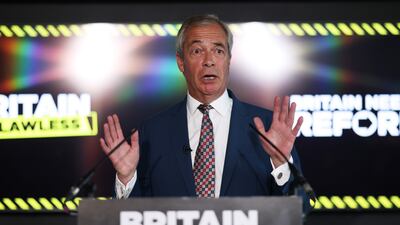
Reform UK Leader Nigel Farage attends a press conference on law and order in London in August. All photos: Getty Images -
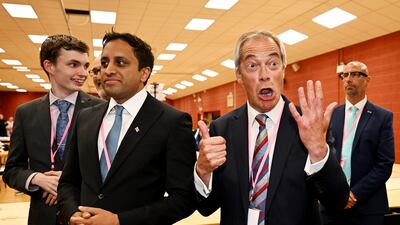
Mr Farage celebrates as Reform Party candidate Sarah Pochin is declared the winner of the Runcorn and Helsby by-election in May -
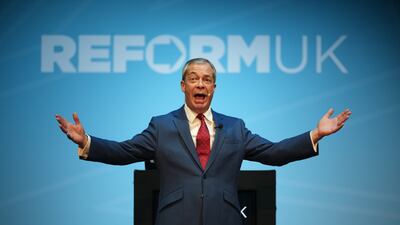
Mr Farage speaks on stage during the Reform UK East Midlands Conference in Leicester in January -
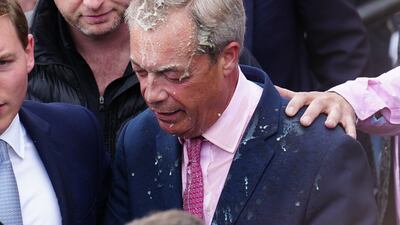
Mr Farage after a woman threw a drink over him at the launch of his general election candidacy at Clacton Pier in 2024 -

Mr Farage shares a joke with boxer Derek Chisora during a visit to Seconds Out gym in Clacton-on-Sea in 2024 -
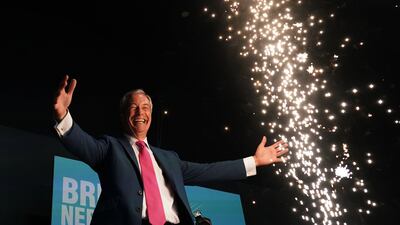
Mr Farage at a campaign event in Sunderland in 2024 -
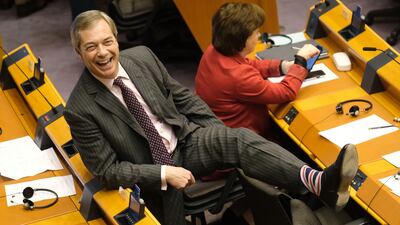
Brexit Party leader and member of the European Parliament Mr Farage at a January 2020 session when the Brussels parliament was to approve the Brexit deal -
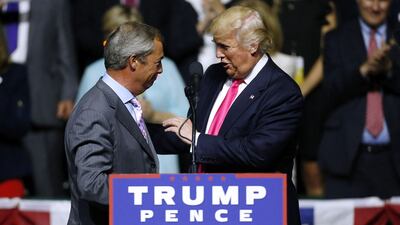
Republican Presidential nominee Donald Trump greets Mr Farage at a 2016 campaign rally in Jackson, Mississippi -
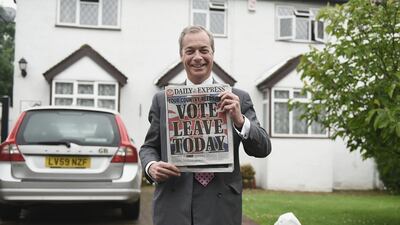
Mr Farage, leader of UKIP and Vote Leave campaigner, holds up the Daily Express as he returns home after buying newspapers in Westerham in 2016 -
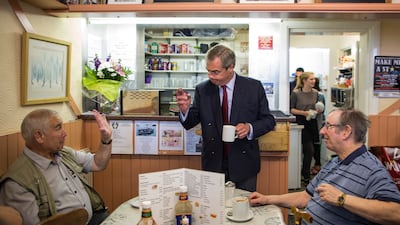
Mr Farage speaks to members of the public in a cafe in Ramsgate in 2016 -
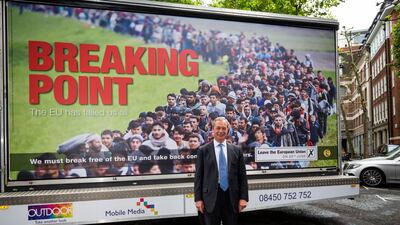
Mr Farage poses with the UKIP's EU referendum poster in Westminster in 2016 -
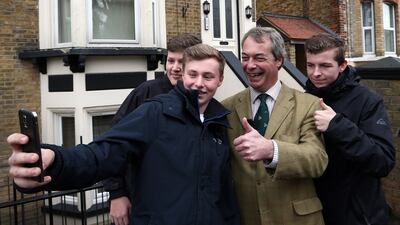
Mr Farage has a selfie taken as he canvasses in the Thanet South constituency in Broadstairs, in 2015 -

Mr Farage is interviewed after being announced as UKIP leader again in 2010 -
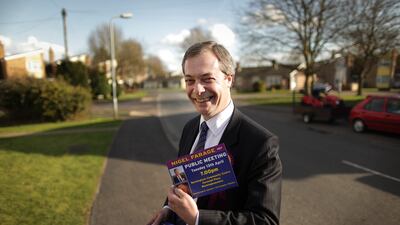
Mr Farage on the campaign trail in Winslow in 2010 -
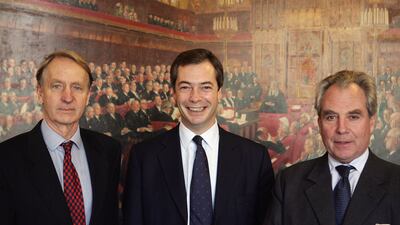
Mr Farage with Lord Willoughby de Broke, left, Lord Pearson in London in 2007. The Conservative peers had defected to UKIP.


That he is such a threat is increasingly reflected in the combative weekly Prime Minister’s Questions (PMQs), where much of Labour’s ire is focused on Reform’s small gaggle of MPs (now totalling four after two suspensions and one by-election win) sitting one bench from the back on the opposition side.
At Wednesday’s PMQs, Mr Starmer again seized the opportunity to attack Mr Farage, condemning him for being in the US rather than parliament, but once again drawing attention to the leader of a four-MP party.
The threat of Reform taking power is very real to many in Westminster. Labour’s Richard Burgon suggested during PMQs that Britain was at a “very dangerous political moment” in which “we risk the election of an extremist far-right government, and we all have a duty to prevent that”.
Political magic
Some say Mr Farage’s political magic is that his views and his personality appeal to both the billionaire and the impoverished single mother.
His exposure and popularity soared when, in late 2023, he participated in the reality TV show I’m a Celebrity … Get Me Out of Here, set in the Australian jungle.
Mr Farage was as willing to eat some fairly unpalatable bugs and engage in conversations with ethnic minority contestants on migration as he was to make naked trips to the jungle shower.
Teenagers and pensioners see him as a different kind of politician, one whose promises of building a greater Britain are genuinely believed. He cleverly uses short TikTok videos and came third in I’m a Celebrity's the popular vote.
Three years later
But can Reform sustain its lead over the three or so years before the next general election?

There are questionable policies that may be picked apart during an election campaign. These include raising the threshold for paying income tax from £12,570 to £20,000, which while eye-catching and popular, will cost the UK economy £80 billion, about half the NHS budget.
On migration, Reform will withdraw from the European Convention on Human Rights, which gives protection to all refugees. This would allow it to carry out forced deportations, perhaps similar to the scale occurring in the US.
The other issue is that with only four MPs, they are a long way from being able to form an accountable shadow cabinet – there are 108 paid ministers in government. However, Reform insiders suggest this will be overcome by appointing, for example, a representative for defence who is not currently in parliament.
“It's very hard to treat Reform like a normal party and that’s not helped by the fact that they don't have any policies, as Farage just refers to them as ‘aspirations’,” said one Westminster insider.
Farage's health
A significant issue for Reform is that their popularity is largely based on one man who has had to contest with his own health issues.
At age 21, Mr Farage almost lost a leg after he was hit by a car. Then, during the 2010 general election campaign, a Ukip banner wrapped around the tail of the light aircraft he was flying in, sending it into the ground.
To this day, he is said to have significant back pain from the broken bones he suffered. A few years later, he was diagnosed with testicular cancer and had one testicle removed.
Alongside his drinking and smoking, questions arise over his health. He will be 65 at the next election. “If he became ill or unable to carry on, the party would collapse in the polls,” said one Westminster source.
But Reform insiders reject that, suggesting they would suffer just a “five or 10 per cent” drop “without Nigel”.
Rising trajectory
Reform’s trajectory is boosted by a major increase in party membership, from 80,000 last year to 240,000 today and from one branch office to 450.
The party admits that it lacks people with political experience, so it is training “thousands of people to get ready for power”, said Gawain Towler, who is on the Reform governing board. “We know our lacuna, what we lack.”
The toxicity of the two big parties explains Reform's electoral march, said Mr Towler, the party’s former head of communications. “Nobody wins a first term on their own merits. You win on the incompetence of the previous incumbent. Right now, that’s a double whammy for us, with a rubbish Labour government and the crackers previous Tory incumbents before them.”
Not joking
Gone too are the political hustlers of yesteryear, replaced by the possibility that power awaits.
“Nigel realises that if he's going to be prime minister it is the greatest responsibility that one can ever have,” said Mr Towler. “He sleeps four hours anyway, but he is utterly, utterly aware of how serious this is.
“This is, it isn’t joking any more. If you're prime minister, you get to send people to die on behalf of the king. This is a job of utmost seriousness because this is our country we wish to save.”
One Reform insider put Mr Farage’s chances at “50-50”. They admitted there will inevitably be scandals among candidates despite the party’s intense vetting procedures, but these will just be “bumps in the road”.
Jonathan Brown, director of the Centre for Better Britain, an independent think tank with links to Reform, warns that the election is a “long way off, so anything could happen”, but he backs the view that both Labour and the Conservatives are broken.
“I don't see a way back for the other parties, Labour is frankly irredeemable at the moment with a proper sovereign debt crisis looming, and the Tories need to gain credibility,” said Mr Brown, Reform’s former chief operating officer.
Tory defectors
Reform's inexperience of government could be bolstered by defectors from the Conservatives, which could become a torrent if the Tories cannot reverse the downward polling.
One defector is former Wales secretary David Jones, who now chairs Reform's Welsh assembly election campaign. Mr Jones disclosed that there are “Conservatives of good calibre” who are “on the brink of coming over”.

“My suspicion is that the Conservative Party will remain toxic and Labour is proving now equally toxic,” he added. He even hinted that a few “less left-wing” MPs from Labour might defect to Reform.
There is also the possibility that the Conservatives will find some dynamism to surge back in the polls, or that Mr Starmer may navigate through the economic straits. But on the current trajectory, Britain could become the next western country to elect a right-wing populist as its leader.

