

Doctors at a leading London children's hospital have announced a breakthrough for developing threatened lungs in the womb as a result of technology at its Zayed Centre for Research into Rare Disease in Children.
The technique uses nano-diamonds smaller than the thickness of a human hair to deliver a growth hormone directly to the developing baby to combat a rare condition affecting one in 3,000 newborns.
Great Ormond Street Hospital and University College London teams used 3D printing technology at the ZCR to test the conditions imposed in the body by congenital diaphragmatic hernia.

Babies with the condition do not have space to develop fully formed lungs. The diaphragm – the muscle between the abdomen and the chest – does not fully develop and as a result, organs that are supposed to sit within the abdomen can move into the chest space and crush fragile growing lungs
Testing the effectiveness of the delivery system was a key step achieved by developing lab-grown human mini-lungs with symptoms of CDH.

To mimic the compression of the lungs seen in CDH, the teams used 3D printing directly around human lung tissue grown in the lab at the ZCR, which simulated the condition.
The system delivers the hormone, which stimulates lung growth, straight to a baby in the womb and scientists hope this new treatment will improve the health prospects of those with severe CDH.
In these cases, when left untreated, fewer than a quarter of babies born with CDH will survive after birth.
The current treatment for severe cases involves surgery while the baby is in the womb. Surgeons delicately place a surgical balloon into the baby’s windpipe to stimulate the lungs to grow. This increases survival odds to 50 per cent.

Amelia Turner was given life-saving surgery at the hospital for CDH when she was days old.
Her mother, Georgia Turner, 26, from Croydon, said the treatment had changed the outlook for children like Amelia who are born with a life-threatening condition.
“My pregnancy and birth was a complete whirlwind after Amelia was diagnosed with CDH – it wasn’t something I’d heard of before and then I realised how serious it was,” she said.
“I had extra scans and treatment at my local hospital, and the team hoped Amelia’s condition would only be moderate. Unfortunately, after Amelia was born, the clinical team told me how serious her condition was.
“New research like this is great to see how experts are trying to make the treatment for CDH more successful for all children, and less invasive. Hopefully, better treatments will also prevent relapse cases like Amelia.”

Researchers said vascular endothelial growth factor is a hormone which supports lung development in pregnancy but is significantly lower in the lungs of babies with the condition.
“This study shows two essential things – first, this new treatment is likely to boost the effect of the surgery before birth we can offer today,” said Jan Deprest, a foetal surgeon at UCLH and KU Leuven, who worked on the study.
“Second, that we can mimic the condition with miniaturised lungs derived from the unborn baby in the laboratory, so that we can test before birth drugs that could save its life after birth.”
The Zayed Centre for Research into Rare Disease in Children is pioneering gene therapy, and is supported by Sheikha Fatima, Mother of the Nation, in honour of her husband UAE Founding Father, the late Sheikh Zayed bin Sultan Al Nahyan.
The centre is in its sixth year of operations. The laboratory is the largest of its kind in Europe, and patients or visitors can watch its scientists at work from the street before they go into the building. Its outpatient ward schedules 17,000 appointments annually.
-
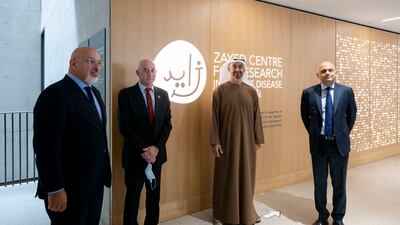
Sheikh Mohamed at the Zayed Centre in 2021 with the former UK health minister Sajid Javid, right, and former UK education minister Nadhim Zahawi, left. All photos: Ministry of Presidential Affairs -

Sheikh Mohamed and Sheikh Hamdan bin Mohamed bin Zayed during the visit to the Zayed Centre for Research into Rare Disease in Children. -
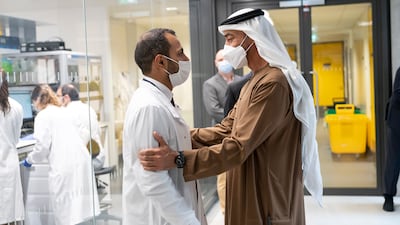
Sheikh Mohamed speaks with Mohamed Al Ameri, researcher and PhD candidate. -
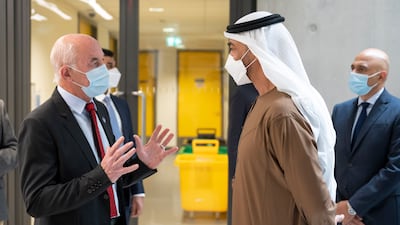
Sheikh Mohamed visits the Zayed Centre for Research into Rare Disease in Children, located in London. -
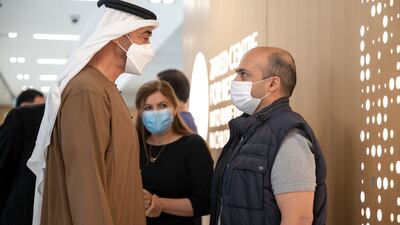
Sheikh Mohamed speaks with a family member of a patient at the centre. -
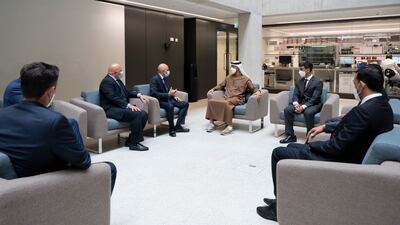
Sheikh Mohamed and Sheikh Hamdan hold a meeting with Mr Javid, the former UK health secretary, at the centre. -

Sheikh Hamdan attends a meeting with the former UK health secretary at the centre. -
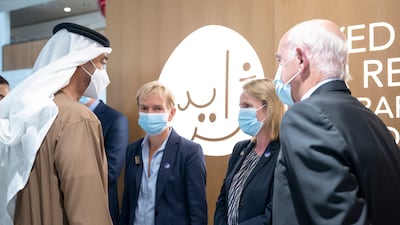
Sheikh Mohamed toured the centre, meeting researchers, professors and doctors working on pioneering research and life-saving treatments. -
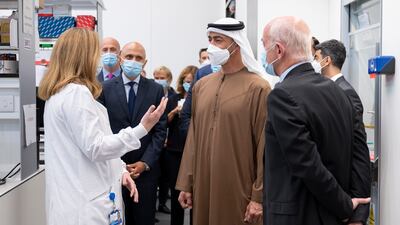
Sheikh Mohamed visiting the centre in 2021, which will celebrate its fourth anniversary in October. -

Sheikh Mohamed was briefed on the centre’s specialist facilities that have enabled it to play a vital role in the global response to Covid-19. -
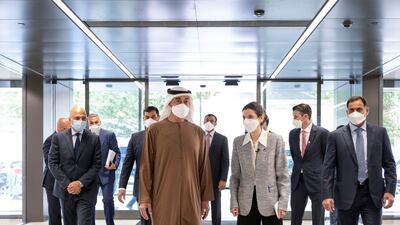
Sheikh Mohamed tours the centre. -

Sheikh Mohamed speaks with family members of a patient at the centre.



