


Some British universities could face closure due to falling numbers of foreign students, experts are warning.
Many universities have become increasingly reliant on international students to prop up their finances. Think tank the Higher Education Policy Institute has now warned that instead of being “the icing on the cake” for universities, foreign student income has become the “foundation” for some.
Josh Freeman, policy manager at the think tank, said the UK government’s crackdown on immigration and restrictions on students bringing dependents, which came into force in January, is having a big impact on lower and medium tariff universities. “There is a big worry about international students since the government changed the dependency rules in January,” he told The National.
The business model of universities has increasingly focused more on income from international students – who are charged higher fees compared to domicile students (those whose permanent home is in the UK) whose annual fees are capped by the government at £9,250.
Fees paid by international students range from £11,000 to more than £60,000 a year depending on the institution and course. In 2022/23 fee income from all international students was £11.8 billion. This was 23 per cent of universities’ total income. But huge drops in numbers following recent visa changes, inflation in home countries and competition have seen numbers shrink, particularly at postgraduate level, leaving almost half in jeopardy.
Figures released by the Home Office showed a 17 per cent (25,200) drop in visa applications for this term from international students compared to last year, raising alarm bells for institutions reliant on their higher fees. Projections within the sector show this decline intensifying in the years ahead.
Russell Group universities reported an overall drop in master's applications of 10 per cent for the September 2024 start.
Making a loss
Already, 40 per cent of universities have forecast a loss for this year, according to the sector's watchdog the Office for Students, and the Higher Education Policy Institute acknowledges it is vital they attract more international students.
The picture is not quite as bad at undergraduate level, but it is still falling short of expectations. Admission service Ucas reported a decline in international students getting on to an undergraduate university courses this year.
“Last week we had Ucas’s report on the 2024 admissions and we are again seeing a slight decline in the number of international applicants,” Mr Freeman told The National. “There has been a slight increase overall [including domicile students] which will be a bit reassuring but we would expect there to be a lot more students.
“Demographically there are more 18-year-olds than there were in previous years, so you would expect the figures to be higher, including more international students. It is worrying. I definitely think it is likely that at least 40 per cent of universities could find themselves in deficit.”
The previous government’s education committee launched an inquiry into the sector’s reliance on international students earlier this year. It sought to explore concerns that some universities have become too reliant on students from abroad to shore up their balance sheets and wanted to examine to what extent that was sustainable.
Universities told the Office for Students they are forecasting their income to rise by £10 billion overall over the next three financial years, however, the watchdog says that projection was “overinflated”.
The universities' forecast was based on generating more than £5 billion from projected increases in tuition fee income from international students, with the sector forecasting an increase in EU entrants of 18 per cent and non-EU entrants of 36.2 per cent over the next two years.
The Office for Students has written to more than 20 of the most at-risk universities to warn them they are under threat of closure if they continue to rely too heavily on income from foreign students.
In 2022-23, 43 providers (16 per cent of the sector) reported surpluses that exceeded 10 per cent of income, whereas 93 providers (35 per cent of the sector) reported losses. Providers’ forecasts show this increasing to 108 providers (40 per cent of the sector) in deficit this year.
The Office for Students has modelled the effect on universities if international student numbers dropped by a range of degrees, with a 45 per cent decrease by next year their worst-case scenario.
“We estimate this could represent a net reduction in income of over £4.3 billion in 2024-25 and over £8.4 billion by 2026-27, compared with providers’ forecasts,” it said. “This scale of impact would represent a significant challenge for the sector to overcome.”
It also modelled the impact if both domicile and international students numbers remained at 2023 levels, and assessed this would still result in a loss of £3.4 billion in fee income by 2026-27.
“Many higher education providers have based their forecasts on growth in the numbers of UK and non-UK students they will recruit,” it said. “However, there are significant risks that this level of recruitment will not be achievable for all providers, given recent trends in UK and international applications (indicated through Ucas data and through Home Office visa applications.”
Increasing tuition fees could help universities
Figures released this month by admissions service Ucas revealed that overall there was a 3 per cent increase in 18-year-olds have being accepted on to undergraduate courses compared to last year, although there was a drop in international undergraduate admissions.
Enroly, a service used by international students for managing university enrolments, said its data showed a 55 per cent drop in deposits and acceptances by international students up to the start of July compared to 2023.
The income from foreign postgraduates at some universities, including Bradford, East London, Hertfordshire and Coventry, accounts for up 55 per cent of their entire income, according to analysis by The Telegraph.
Mr Freeman said increasing tuition fees for domicile students could help institutions weather the storm. “Tuition fees are decreasing in value, they only went up by £250 in 2017. In 2012 universities had a lot of money, now that has decreased significantly and the fees are worth a lot less than they were in 2012.
“Universities make a loss on every domestic student but they can charge any fee to international students and they are their main source of income,” he said. “Last year the University of East Anglia was in serious trouble, they got a new vice chancellor who switched their business model to get more international students and they got more money and put themselves in a better financial position.
“Oxford and Cambridge have international reputations and they are turning international students away. But the smaller universities offering lower tariffs do not have the same means to attract foreign students like the big-name universities and these are the ones in jeopardy.
“If the tuition fee is not increased with inflation, the government will have to accept that some universities will close. Increasing fees would fix that. The cheapest way is for students to pay this cost but, politically, putting up fees is very unpopular and people think fees should be scrapped or go down.”
The University of East Anglia had suffered a 40 per cent drop in international student numbers.
Mr Freeman does not think the UK has priced itself out of the market for international students as institutions such as UCL, Oxford and Manchester remain popular. In the US, average fees were $23,630 (£17,600) last year. “They can charge enormous fees and people will keep going. It is the mid and lower tariff universities that are going to get into trouble,” he said.
“It is not necessarily about putting international fees up but taking more international students. The government will not be too happy about this as it wants to reduce migration. The universities are in a sticky situation.”
Universities UK has written to the government to urge it to increase domicile fees to help save universities and suggested a rise from £9,250 to £12,000.
UK university rankings – in pictures
-

1 University of St Andrews. Getty Images -
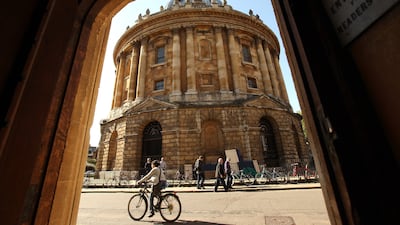
2 University of Oxford. Getty Images -
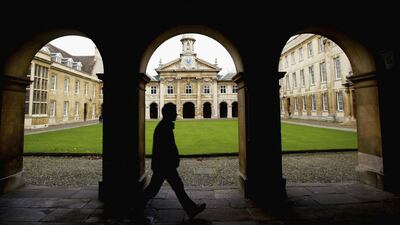
3 University of Cambridge. Getty Images -
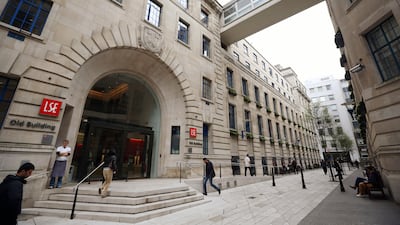
4 London School of Economics and Political Science. Getty Images -
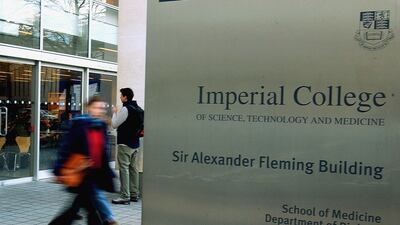
5 Imperial College London. Getty Images -

6 University College London. Getty Images -

7 Durham University. Alamy -
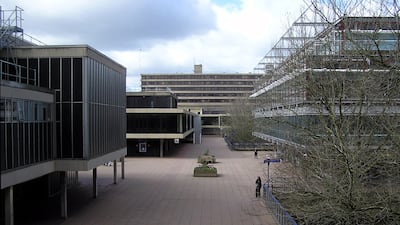
8 University of Bath. Wikimedia Commons -

9 University of Warwick. Alamy -
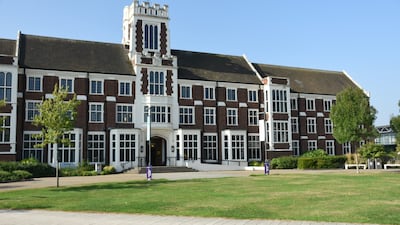
10 Loughborough University. Wikimedia Commons


Universities face difficult times ahead
Kate Ogden, senior research economist at the Institute for Fiscal Studies, said foreign student figures suggest universities face difficult times ahead.
“The latest figures on student visa applications – down by one-sixth compared with last year – suggest that UK universities may no longer be able to rely on recruiting ever-increasing numbers of international students to make up for real-terms falls in the resources available for teaching domestic undergraduate students,” she said.
“Much of the sector is in reasonable financial health and should be able to adjust. But for some less selective providers, which rely heavily on international student fees and are facing greater competition for domestic students from more selective competitors, the next academic year could be a difficult one.”

