Britain's Prime Minister Rishi Sunak said "the whole of the UK is shocked by the bloodshed" in the Israel-Gaza war. AP

UK's Sunak backs Israel’s right to defend itself as he marks six months since Hamas attack


Neil Murphy
  • English
  • Arabic

Live updates: Follow the latest on Israel-Gaza

The UK continues to stand by Israel’s right to defend its security, British Prime Minister Rishi Sunak has said following six months of conflict.

But Mr Sunak urged the Israelis to ensure aid gets into Gaza more swiftly, and said the UK remains “appalled” by an Israeli air strike that killed three British aid workers.

Sunday marks six months since the October 7 attack, in which Hamas militants breached the barrier between Gaza and Israel and attacked military bases and civilian communities.

More than 1,100 people were killed, with 250 people captured as hostages by Hamas, approximately 130 of whom remain in captivity.

It was the trigger for Israel’s continuing military action in the Gaza Strip, which has resulted in the deaths of more than 33,000 Palestinians, according to the territory’s Hamas-run health authority, as well as mass displacement of the population and an continuing humanitarian crisis.

Mr Sunak said: “Today marks six months since the terrorist outrage of October 7 – the most appalling attack in Israel’s history, the worst loss of Jewish life since the Second World War.

“Six months later, Israeli wounds are still unhealed. Families still mourn and hostages are still held by Hamas.”

“We continue to stand by Israel’s right to defeat the threat from Hamas terrorists and defend their security.

“But the whole of the UK is shocked by the bloodshed, and appalled by the killing of brave British heroes who were bringing food to those in need.”

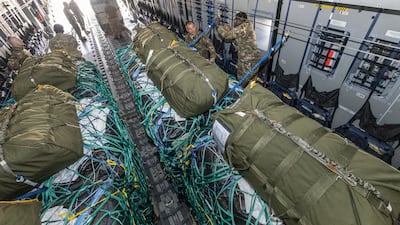
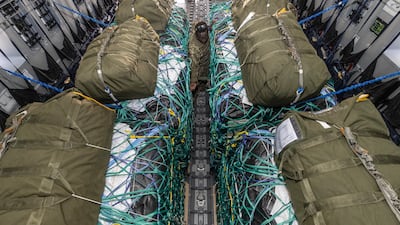
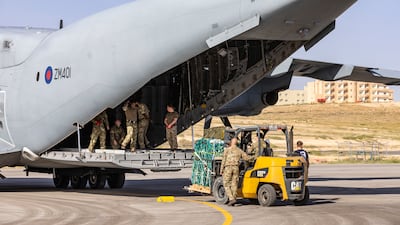
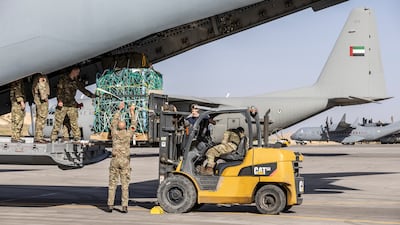
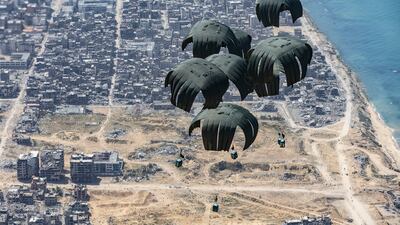
UK drops more aid into Gaza - in pictures

John Chapman, 57, James “Jim” Henderson, 33, and James Kirby, 47, were the three Britons among seven aid workers who died in air strikes carried out by Israeli military on a World Central Kitchen convoy on April 1.

The Prime Minister highlighted the growing toll on Palestinian civilians, and said the UK had been “straining every sinew” to get aid into Gaza, while emphasising the need for Hamas to release its captives.

"This terrible conflict must end. The hostages must be released. The aid....must be flooded in," he added.

He called for an immediate humanitarian pause in the fighting “leading to a long-term sustainable ceasefire”.

David Lammy, the opposition Labour party’s shadow foreign secretary, also called for Israeli hostages to be returned home, and condemned the “intolerable death and destruction” of Israel's military campaign.

But in contrast to Mr Sunak, he called for “an immediate ceasefire”.

In recent weeks, the British Government has come under pressure to reveal whether it has received legal advice about continuing arms sales to Israel.

Mr Lammy said: “The UK Government must also unequivocally commit to complying with international law in this conflict, including following the licensing criteria governing arms sales, as well as calling on Israel to implement the provisional measures in the ICJ's binding January ruling in full.”

The International Court of Justice ruling ordered Israel to take all measures to prevent genocide against Gazans and allow vital aid into the Palestinian enclave.

Mr Lammy also insisted there was a need to “look forward to how we can build a just and lasting peace out of the horrors of this war”.


The specs

AT4 Ultimate, as tested

Engine: 6.2-litre V8

Power: 420hp

Torque: 623Nm

Transmission: 10-speed automatic

Price: From Dh330,800 (Elevation: Dh236,400; AT4: Dh286,800; Denali: Dh345,800)

On sale: Now

Children who witnessed blood bath want to help others

Aged just 11, Khulood Al Najjar’s daughter, Nora, bravely attempted to fight off Philip Spence. Her finger was injured when she put her hand in between the claw hammer and her mother’s head.

As a vital witness, she was forced to relive the ordeal by police who needed to identify the attacker and ensure he was found guilty.

Now aged 16, Nora has decided she wants to dedicate her career to helping other victims of crime.

“It was very horrible for her. She saw her mum, dying, just next to her eyes. But now she just wants to go forward,” said Khulood, speaking about how her eldest daughter was dealing with the trauma of the incident five years ago. “She is saying, 'mama, I want to be a lawyer, I want to help people achieve justice'.”

Khulood’s youngest daughter, Fatima, was seven at the time of the attack and attempted to help paramedics responding to the incident.

“Now she wants to be a maxillofacial doctor,” Khulood said. “She said to me ‘it is because a maxillofacial doctor returned your face, mama’. Now she wants to help people see themselves in the mirror again.”

Khulood’s son, Saeed, was nine in 2014 and slept through the attack. While he did not witness the trauma, this made it more difficult for him to understand what had happened. He has ambitions to become an engineer.

Skoda Superb Specs

Engine: 2-litre TSI petrol

Power: 190hp

Torque: 320Nm

Price: From Dh147,000

Available: Now

LIVING IN...

This article is part of a guide on where to live in the UAE. Our reporters will profile some of the country’s most desirable districts, provide an estimate of rental prices and introduce you to some of the residents who call each area home.

Mercer, the investment consulting arm of US services company Marsh & McLennan, expects its wealth division to at least double its assets under management (AUM) in the Middle East as wealth in the region continues to grow despite economic headwinds, a company official said.

Mercer Wealth, which globally has $160 billion in AUM, plans to boost its AUM in the region to $2-$3bn in the next 2-3 years from the present $1bn, said Yasir AbuShaban, a Dubai-based principal with Mercer Wealth.

Within the next two to three years, we are looking at reaching $2 to $3 billion as a conservative estimate and we do see an opportunity to do so,” said Mr AbuShaban.

Mercer does not directly make investments, but allocates clients’ money they have discretion to, to professional asset managers. They also provide advice to clients.

“We have buying power. We can negotiate on their (client’s) behalf with asset managers to provide them lower fees than they otherwise would have to get on their own,” he added.

Mercer Wealth’s clients include sovereign wealth funds, family offices, and insurance companies among others.

From its office in Dubai, Mercer also looks after Africa, India and Turkey, where they also see opportunity for growth.

Wealth creation in Middle East and Africa (MEA) grew 8.5 per cent to $8.1 trillion last year from $7.5tn in 2015, higher than last year’s global average of 6 per cent and the second-highest growth in a region after Asia-Pacific which grew 9.9 per cent, according to consultancy Boston Consulting Group (BCG). In the region, where wealth grew just 1.9 per cent in 2015 compared with 2014, a pickup in oil prices has helped in wealth generation.

BCG is forecasting MEA wealth will rise to $12tn by 2021, growing at an annual average of 8 per cent.

Drivers of wealth generation in the region will be split evenly between new wealth creation and growth of performance of existing assets, according to BCG.

Another general trend in the region is clients’ looking for a comprehensive approach to investing, according to Mr AbuShaban.

“Institutional investors or some of the families are seeing a slowdown in the available capital they have to invest and in that sense they are looking at optimizing the way they manage their portfolios and making sure they are not investing haphazardly and different parts of their investment are working together,” said Mr AbuShaban.

Some clients also have a higher appetite for risk, given the low interest-rate environment that does not provide enough yield for some institutional investors. These clients are keen to invest in illiquid assets, such as private equity and infrastructure.

“What we have seen is a desire for higher returns in what has been a low-return environment specifically in various fixed income or bonds,” he said.

“In this environment, we have seen a de facto increase in the risk that clients are taking in things like illiquid investments, private equity investments, infrastructure and private debt, those kind of investments were higher illiquidity results in incrementally higher returns.”

The Abu Dhabi Investment Authority, one of the largest sovereign wealth funds, said in its 2016 report that has gradually increased its exposure in direct private equity and private credit transactions, mainly in Asian markets and especially in China and India. The authority’s private equity department focused on structured equities owing to “their defensive characteristics.”

Kandahar%20
%3Cp%3E%3Cstrong%3EDirector%3A%3C%2Fstrong%3E%20Ric%20Roman%20Waugh%3C%2Fp%3E%0A%3Cp%3E%3Cstrong%3EStars%3A%C2%A0%3C%2Fstrong%3EGerard%20Butler%2C%20Navid%20Negahban%2C%20Ali%20Fazal%3C%2Fp%3E%0A%3Cp%3E%3Cstrong%3ERating%3A%3C%2Fstrong%3E%202.5%2F5%3C%2Fp%3E%0A
FA%20Cup%20semi-final%20draw
%3Cp%3ECoventry%20City%20v%20Manchester%20United%C2%A0%3C%2Fp%3E%0A%3Cp%3EManchester%20City%20v%20Chelsea%3C%2Fp%3E%0A%3Cp%3E-%20Games%20to%20be%20played%20at%20Wembley%20Stadium%20on%20weekend%20of%20April%2020%2F21.%C2%A0%3C%2Fp%3E%0A
Updated: April 06, 2024, 10:11 PM