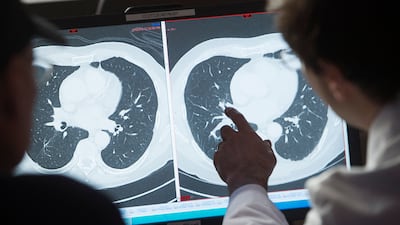

A new pancreatic cancer drug has been used in the UAE for the first time, expanding treatment options for one of the deadliest forms of the disease.
Burjeel Cancer Institute at Burjeel Medical City in Abu Dhabi announced the first use of Rasonque (daraxonrasib) on a 61-year-old Emirati woman with an advanced form of the illness.
The patient’s cancer had continued to progress despite bouts of chemotherapy, before she was administered the new drug.

Genetic testing is helping guide medics towards the most effective treatments based on each patient’s condition and needs.
Rasonque was used for the first time in the UAE under the guidance of the Department of Health Abu Dhabi after the medication received FDA approval in the US in August.
Prof Humaid Al Shamsi, chief executive of Burjeel Cancer Institute, said it was an important step in expanding treatment options for pancreatic cancer, which remains one of the most challenging to treat.
“Recent scientific advances are opening up new possibilities through medicines that target the factors responsible for cancer cell growth with greater precision,” he said. “What distinguishes this treatment is that it does not rely on the conventional approach of chemotherapy but instead targets the mechanisms that enable tumours to grow.
“Clinical studies have shown encouraging results in helping shrink tumours in some patients and extending the period during which the disease does not progress. This represents an important advancement, particularly for eligible patients who have not achieved the desired results from previous chemotherapy treatments.”
Stops growth
The new drug works by inhibiting the proteins that help cancer cells grow and spread, and by blocking their signals, which may help shrink the tumour or slow disease progression. Unlike conventional chemotherapy, which affects rapidly dividing cells, the drug acts specifically on the mechanisms responsible for cancer cell growth.
Doctors performed a genetic test on the patient to identify alterations associated with the growth and proliferation of cancer cells.
That helped them select a treatment option best suited to the woman’s condition. Following the test results, the patient began receiving the new treatment to control disease progression and slow tumour growth.
Her condition improved with treatment, which is expected to continue for several months.
Use of artificial intelligence
Pancreatic cancer is the sixth leading cause of cancer deaths globally and has claimed 52,740 lives in the US so far this year. Only around 13 per cent of patients live more than five years after diagnosis, but treatment and early detection are rapidly improving and are expected to improve life expectancy.
In April, research by the Mayo Clinic found artificial intelligence could spot pancreatic cancer early enough to enable effective treatment.
The AI is capable of detecting subtle signs in abdominal CAT scans up to three years before a clinical diagnosis and before tumours become visible.
The model is designed to analyse CAT scans already obtained for other health reasons, such as in high-risk patients with new-onset diabetes.
Pancreatic cancer is relatively rare in the UAE. According to the Global Cancer Observatory, there were 190 new pancreatic cancer cases in the UAE in 2024, ranking it 14th among all cancers.
Data from the UAE National Cancer Registry for 2021 recorded 110 cases out of 5,612 malignant diagnoses, or around 2 per cent.
However, the UAE does have high rates of diabetes, affecting around 21 per cent of the population, or 1.3 million people. Diabetes is linked to a higher risk of developing pancreatic cancer.
Wider use of AI
AI is being used more widely in the early detection of cancer and could rapidly increase survival rates.
In Israel, a digital questionnaire sent out to 1.2 million women aged 25 or over aims to collect data that AI can analyse to develop individual patient risk scores.
The digital tool developed by Clalit Health Services assesses individual risk based on personal, genetic and family history, even in the absence of symptoms.
“Although screening and follow-up recommendations are partly determined by age, some women require an individualised assessment,” said Dr Tatiana Dorfman, director of the Breast Health Institute at Clalit-Lin Medical Centre in Haifa.
“That assessment takes into account their specific risk factors, including a family history of cancer, genetic mutations and other relevant factors. The importance of this initiative is that it allows us to look at each woman individually, rather than relying solely on general recommendations.
“This will enable us to identify risks in time and save lives.”

