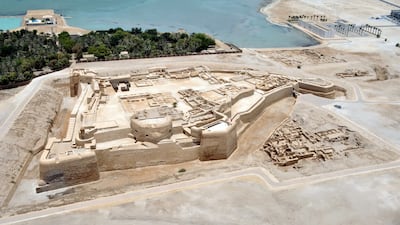
The UAE and Bahrain have launched a joint archaeological excavation at Qal'at al-Bahrain, a Unesco World Heritage Site, to explore the ancient civilisations that once connected the two nations.
Under the Magan – Dilmun Dialogues: Qal'at al-Bahrain Excavation, led by Zayed National Museum in collaboration with the Bahrain Authority for Culture and Antiquities and Bahrain National Museum, archaeologists and museum specialists from both countries will undertake a six-week dig at Bahrain Fort, one of the Arabian Gulf's most significant archaeological sites.
The project is supported by the Department of Culture and Tourism - Abu Dhabi.

The excavation will focus on deep-level examination of the Dilmun period, dating to the Bronze Age, with the aim of shedding new light on the historical, cultural and economic ties between Dilmun and Magan – the ancient names associated with Bahrain and the UAE.
Findings are expected to contribute to a broader understanding of the trade networks that linked communities across the Gulf thousands of years ago.
Mohamed Khalifa Al Mubarak, chairman of the Department of Culture and Tourism - Abu Dhabi, said the initiative carried forward a legacy of bilateral archaeological co-operation stretching back more than six decades, to when Danish archaeologists invited by UAE Founding Father, the late Sheikh Zayed bin Sultan Al Nahyan, conducted excavations at Umm an-Nar in 1959.
“Archaeology helps us understand how the civilisations of the Arabian Gulf developed and how our communities have been connected through centuries of trade, exchange and shared experience,” he said.
“The Magan – Dilmun Dialogues builds on a history of archaeological collaboration between the UAE and Bahrain, bringing our field and museum teams together to deepen our understanding of these connections and exchange knowledge and expertise.”
Field school
The project will also function as a field school, offering early career archaeologists and museum professionals from both countries hands-on training in stratigraphic excavation, archaeological recording, processing discoveries, conservation and environmental archaeology.
Dr Peter Magee, director of Zayed National Museum, said the initiative was valuable because it would allow participants to follow the full archaeological process, from fieldwork and scientific analysis through to exhibition.
Discoveries made during the excavation will eventually inform a joint temporary exhibition at Zayed National Museum in Abu Dhabi and Bahrain National Museum in Manama.

