
Flydubai captain Smit Machchhar has spoken of the moment his co-pilot repeatedly struck him with an axe before sending their Boeing 737 plunging towards the Arabian Desert, with the intention of killing 172 people on board.
In a world exclusive interview with The National from his hospital bed in Abu Dhabi, Capt Machchhar said the first officer sitting next to him for two hours had shown no sign of what Emirati prosecutors say was a “premeditated terrorist plot” to hijack the aircraft.
Flydubai Flight 1073 from Dubai to Tel Aviv plunged 17,000 feet in less than a minute when the first officer attacked Capt Machchhar and seized control of the plane.
Capt Machchhar has been hailed as a hero for getting the cockpit door, locked from the inside, open and allowing the attack to be foiled. All of the 172 passengers and crew on board the September 30 flight survived.
The first officer has been detained in the UAE and faces terrorism charges. The statements made in this interview reflect the interviewee’s recollection of events, based on his personal experience and his perception of them at the time they occurred.
In his interview with The National at Zayed Military Hospital, Capt Machchhar revealed:
- He thought the first blow to his head was a falling piece of equipment, before more blows rained down on him
- The co-pilot – who prosecutors said was radicalised by online Islamist content and in a religious study centre in Australia – showed no sign of unusual behaviour
- Capt Machchhar does not know what sparked the first officer to seize the controls when Tel Aviv airport, which he planned to crash into, was more than an hour away
- He expects an airline industry security review may lead to changes, amid questions over the cockpit fire axe
- He thanked the UAE for his treatment and returning him to his family, saying: “I was told that, by the order of His Highness Sheikh Mohamed, the President of UAE has called you back home – I smiled for the first time.”

Cockpit battle
Narrating the hijacking to a media outlet for the first time, Capt Machchhar said he thought the blow to his head was from a cockpit panel that had collapsed.
“The first time when I was hit … my thought was something's gone horribly wrong with the aircraft structure, which has fallen on my head,” he said. “It almost made me fall on my control column. In the next couple of seconds, when the hits kept on coming, [I realised] it's the other person who I thought was supposed to be on the team.”
He recalled those initial moments, explaining: “My immediate action was to free myself from the seat belts. And I tried to just block the blows as much as I could, because the blows were coming on the head.”
Capt Machchhar suffered serious injuries to his head and arm, including defensive wounds from trying to stop the blows. “While the first few blows came in, my vision … it was so narrow. I lost a lot. I was just looking [at] outlines.”
Capt Machchhar is not entirely clear how events unfolded nor the timeline. But he managed to open the cockpit after several attempts. He explained that every time he had to exert himself physically, he would lose blood and consciousness.

Nosedive
“Immediately, my hand went to the knob which opens the door," he said. "And [I was] screaming for my colleagues. I believe that was the first time when I lost consciousness. I fell face down in the cockpit.”
He believes he regained consciousness as the attacker plunged the aircraft into a dive. Crew members and passengers began banging on the other side of the cockpit door.
“The scariest thing that I heard and felt was the engines spooling down. When I say spooling down, it's the engine sound going from full blast to like … not what you want at that stage in the flight. And I felt the aircraft was steeply going down.”
Capt Machchhar became emotional as he explained his instinct to survive.
“At that point, I realised that you will not survive this," he explained. "And I was constantly looking for the door. I did go for it. I did push it … the next thing I remember was I was facedown, lying with, thank God, the cockpit door open. I was between the cockpit and the galley.”
Chaos and commotion
Capt Machchhar said there was “so much chaos and commotion” as he was hauled out of the cockpit. It was at that moment that passengers and crew seized the first officer. A pair of flydubai pilots who were travelling as passengers took control of the plane.
“If I have to say how many people were trying to control the situation, I would say a million. I know it doesn't make sense, but, yeah, I would say a million people were trying to take over control,” he said.
Flydubai pilot hailed a hero for averting disaster on Israel flight - in pictures
-

Flydubai flight FZ1073, on its way to Israel from Dubai, was diverted to Saudi Arabia on September 30 after an in-flight security incident that led to the stabbing of its pilot. Photo: Kann Media -
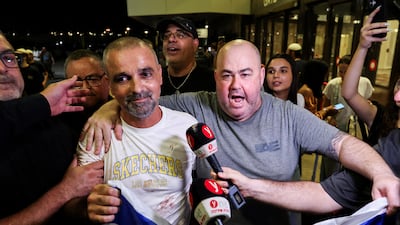
Yaniv Hayun, one of the men who helped incapacitate the attacker, at Ben Gurion Airport in Israel. Reuters -
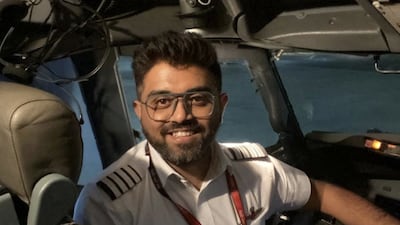
Indian pilot Smit Machchhar has been hailed as a hero for saving passengers despite being stabbed. Reuters -
A second flydubai plane was sent to Saudi Arabia to retrieve the stranded passengers and return them to Israel. Getty Images -
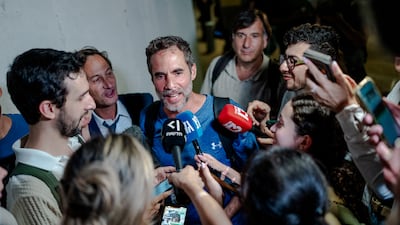
Assaf Regavim, who filmed a video from inside the cabin and helped to overpower the attacker, talks to reporters at Ben Gurion Airport. Getty Images -

A relieved passenger from Flight FZ1073 after landing in Israel. Getty Images -
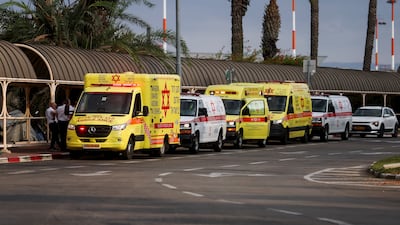
Ambulances are kept at the ready as passengers arrive in Israel on the second flydubai aircraft. Reuters -
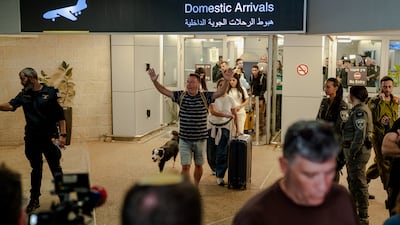
A passenger exits through the domestic arrivals doors with his dog and his luggage at Ben Gurion Airport. Getty Images -

Israeli Prime Minister Benjamin Netanyahu meets Yaniv Hayun, a passenger on the diverted flydubai plane. Reuters


He described the moment others came to his rescue as “magic”, saying: “The next thing I remember was [being] pulled out by one of the passengers. And then, soon after that, the senior cabin crew thankfully reached where I was and did his magic. And yeah, that's how I'm speaking to you today.”
Recovering in his bed in Zayed Military Hospital, Capt Machchhar has been trying to piece together events in the two weeks since the failed terror plot.
He remembers praying as the cabin crew chief and others, including dentist Shota Musaev, tried to stem the bleeding from his wounds. “There was heavy bleeding from his head and left hand,” Dr Musaev told The National last week.
“He had very, very deep cuts and we needed many ice packets. But every time I opened the T-shirt to check the bleeding, it would bleed more. So I pressed not very hard and with ice. All through the 45 minutes I kept the pressure on.”
Capt Machchhar was clearly emotional as he spoke. He said: “I prayed a lot. I thought about my son, my daughter, and prayed. That was the point where I would say I didn't give up.”
He spoke frankly: “Did I give up? No. I can 100 per cent tell you I did not give up. But was I sure I was going to make it? No.”
No suspicion of co-pilot
Asked whether he suspected anything from his co-pilot's behaviour, he said he did not notice anything.
“If there was something that could have hinted earlier on the ground or something, yes, of course, I would have acted. I would have spoken up. I would have questioned some things like that,” he explained.
He described that morning as ordinary, saying it was the first time he had met the first officer. “It was a morning flight. So, yeah, there was some small talk, but there was not really like a deep conversation,” he said.
Capt Machchhar added: “We avoid getting into deep conversations, especially during high-intensity or high-density airspace, especially nowadays with all the restrictions. Saudi is very high density.”

"Nothing until that point would have caused me to think that: 'Hey, hold on, there's something off.'”
There has been speculation about why the first officer attacked his colleague when the plane was an hour away from Tel Aviv airport, which prosecutors said he intended to crash into.
“I won't say I've been thinking a lot about it, but yes, I did give it a thought. It makes no sense to me,” Capt Machchhar said.
There was also much scrutiny over the presence of a cockpit axe, and how the co-pilot was radicalised.
Asked whether aviation security will change as a result of the close call, Capt Machchhar said: “I think so. And for good."
He added: “I won't blame it on anyone. You've got to learn from the event … I would just say: learn from whatever's happened and then make sure that this doesn't happen again, ever.”
Capt Machchhar, who lives with his wife and children in the UAE, faces a long recovery but wants to return to the cockpit.
“Did my love die for aviation? Not at all. Not at all,” he said with a smile. “I'm just glad that I was able to do my part.”

